Read my review of In the Land of Women (2007) here at The L Magazine online.
http://www.thelmagazine.com/5/7/Film/film15.cfm?ctype=2

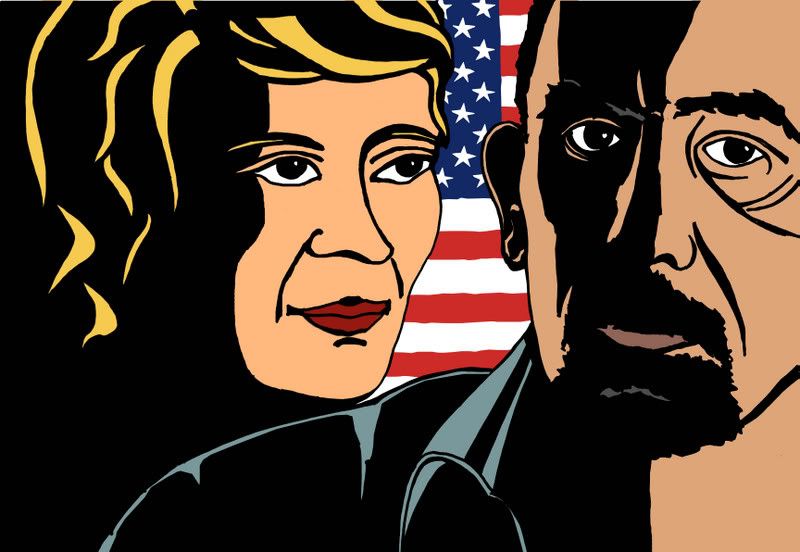
 Otto Preminger’s domestic noir Angel Face (1952) makes absurdly good use (twice!) of one of the great cinematic clichés—death by “going over the cliff.” The cliff, in this case, is a 150 ft drop behind a posh mansion owned by a once-great writer, his young and fabulously wealthy second wife, and her stepdaughter Jean Simmons. Robert Mitchum is the chauffeur that Simmons drags into her murderous, Oedipal melodrama. He is slightly less interested in “all that,” however. Mitchum’s disaffected, disconnected persona fits perfectly in this overly stuffed psychodrama. Just as Simmons takes her neuroses and anxieties too seriously, Mitchum seems interested only in the sex, and what little pay his driving skills can earn him. Together, they strike a balance that makes the film watchable, but hardly credible. Too much time is spent on resolving the murder plot, which is ultimately of little importance, and not enough on the lesser, not-so-symbolic details. Writers Frank Nugent and Oscar Millard (working from a story by Chester Erskine) assemble the narrative rather haphazardly, inserting scenes for a singular effect only, while never fully grasping the overall impact of the completed scenario, which is more psychologically affected than effective. Otto Preminger’s direction is so consistently slight it is as though he were trying to remove himself as director from the film.
  At his most effective, Preminger is able to communicate not only plot, but also psychological motivations, purely through visual and sound montage—that is through cinematic means, rather than literary. The most haunting scene of the film is a short segment that begins with a character sitting down to play the piano, and as the notes ring out Preminger cuts to another character stepping into a car. The piano carries over on the soundtrack, and its presence transcends to omnipresence; without any other hints, we become aware of the murderous trap that has been set. But moments such as these are rare in Angel Face, and more often than not, instead of being reticent Preminger seems only remotely interested in the material at hand.
 Jules Dassin’s Two Smart People (1946) goes too far in trying to create that sellable, box-office concoction of the charming criminal: a man so handsome women can’t help but to be manipulated, a thief but nothing so reviling as a murderer, and one who’s caught between the desire to get away with the loot or to get away with the girl. John Hodiak is on a train back to Sing Sing to do time for stealing some bank bonds (that are still missing), Lloyd Nolan is the officer assigned to ensure he makes it back to New York, and Lucille Ball is the femme fatale who’s after the bonds (and who of course falls for Hodiak in the process). I couldn’t care less for the plot, but sadly Dassin and his screenwriters Leslie Charteris and Ethel Hill clearly do. The narrative is strictly literal, and even Karl Freund’s cinematography can’t bring any abstraction or ambiguity to the film. But whereas Hodiak’s and Ball’s characters are too compromised—perverted by the need to appeal to a mass audience—Elisha Cook’s is able to maintain a relative purity, and is the only worthwhile element to the film. Cook plays a sleazy lightweight crook who tries to use Ball as bait to get the bonds, and while he’s a convenient complication for the plot (audiences need drama, no?) he isn’t overly villainized nor sweet-toothed. He’s the only authentically hardboiled character in the film, and one gets the impression that he is acting without regard for popularity, without pretense, and without ulterior motivations: likeability, plot, sex-appeal and commercialization haven’t gotten to Cook yet (nor did they ever). Ultimately, Two Smart People’s concoction of romantic comedy and film noir is neither so satiating nor satisfying: it brings with it all the weakness of the former (complacency, corn and cheese) and disregards all the strengths of the latter (a primary concern for atmosphere, a minimalist conception of plot, and an overall sense of moral ambiguity).
 There’s a lot of amusement to be had in watching David Butler’s My Weakness (1933), little of which has to do with its Pygmalion inspired plot about a spoiled rich nephew (Lew Ayres) who, in order to get his allowance back from his uncle, must turn Irish maid Lillian Harvey into a socialite fit for a millionaire. The plot might be pure bunk, but the dialogue is as sharp as can be delivered without drawing blood from our ears: “Be interested in stamps and he’ll forget that he hates women,” “What this country needs is less permanent waves and more permanent wives,” “We’ll get a bunch of carrots and make a night of it!” and best of all, “With all these tips I might be a bigamist by morning.” A stop-motion animation number, “Be Careful,” where amongst others a pack of dogs and Rodin’s “The Thinker” sing about the dangers of falling in love, also stands out in the film.
 .jpg) “Yes, for years my brother has been trying to perfect a death ray that could destroy cities,” Chandu the Magician (Edmund Lowe) says to his Yogi mentor before setting off to save the world from evil. The brother, Robert Regent (Henry B. Walthall) mind you, isn’t the villain of Chandu the Magician (1932), he just happens to be creating a death ray the way some people bake brownies, or others make model airplanes. The real villain is Roxor (Bela Lugosi), who kidnaps Regent and his death ray in attempt to rule the world, return it to primitivism, and destroy everything around him.
“Yes, for years my brother has been trying to perfect a death ray that could destroy cities,” Chandu the Magician (Edmund Lowe) says to his Yogi mentor before setting off to save the world from evil. The brother, Robert Regent (Henry B. Walthall) mind you, isn’t the villain of Chandu the Magician (1932), he just happens to be creating a death ray the way some people bake brownies, or others make model airplanes. The real villain is Roxor (Bela Lugosi), who kidnaps Regent and his death ray in attempt to rule the world, return it to primitivism, and destroy everything around him.  The Black Dahlia (2006) has, at its core, one fatal flaw: that it fails to realize the haunting mystique surrounding murder victim Elizabeth Short, an aspiring actress-turned-corpse who became a deathly obsession for the two police detectives assigned to her case, Bucky Bleichert (Josh Hartnett) and Lee Blanchard (Aaron Eckhart). Short’s mystique lies beyond the fictional realm: hers is a real life unsolved murder, one of Hollywood’s most notorious, that has seduced generations of curious minds, including Kenneth Anger (who wrote about her in his book Hollywood Babylon), but also writer James Ellroy, upon who’s novel the film is based. But this movie engenders none of the obsession, none of the fascination felt by these real-life writers, nor by the fictional detectives within the film. As far as The Black Dahlia is concerned, Elizabeth Short is as anonymous dead as she was alive: a small town girl who came to the big city to try and make it, but who never did.
 In director Alfred E. Green’s I Loved a Woman (1933), a moralistic period piece set at the close of the 19th century, Edward G. Robinson is the young, idealistic president of a meat canning company who is seduced by the ambitious opera singer Kay Francis. Under her influence, Robinson not only cheats on his philanthropist wife (Genevieve Tobin), but also tosses his ideals to the wind and starts canning “impure” meat which, according to the headlines, results in more deaths in the Spanish-American War than bullets. A grand jury indictment forces Robinson, in his old age, to flee to Greece sans wife, mistress, and canned beef. An unusual story that is less socially conscious that it would like to admit. Any peculiarities to the story are made up for by conventional formula and predictable outcome. The script is less inspired than required—and you can say the same about the acting and directing. Two things of note in this picture, the first of which is a piece of wisdom from a board member: “There isn’t so much difference between a Rembrandt and a pork packer.” The second: Key Francis singing “Home on the Range” ala Maria Callas, whilst Robinson’s eyes float toward the heavens and his mouth towards the floor.
 All Fall Down (1962) is an acute yet reticent portrayal of an American middle-class family on the brink of collapse. 16-year-old Clinton (Brandon De Wilde) has dropped out of school, and his estranged older brother, Berry-Berry (Warren Beatty) has moved to Florida and broken communication with their parents. With their eldest son gone, Ralph (Karl Malden) and Annabell (Angela Lansbury) have turned him into a saint, of sorts, imbuing him with a grace with such vehemence that their disillusionment is markedly clear. The family has been riding the brink for years, it seems, yet so much of the film concentrates on how the family masks this painful truth with smiles, holiday traditions, and affectionate nicknames from yesteryear, such as Ralph always referring to Berry-Berry as “that old rhinoceros.” However, the illusion of being a close-knit family is shattered when Berry-Berry suddenly returns home.
 Phantom Raiders (1940) almost has it all—an improbable yarn about exporters blowing up their ships via radio waves in order to collect insurance, characters so impotently written they cannot even fulfill their archetype, and a host of actors with the veracity of paper plates and plastic cutlery—but what is lacks is the characteristically subtle, ambiguous direction and deliberate interplay of light and shadow from filmmaker Jacques Tourneur (Cat People [1942], Out of the Past [1947] and Stars in my Crown [1950]). Walter Pidgeon, reprising his role as detective Nick Carter (1939’s Nick Carter, Master Detective, similarly directed by Tourneur), seems like he wants to be a tall Cary Grant; to our dismay, he accomplishes little charming or sleuthing, appearing instead like a tennis-pro giving stilted encouragement on the first lesson to a real talent-less floozie. Also returning is Donald Meek as Pidgeon’s sidekick Bartholomew the Bee Keeper, but Meek’s madcap quirks (such as keeping bees in his coat pocket) are overlooked, and he often just seems to be in the way; his gags reach their peak when he confuses a slip of paper in a Chinese fortune cookie as a covert communiqué. Phantom Raiders is certainly a lighthearted fare, but lighthearted what? With its willy-nilly approach to sabotage and detective work (neither of which are given serious consideration), it can only described as lighthearted confusion.
 An original production for that cinema trove Turner Classic Movies, The John Garfield Story (2003) is a documentary about the ephemeral but everlasting career of John Garfield (1913-1952) who, in his brief career spanning from 1938-1952, redefined the Hollywood anti-hero in films such as Out of the Fog (1941), The Postman Always Rings Twice (196) and Force of Evil (1948). His was a wicked charm: more brutal than James Cagney, cagier than Edward G. Robinson, and more handsome than Humphrey Bogart. But his demeanor was more naturalistic than anything in Hollywood at that point; some might say his style was engendered by his lower-class upbringing, or perhaps his experience on the New York stage, but even there his markedly unaffected performances were new. Garfield’s arrival on both stage and screen was a cause célèbre that laid the foundation for such luminaries as Marlon Brando, Harvey Keitel and Robert De Niro. Even in someone like Michael Imperioli, the remnants of Garfield’s legacy are omnipresent.
  Art is no substitute for murder. Crack-Up (1946) tries to be the exception that proves the rule, fails, and only proves to be an exceptionally dull movie.
  Arguably the pinnacle of silent cinema, F.W. Murnau’s The Last Laugh (Der Letze Mann) (1924) is still revelatory eighty-two years later. Director Murnau and cinematographer Karl Freund exceeded the gamut of film techniques to render cinematically—without the aid of intertitles (there is only one in the whole movie)—the shame and anxiety felt by an aged hotel doorman (Emil Jannings) when his position and uniform are taken away from him. Demoted to bathroom attendant, Jannings feels to ashamed to return to his lower-class neighborhood without the flashy buttons and dangling tassels that featured so prominently on former uniform. To continue the charade, he steals the uniform from work and dons it every evening on his way home, only to remove it before he arrives at work. However, when a neighbor shows up to bring Jannings soup for lunch, his true position is unmasked.
 But The Last Laugh was the result of a much different collaboration—Murnau and Freund—and is now considered one of the highpoints of German Expressionist cinema. Expressionism is a style that proliferated in the early 1920s, noted for its creative use of chiaroscuro lighting and fantastic sets that bend and distort reality. One of the goals of Expressionism is to outwardly convey more subjective emotions. The sets, sometimes markedly fake, seem almost theatrical, yet their purpose isn’t to replicate reality but to distance itself from reality. Effects are used to push the film further into nightmare, into subjectivity.
  The film’s epilogue, a twist ending that the sole intertitle describes as “improbable,” is such an ironic dose of poetic justice that it doesn’t spoil the grim poignancy of the story. To see Janning flourish with such excess—mounds of food caught in his moustache’s white tufts—is to realize how impossible the outcome really is. In the final shot, Jannings rides off in his carriage, a beggar cradled at his feet ready to receive Jannings’ generosity. We see Jannings’ hand rise, turn, and wave to the hotel employees behind him—his hand and the receding structure fill the frame. The shot is elegiac, and Jannings’ wave his last gesture, a goodbye to life.
 Patrice Chéreau’s Gabrielle (2005) is a wholly professional film: breathtaking authenticity abounds in this 19th century chamber drama about an aging aristocratic couple that, after ten years of marriage, still has not grown to love one another. They host weekly parties for their milieu in their home, assuming the roles of a respectable couple. When one day Jean (Pascal Gregory) finds a note from his wife, Gabrielle (Isabelle Huppert), saying she is leaving him for another man, he is shocked. But, when only hours later Gabrielle mysteriously returns home to reassume her role as his wife, Jean is utterly confounded, not only as to how to deal with his wife’s infidelities, but how to save face in front of his milieu and their social codes.
  Adapted from Joseph Conrad’s short story “The Return” by director Chéreau and Anne-Louise Trividic, the film is a cinematic splendor. Cinematographer Eric Gautier figures the story through an array of styles: leaden blach and white images; deep, murky colors; and at times giving the faces a jaundiced pallor, reflecting the severity of the moral breach felt by Jean and Gabrielle. The film, however, does not fully embrace the constricting ethics of 19th century France. Instead, Gabrielle’s story is filtered through many gradations, and prominence is given to her own stoic dissatisfaction while married to Jean.
 The middle third of Gabrielle is devoted, largely, to a conversation between Gabrielle and her maid, Yvonne (Claudia Coli), as she assists in undressing and preparing Gabrielle for bed. Structurally, devoting this much time (approximately 30 of 90 minutes) to a conversation is decidedly atypical, as is the attention paid to Yvonne. Maids are often transparent characters who thoughts and motivations can be discerned through the slightest glance—or they are simply ignored. As Yvonne, Coli balances loyalty to Gabrielle, along with sympathy for her plight as the unsatisfied wife. But at the same time, Yvonne is silently dissatisfied at Gabrielle’s return, what she believes is Gabrielle’s acquiescence to society’s morays.
  Gabrielle’s reason for returning remains a mystery, an ambiguity that makes the story compelling and engrossing. Huppert conveys determinism without belying the motivations or reasoning behind her actions. She tantalizes the audience by disclosing just so much her character; more than subtle, she is reticent. All of Gabrielle, in fact, is a redolent, myriad reticence: a mystery that concludes, but is never solved.
 Perhaps I’m just too cynical, but I wanted to like Francois Ozon’s latest film Time to Leave (2005) much more than I actually did. The story focuses Romain (Melvil Poupaud), a 30s-ish photographer who, after collapsing on assignment, is told he has terminal cancer. Declining medical treatment, he has three months to live. What was initially appealing about the story is its refreshing take on the subject: instead of telling everyone he has only months to live, he chooses to keep it a secret, revealing it only to his grandmother, Laura (Jeanne Moreau). This restrained emotion, however, finds its outlet elsewhere—in sappy scenes that reach for easy sentiment and eschew Romain’s complex decision and its consequences.
  Just found out that Mickey Spillane has passed away. He was 88 years old. One of my favorite writers, he is always an inspiration. His prose is lucid, dripping with detail, and--most importantly--kinetic. I appreciated how his mysteries were not hackneyed yarns that you race to finish before the end of the book--they seem to be written off the cusp, improvised almost: it's about how Mike Hammer acts and reacts. When actions spoke louder than words, the action hollered. And Hammer, too, is not the usual detective hero: he's not the smartest cookie, but he's the most wired, explosive detective there ever was, and he'd go farther than anyone around. That was his strength: to be unafraid of extremes. The same can be said of Spillane's writing, which unabashedly used italics and exclamation points, punctuation that has become taboo over the years. Spillane was fearless.
 Legendary bottom-feeder Davy Jones is the old haunt in the bottom-of-the-barrel Pirates of the Caribbean 2: Dead Man’s Chest (2006). As a sequel, it fails to achieve the same level of spontaneity and charm of its predecessor, largely because it is reusing the same bag of tricks, but to lesser effect. Action sequences and special effects take precedence over story, a compromise that barely keeps the movie afloat for its bloated 2 1/2 hours.
  The script leans more on adventure and excitement than on character, a decision that weakens our connection to the story. It is as though writers Ted Elliott and Terry Rossio expected our empathy with the characters to carry over from the first film, and they do little in this sequel to help re-forge the bonds. For example, the relationship between fiancés Will and Elizabeth (whose marriage is interrupted in the opening scene) seems stagnant: they hardly share any on-screen time together, and when they do the proverbial “sparks,” typically felt between the ingénue and leading man, are decidedly absent.
  Johnny Depp, the highlight of the first film (who even garnered an Academy Award nomination), reprises his role as the gangly, strangely flamboyant pirate Jack Sparrow, but adds nothing new to the role. His mannerisms have grown redundant, and his character meets, but never exceeds, our expectations—in short, he is predictable. He shies away from valor and adventure at first, choosing always to save himself over others, but just when you think he’s a selfish lout, he joins the fight and waxes gallant like the rest.
  I also had the feeling that I had seen some parts of Pirates’ before, and not just in the original. A scene on a cannibal island where Jack Sparrow is mistaken for a god and Will Turner is bound to a log seems very much a scene from Return of the Jedi (1983) in which the ewoks think C-3PO is a god, and Luke Skywalker, Han Solo and Chewbacca are bound to logs in preparation for cooking.
  Born to Kill (1947) hardly fulfills its lot: it lives long enough for a double homicide, then promptly turns to hang itself. Its ailment is a confused script: characters that are neither here nor there (though, perhaps if they actually went somewhere the movie might be better). As it stands, the characters seem amorphous, with ill-defined motivations and stock personalities from any number of better hardboiled yarns.
  Taking the first train out of town, Sam meets Helen Brent (Claire Trevor). Fate (or coincidence) has thrown them together: unbeknownst to Sam, Helen is Laurie’s roommate who discovered the bodies, but for furtive reasons did not inform the police; and Helen is unaware that Sam is the murderer. This hardboiled match-made-in-heaven meets an early death when Sam discovers Helen is already engaged. In retaliation, he marries her sister. Both relationships begin to disintegrate when Mrs. Kraft appears with a private detective and a determination to bring Laurie’s killer to justice.
 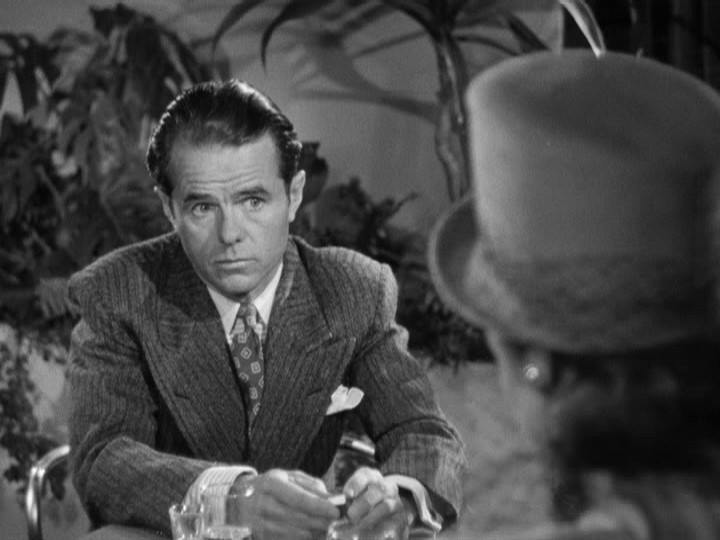 My biggest disappointment with the picture, however, is with Elisha Cook, who plays Sam’s confidant Marty Waterman. Cook, with his small frame and whimpering voice, is famous for playing the fish-out-of-water in such noir gems as The Maltese Falcon (1941), The Big Sleep (1946) and The Killing (1956)—a softboiled soul in a hardboiled world—but in Born to Kill he’s so much the softy that it is difficult to believe. When Sam confesses to Marty that he murdered Laurie and her boyfriend, Marty’s concern is so congenial it seems to be in jest but, in actuality, he is being earnest.
  Revealed in the first moments of Richard Fleisher’s The Narrow Margin (1952) is a plot impossibility so contrived it almost makes the movie seem like one big train wreck. The story concerns police detective Walter Brown (Charles McGraw). who is assigned to escort Mrs. Frankie Neall (Marie Windsor), the wife of a recently murdered gangster, from Chicago to Los Angeles where she is to testify in court and identify key mob personnel. On the same train, however, is a pair of mob hit men with instructions to make sure the moll only leaves the train on a stretcher.
  Almost, but not quite, a train wreck. The collaboration between director Fleisher and cinematographer George Diskant is the best part of the movie: the narrow confines of the train are realistically created, as well as highly affecting. There is a physical constraint that emanates and infuses the suspenseful plot with even greater anxiety. During the fights and chases, the camera is in such close quarters with the actors that it seems as though a collision is inevitable.
 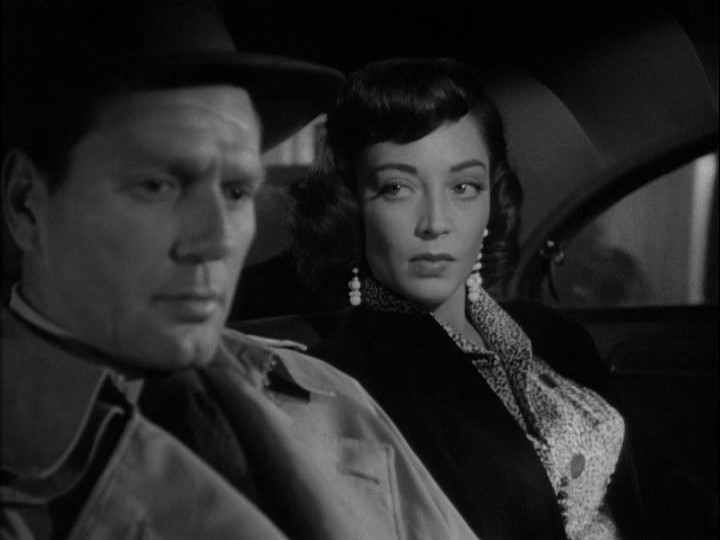 The actors do their best, given the incredible senselessness of their characters. Marie Windsor, especially, seems to have gotten the short end of the stick: as the femme fatale, Mrs. Frankie Neall's only weapon is her stupidity, and she seems to be a threat only to her own safety. Charles McGraw plays Walter Brown the way Dana Andrews might: monotone, with few vocal inflections. McGraw delivers lines like, “Mrs. Neall, I’d like to give you the same answer I gave that hood—but it would mean stepping on your face,” the way a hardboiled detective should.