Tuesday, February 14, 2006
Trapped by Sound: Pabst's Threepenny Opera
Sunday, February 12, 2006
King of Hearts (1966)
Phillipe de Broca's King of Hearts (1966) finds the Germans retreating from a small French village at the end of the first World War. Before they do, however, they trigger the town to blow-up when the clock strikes midngight. Logically scared for their lives, the townspeople evacuate, leaving the local asylum unguarded. When Scottish officer Alan Bates arrives in town, he finds the town overrun by the innamtes, and he is soon crowned the King of Hearts. But the Scots and Germans haven't gone for good, and when they show up back in town, it's hard to tell who's the whacko.
And that's the point--that the soldiers, and the world at large, is crazier than anything inside the gated asylum. The loonies are much happier amongst themselves, remaining oblivious to anything so "overly dramatic" as fighting (as one of the inmates describes an impromtu battle between the two armies).
One of the most pleasant things about King of Hearts is its comedic pacing: it never goes for the quick guffaw, instead the movie feels rather understated, as though its humor can only heigthen with familiarity.
Saturday, February 11, 2006
Deceitul, Murderous Delight: The Two Mrs. Carrolls
Director Peter Godfrey, while delivering a solid noir-melodrama, reuses much of the imagery and tension that Alfred Hitchcock used in his film Suspicion (1941): the shot of Bogart holding the poisoned glass of milk is a straight copy of Cary Grant in the earlier film. Both films, however, distinguish themselves in different ways. Hitchcock's film is a family-sized red herring served on a silver platter; Godfrey, on the other hand, consummates the tale of deceit and delivers a murderer at the end of the film. Thomas Job's script (from the play by Martin Vale) is excellently written, with smart dialogue and a handful of wry stock characters (the grumpy maid, the elderly fisherman) that, as often is the case, are the most memorable parts of the film.
Friday, February 10, 2006
Vamp-Camp: A Fool There Was
Though coming fifteen years before Josef Von Sternberg's "The Blue Angel" (1930), "A Fool There Was" tells a similar story of a successful, respected man turned wayward and ruined by his lust. The object of his obsession is Theda Bara, known only as "The Vampire," a woman whose sole preoccupation is with bringing men to ruin: poverty, death, and suicide meet all of her former lovers. Called to England as an ambassador, John Schuyler (Edward Jose) books passage alone on a boat. On board, he becomes the next victim of "the Vampire," and off they go to Italy. Away from his family, Schuyler misses them terribly, but cannot live without his new mistress. Returning home (with Bara in tow), Schuyler fails to balance both his familial responsibilities and his desire for Bara and ends his life in utter ruin.
Director Frank Powell uses flowers as a symbol of female sexuality in the manner of Georgia O'Keefe. At one point Bara even thwarts a jealous lover's pistol with her long stemmed flower. But in other aspects of the film, Powell's direction isn't so successful. The introduction of the family is confused, with too many persons introduced too quickly with little to distinguish them. He doesn't exhibit the same flair for composition or editing that Thomas Ince or D.W. Griffith concurrently used in their own films: Powell's seem flat and unassured compared to them. The story, too, feels undeveloped beyond the bare bones of the plot. It is Bara's image that receives all the attention of the filmmaker, and her expressionistic glamour must have been a shock to audiences used to the Pickford curls. Bara's rampant seduction is domineering compared to the submissive roles played by Lillian Gish. This is not to sleight either Pickford nor Gish, nor to place Bara on a higher platform than either of them, but merely as context with which to compare Bara's character, for hers was the original vamp, the first femme fatale--but if that is all she represents, then "A Fool There Was" would not be worth much. Bara's value comes in her character, complete in vision and in action, which allows her to rise above a mundane script, and separate her from all its mediocrity.
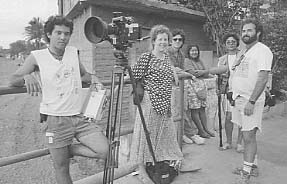
Communal Poetics: Maureen Gosling's Blossoms of Fire
Wednesday, February 01, 2006
The Maltese Falcon: Two Adaptations
Dashiell Hammett's 1929 novel "The Maltese Falcon" was turned into three films in one decade: Roy Del Ruth's 1931 The Maltese Falcon (later retitled Dangerous Woman), William Dieterle's 1936 Satan Met a Lady and John Huston's 1941 The Maltese Falcon.
****
The 1931 version plays much like Roy Del Ruth's other pre-Code gems, such as 1930's Lady Killer with James Cagney: the sensation of comedy and cruelty, with an unmistakable affection for the sleazy and the lurid. An abridged version of the novel, private dick Sam Spade is still the protagonist (though Del Ruth really emphasizes the "public" over the "private"). After his partner is killed on a case, Spade is drawn into a free-for-all over a mystery jeweled falcon--femme fatales, young gunmen, exotic foreigners, fat old men and the coppers--the film is everything film noir would come to be, but The Maltese Falcon is not quite there yet. It is not as dark or cynical as 1940s harboiled films would be; instead, there is a certain lightness about this Maltese Falcon--perhaps its the way that Spade (played by Ricardo Cortez) always has this conniving grin on his face, and can't say anything straight. Duplicity does not expose the darker side of humanity, but the funnier side of things: with no one telling the truth, any absurdity can pass through someone's mouth. It's almost the aesthetic of a Marx Brothers film, but without the slapstick action.
***
Satan Met a Lady, too, feels like a Marx Brothers film--but not in a good way. It feels like the "straight" scenes, the little bits of plot that try and form a cohesive action, but utterly fail dramatically. Satan, however, has none of the comic relief of a Groucho, nor the sarcasm of Roy Del Ruth's 1931 adaptation. The plot retains the core of the story, but with some excess baggage, such as Spade being an exiled detective, run out of every town by various "public morality groups." The story, however, is so streamlined (to make room for new additions), that in its 76 minutes it hardly finds time to cohere. Duplicity is never so much an issue as unbelievablity: the acting is not convincing of anything but a poor script.
****
***
Subscribe to:
Posts (Atom)