The acting is high caliber all around, with every performer believable in her their role. Isabelle Huppert lives up to her legendary reputation as one of international cinema’s greatest living actors. Pascal Greggory recalls Lancaster’s performance in Visconti’s The Leopard (1963), conveying aristocratic nobility with such grace that it seems absolutely genuine. More than authentic, his airs do not seem forced, nor are they over-played, which makes his own egoism less reactionary and more convincingly realistic.
Friday, July 21, 2006
Recent Watching: Gabrielle (2005)
The acting is high caliber all around, with every performer believable in her their role. Isabelle Huppert lives up to her legendary reputation as one of international cinema’s greatest living actors. Pascal Greggory recalls Lancaster’s performance in Visconti’s The Leopard (1963), conveying aristocratic nobility with such grace that it seems absolutely genuine. More than authentic, his airs do not seem forced, nor are they over-played, which makes his own egoism less reactionary and more convincingly realistic.
Monday, July 17, 2006
Recent Watching: Time To Leave (2005)
The film is, essentially, a series of goodbyes. Romain visits his parents, his grandmother, his sister, and his boyfriend, secretly concluding their relationship and setting things straight before he dies. Each scene ends with the same ironic touch: Romain snapping a photograph for keepsakes. His stoicism isn’t so much poignant as it is pitiable. We recognize the futile gesture in taking the photograph, and it pulls at our heart strings, begging us to feel some sort of emotion for this dying character—but does the film really have to try so hard and use (and re-use) such a gesture until it becomes a gimmick?
The best moment of the film is the scene between Romain and his grandmother. When she asks why he chose to only confide in her, he says, “Because you, like me, will be dying soon.” This touch of fatalism is sobering, because it isn’t trying to make us cry or feel nostalgic in any way. Its motivations are unadulterated by sentiment.
As the grandmother, Jeanne Moreau is fantastic. But she’s on-screen for a sparse few minutes. It’s a shame, because hers is a character that intrigues and vies for our attention, something that very few other characters manage to do. Likewise, Marie Rivière, the charming star of Eric Rohmer’s Summer (1986) and Autumn Tale (1998), appears onscreen for only one scene as Romain’s mother, and her character is given no opportunity to grow beyond the periphery of importance. This is the pervasive problem with Time to Leave: the characters are not fleshed out enough to be compelling.
RIP, Mickey...
Tuesday, July 11, 2006
Recent Watching: Pirates of the Caribbean 2: Dead Man's Chest (2006)
Like hidden treasure, the plot is buried deep within a chaotic structure filled with too many ghost ships, sea serpents, island cannibals and conniving British exporters—only once you dig up the plot, you discover how little it is worth. Squid-faced ghoul Davy Jones (Bill Nighy) is out collecting on Captain Jack Sparrow’s (Johnny Depp) soul. Meanwhile Sparrow, with Will Turner (Orlando Bloom) and Elizabeth Swann (Keira Knightley) in tow, is in search of buried treasure—a chest that contains Jones’ still beating heart. Whoever is in control of this is in control of Jones and, in turn, the seas that he still haunts. However, Sparrow isn’t the only one who wants the treasure: Will Turner has his own reasons for assisting Sparrow, as does the tyrannical East Indian Trading Company, who wants to create a monopoly on trade waters.
The film tries to maintain a sense of humor throughout, but often it feels out of place. Instead of being witty, the writers often resort to anachronisms: modern jests that are out place in the movie’s historical setting, such as Depp sprinkling paprika under his arms as though he were in a deodorant commercial, or the way in which characters slip out of their stylized dialect to say lines in a more contemporary manner. During these winks at the audience, the historical façade drops, and it seems that neither the actors nor the writers are up to the challenge of creating authentic pirate humor.
As often happens when too much attention is given to special effects, they cease to be neither special nor effective. Such is the fate of Pirates’ densely grotesque visuals, particularly Davy Jones and his salt-water zombies, whose scaly flesh writhes as though it were still living. Director Gore Verbinski and his special effects crew have painstakingly integrated live-action footage and computer animation seamlessly, but they lay it on so often that the spectacle soon loses its impact. It might be archaic of me, but with blockbusters becoming increasingly reliant on CGI, I long for another filmmaker like David Lean who is able to create epics without all the artifice and gloss. In films like The Bridge On the River Kwai (1957), Lawrence of Arabia (1962), and Doctor Zhivago (1965), Lean was able to craft visceral, exciting images using actual landscapes, and the simplicity is effective and immediate. I find the spectacle of reality more invigorating than any computer generated sea monster, which is not to say that the two are mutually exclusive and cannot share the multiplex together, but just that they don’t anymore. Blockbusters like Pirates and superhero movies dominate theaters, and I am left to look elsewhere for other varieties of cinema.
Sunday, July 09, 2006
"Born to Kill" (1947): Dead on Arrival
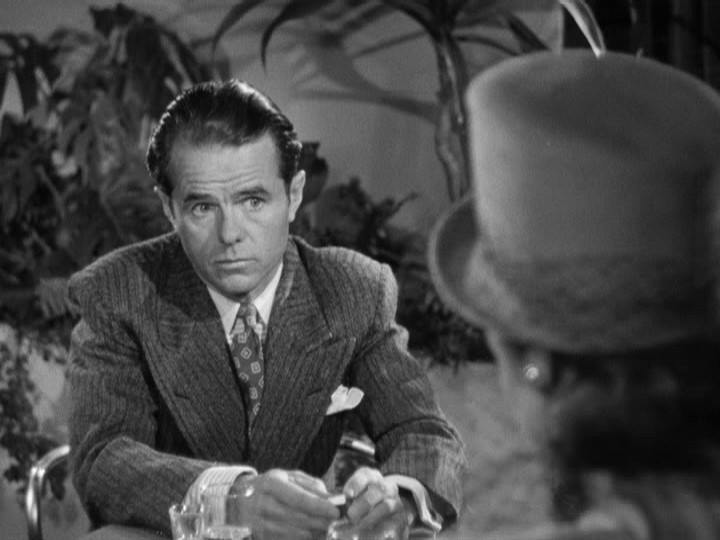
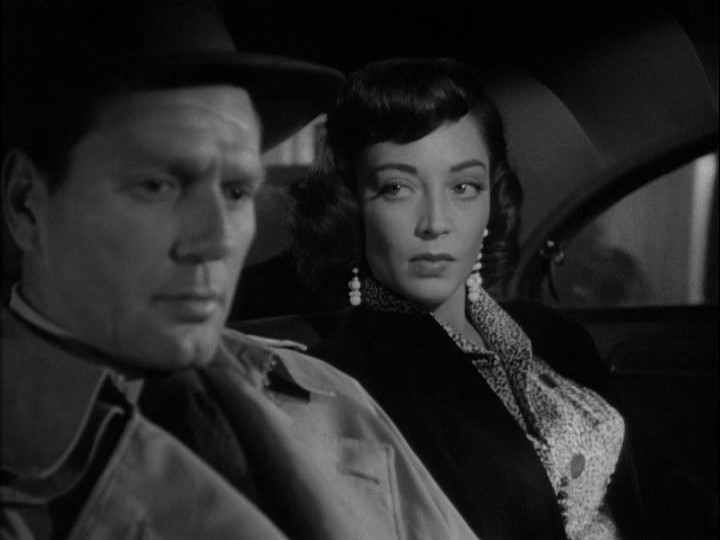
The opening ten minutes are the movie’s finest moments. The story begins in a boarding house owned by the elderly, beer-guzzling Mrs. Kraft (Esther Howard), one of those colorful, eccentric personalities that old Hollywood specialized in—and if only there were more characters of this sort in Born to Kill, because most of the rest of the characters are far too serious to be enjoyable. One of the tenants, Laurie Palmer (Isabel Jewell), is two-timing her boyfriend Sam Wilde (Lawrence Tierney), and when he finds out, he murders both her and her other beau. Killing the girlfriend is one of the archetypical noir plots, and Tierney is well suited to this sort of raw violence with his steadfast and unperturbed demeanor. Director Robert Wise films the scene without a hint of melodrama or exaggeration, setting a precedent that is disregarded for the rest of the picture.
The biggest problem with this story is its lack of focus: the film awkwardly switches gears and is unable to efficiently combine its multitude of conflicts. There is the issue of Sam’s psychosis, which seems to just be the result of a bad temper. Likewise, Helen’s attraction to violence is an unexplained anomaly (it is never sufficiently explained why she doesn’t call the police when she discovers the bodies). Under the surface there is sub-plot about Sam marrying for money, and how Helen is jealous of her sister’s inheritance (of which Helen received none), but like many of the undercurrents in Born to Kill, they are more underdeveloped than subtle.
Versatile director Robert Wise, who early in his career edited Orson Welles’ Citizen Kane (1941) and later went on to direct such classics as The Set-Up (1949) and West Side Story (1961), stoically commands the unsteady script, but seems unable to balance all its deficiencies. The performances are, by and large, professional and convincing (Tierney and Trevor, in particular), and occasionally brilliant (such as Mrs. Kraft, the landlady). Still, Born to Kill lacks the cohesiveness of something like This Gun for Hire (1942), where the script and story is rock steady and can provide a solid foundation for the actors to build upon. Born to Kill, with occasional flashes of excellence, lacks the foundation necessary for consistency.
Friday, July 07, 2006
The Narrow Margin (1952)
Now, for the kicker: the hit men don’t know what the woman looks like—but they know what the cop looks like, so they’ll identify her that way. Talk about un-organized crime: she’s the wife of someone in their own racket, yet they don’t know what she looks like, and are unable to find a photograph of her. They even know where she lives, because in the opening scene they arrive at her apartment to knock her off; a gunfight with her police escorts results only in the death of Brown’s partner. This impossibility wouldn’t be so onerous if it were not reiterated every few minutes, or play such a big role in the plot—and there’s even a “mistaken identity’ plot twist waiting for you at the end of the line, and it’s a real doozy.
The script, written by Earl Felton from a story by Martin Goldsmith and Jack Leonard, is a mixed bag of half-baked plot and hardboiled dialogue, the sort that has become indicative of the whole film noir genre. Lines like, “She’s a 60-cent special: cheap, flashy, and strictly poison under the gravy,” are some of the highlights of the movie. Actually, that line is pretty classic, and ranks up among some of the best hardboiled quotes.
Wednesday, July 05, 2006
Saraband (2003): Ingmar Bergman's Most Recent Masterpiece
Marriane’s impetus for visiting Johan is one of the biggest mysteries of the film—several times Johan even asks Marianne, but she is unable to come up with an answer—and, in some ways, I think it remains a mystery to her even when the film ends. Sitting at her desk (as she was in the opening shot), she tells of how she had to leave his house to get back to work as a lawyer and, while for some time they kept in touch over the telephone, eventually they lapsed out of communication once again. The circularity of the story is a fatalistic gesture to end the movie on: by not bringing closure to all of the characters in Saraband, Bergman acknowledges the lack of resolution that exists in our own lives, the loose ends we all let go of at some point.
Monday, July 03, 2006
Elegy for the Aged Gangster: "Choice of Arms" (1981)
The story’s foundation is secure, but on the whole the writing seems uneven: some characters and scenes feel extraneous, and the first half of the film doesn’t flow too well. Partly, this might be because the American cut is only 114 minutes long, 21 minutes shorter than the European cut. But while the first half of the film seems awkwardly assembled, with characters and situations lacking the necessary exposition, the second half is tight and gives new depths to the characters, Noel Durieux in particular.
Knowing that the cut I saw wasn’t complete, I want to believe that all of Choice of Arms’ faults would somehow be fixed if the 21 minutes were reinserted, but the most I can do is speculate. As it stands now, the biggest flaw is with Nicole Durieux. Catherine Deneuve has proven herself as one of the world’s strongest actors in such films as The Umbrellas of Cherbourg (1964), Repulsion (1965), and Belle de Jour (1967), but here she isn’t given a chance to lend her talent: hers is only a peripheral role. It seems that whenever Mickey shows his face around the house, Noel is forever telling Nicole to deal with the horses. Thus, all the important scenes take place between Montand and Depardieu—Deneuve is never given a chance to develop any rapport with them.
Depardieu, however, gives a magnificent performance as Mickey. He delivers his dialogue with such immediacy that pre-meditation seems impossible. It is this unpredictable quality that makes his scenes so rife with anxiety. One of the highlights of the film is a scene where Mickey gets into a scrape with a female gas station attendant. When he pulls his gun on her, she keeps right on at him, screaming and provoking him still further. In a way, her cheeky impudence is rather humorous, but after having witnessed him kill before, we can’t help but think she’s asking for it. Instead, Mickey gets back in his car and backs into the front window of the store.
Contrary to Depardieu’s wired performance, Yves Montand plays his character as stoic and aloof. There’s an unnerving calmness about Noel, even when Mickey is running around the room firing off his pistol: it is as though Noel has seen this before, and knows exactly how to handle the situation. Noel inspires in us a murderous confidence, knowing well that if he has to, he will go to the farthest measures to assure he and his wife’s safety. Which is not to imply that Noel is a trigger-happy retiree: like Michael Corleone in The Godfather: Part III (1990), Noel is happy to be out of the game and not at all anxious to get back in it, but that doesn’t mean he’s forgotten how to play if need be.
As effective a story as Choice of Arms is, it still follows the gangster movie code in many ways. Aged gangsters are always calm, cool and collected—Noel in this film, Tony le Stephanois (Jean Servais) in Jules Dassin’s Rififi (1955), Jean Gabin’s Max in Touchez Pas Au Grisbi (1954), and Marlon Brando’s Don Corleone in The Godfather (1972) amongst many others in the genre. The young gangsters are always too hotheaded, as well—Depardieu in this film, Sonny Corleone in The Godfather, and the list continues. These archetypes, clichés though they have become, are almost essential to the genre: an inherent way to communicate generational conflict, nostalgia for the past and uncertainty for the future. There is always something elegiac about these stories, the we watch the old generation, so staid, unable to pass on quietly; it is as though the world is so unstable in the hands of the young that the old cannot leave well enough alone. This is really the core emotional conflict of Choice of Arms, with Mickey being a threat to the security that Noel has established. Such a timeless theme that permeates multiple genres and such disparate films such as La Dolce Vita (1960) and Treasure of the Sierra Madre (1948), Choice of Arms may not be the most original movie ever, but Yves Montand and Gerard Depardieu really make the film worthwhile.
The Visual Artistry of Fassbinder's "The Bitter Tears of Petra von Kant (1972)
Subscribe to:
Posts (Atom)