Monday, November 21, 2005

Berkeley Makes Mom Proud, No Chorus Girls In This Picture


“Say!” The actors say that a lot in Fast and Furious (1939) because it’s a beauty pageant mystery, and clues and bathing beauties keep catching the characters off-guard. It’s funny, though, that they should be caught off-guard, since nothing is so surprising as how predictable everything is. It’s sort of a Gold Diggers Dick Powell movie meet a Murder, My Sweet Dick Powell movie, but without Dick Powell. How director Busby Berekley resisted Kandinsky-esque formations of bathing beauties is beyond me—perhaps it is because the girls hardly figure in the picture at all. Perhaps a conversation between Ann Southern and her detective/husband Franchot Tone says it all about the movie. She: “Don’t reproach yourself for that, darling. It wasn’t your fault.” He: “No, but it’s a rotten feeling anyway.”

Thursday, November 17, 2005

"Good Morning, Night" a Nightmare


As a political thriller, Marco Bellocchio’s latest Good Morning, Night (2003), is apolitical and unthrilling. He botches the real-life abduction and execution of political leader Aldo Moro. The story is so replete with intrigue and conspiracy that the only way Bellocchio could have ruined it (as he has done) would have been for him to ignore it. And that’s exactly what he did. The entire political context is missing, as well as is, most importantly, the police’s half-assed investigation and failure to find Moro before he was executed. The only way to make sense of the story is to have read about it beforehand, either from Leonardo Sciascia’s expert report or another source.

But, even as a thriller, Good Morning, Night fails: there is no strong character, nor a mysterious thread, for us to follow: from the outset, it is clear that Moro will be executed. Surprisingly, there are actually a few scenes that cushioned my disappointment, and they’re really quite good. Chiara, the wife-figure of the abductors (who works by day to support and feed them), has several dreams in which she awakens to find her conspirators asleep, and Moro roaming free in the apartment. The way the lunar light strikes his face, so sculpted by age, is iridescent. It’s hilarious, because Moro doesn’t seem to care about his captivity in these dreams: his ambivalence is charming and unfitting considering the circumstances. But, that’s why they’re dreams: Bellocchio doesn’t have to make them fit with the rest of the story. Like dreams themselves, they are momentary lapses in the narrative—regardless of their brevity, they’re a welcome relief.

Tuesday, November 15, 2005

The Whitest Noir: The Strip


The Strip (1951) is one of those anonymous genre pics, one of those last gasping breaths as the studio system began to crumble. This one is a murder mystery—hardly a noir—but unlike many of its brethren, this movie was unable to overcome the conventions and trivialities of its genre.

A flimsy frame begins the narrative: a dead man and a woman on the verge of death are discovered in a woman’s apartment. Stanley (Mickey Rooney), the woman’s (Janie) former lover, and the man’s (Sonny) former employee, is pulled into the police station to confess. If this sounds familiar, it’s because it was already done in Murder My Sweet (1944), and probably a dozen other films that same decade.

Stanley takes us back to his first day in California, where Sonny runs him off the road. Sonny, as it turns out, is a high profile mobster who takes a liking to Rooney and hires him to run the rackets. After a year, however, Stanley gets a shot at his dream—playing drums in a jazz band—and signs off. He takes the new job in a Sunset Strip club run by Fluff (a wonderful, piano-playing William Demarest) in order to pursue the love interest of the picture, Janie, a “dancer” in Fluff’s club. (Think a Sunday matinee-friendly Constance Towers from The Naked Kiss [1964].) Janie, however, yearns to be a Hollywood starlet, so Stanley hooks her up with Sonny. Yeah—as expected, Sonny and Janie hit it off and Stanley is jealous.

The real kicker of the picture, however, is what Stanley does. He reveals to Janie that Sonny is a mobster. Christ almighty! What a surprise. Well, to Janie it is. As if the picture hadn’t been falling apart at the threads already, here the dog really runs with the thread. What Sunset Strip “dancer” looking to break into Hollywood wouldn’t be aware of the mob connections? And, secondly, what guy, after running the rackets for a whole year, would be as naïve and idealistic as Stanley? Mickey Rooney hardly looks the role of a gangster. In fact, the whole relationship between him and Janie is more reminiscent of his partnership with Judy Garland than it is the lurid romance of a Barbara Stanwyck and Fred MacMurray.

As much as nostalgia like Happy Days (1974-1984) and American Graffiti (1973) try to romanticize the naiveté of the 1950s, films like Clash by Night (1952) and Kiss Me Deadly (1955), who present characters equally fatalistic as sadistic, will constantly remind viewers that not every story was so innocent. This is one reason by The Strip feels so unnecessarily dated: the bright lights shine brighter than ever, and there is nothing noir to dim them whatsoever. The character relationships are more fitting to a small suburban setting, where Johnnie loves Suzie, who really loves Jamie, who is a small-time hood (whose major vice is a couple beers). In the end, of course, Suzie realizes her mistake and runs back to Johnnie, where the two of them propagate in the safety of their own home. (Such is the ending of The Strip, as well.) It’s disappointing that The Strip never develops the motivations beyond such meager plot points.

The saving graces to the film are the performances of Louis Armstrong, Jack Teagarden and Earl Hines: they’re the house band at Fluff’s. The film graciously allows them to step out and play a few tunes with such rare artistry: most house bands in movies are never allowed the space to develop anything beyond background music. Scarring the music, however, is Mickey Rooney, once more. His drumming (whoever dubbed them) is abrasively loud and untasteful: it really kills the vibe.

The story never brings the frame full circle: the film ends with Sonny being murdered in his apartment, whereas the introduction shows him in Janie’s. Really, such a mistake is the final straw in such a barnyard of oversights.

Sunday, November 13, 2005

The Squid and the Whale: Too Much Ink


I finally caught The Squid and the Whale (2005) last night, about a month after all the hoopla started, and while it is not the best long-run film in the city (Grizzly Man and Good Night and Good Luck take the top spots) it deserves some of its laurels. There have been, however, many more worthwhile short-run features that I fear might have been overlooked by the rushing crowds (at least here in New York City), mostly the new doc Henri Langlois: Phantom of the Cinemateque (2005). Langlois often gets lip service as a footnote to Bazin or any of the Cahiers critics, but director Jacques Richard’s film gives Langlois overdue respect as the real father of cinema studies, worldwide.

The Squid and The Whale is the film that we all have stored in us—the unique and universal story of our childhood, our arguing parents, our growing emotions—and writer/director Noah Baumbach certainly fulfilled many peoples’ dreams, I imagine. His film is very empathetic: the acting solid and convincing, and never reaching for the obvious, earnest emotions. Jeff Daniels, especially, as the patriarch Bernard Berkman, is a misogynist contradiction. He is hurt by his wife’s affairs. More hurtful, however, is the fact that she doesn’t live up to the double standard of fidelity: he encourages his sons to sleep around with different women, yet he cannot tolerate “loose” women.

The crux of the story is the divorce of Bernard and his wife Joan, and the joint-custody of their children, the teenage Walt, and the younger Frank. The family cat is also given particular attention: unable to agree on a permanent home, it travels with the children from house to house. The separation increases all the characters’ neuroses. We see the father change from victim to ardent gaslighter, and the children become increasingly unstable emotionally. Walt, especially, picks up his fathers’ habits: he dates a young girl, only to throw her over in hopes of something better coming by.

The last quarter of the film suffers from poor writing, the final scene especially. The conclusion relies on the “squid and the whale” metaphor, which is a reference to a museum exhibit that Walt would visit with his mother when he was still a child. In it, a giant squid is both attacking and being eaten by a whale. As a symbol, it feels very closed: the victim/aggressor metaphor seems too flaccid, and the memory too personal, to strike that “universal” chord that Baumbach had been playing the entire film. The ending, while avoiding facile reconciliation, is facile in its ambiguity.

Baumbach’s directing relies too heavily on the script. As nice as it is to see such solid actors perform on screen (Daniels, and Laura Linney as the mother), I can’t help but imagine The Squid and the Whale as one of those radio productions that were thrown onto the silver screen in the early throws of sound cinema ecstasy. There is no visual storytelling in the film, and in that sense, it’s a very literary movie. (So fitting, seeing how both parents are part of the New York literati, Bernard on his way out, and Joan on her way in.)

Going back to Langlois, for a moment, one can clearly see his influence (in the guise of New Wave filmmakers) on Baumbach. The father has a poster of Jean Eustache’s The Mother and the Whore (1973) in his house, and right before medics lift the stretcher into the ambulance, the father brushes his lips with his thumb, mimicking Belmondo at the end of Breathless (1960). A more subtle allusion is to Truffaut’s The 400 Blows (1959): the torment of living with two fighting parents, and the children’s way of coping with them, is akin to both films. Antonie Doniel, however, is more of a hard-ass in the tradition of Cagney, whereas Walt and Frank seem a world away from stolen typewriters and military schools: they are definitely the product of a privileged, middle-class. But, unlike New Wave directors, Baumbach doesn’t quite understand the mythology of cinema. Yes—Baumbach does reference the mannerisms of Belmondo, but by having the character explicitly say what the allusion is, words once more overpower the image, and more than a cinematic reference, it becomes a literary allusion. Words predate every image. The picture fails to have a “look” of its own, and because of that The Squid and the Whale is an underdeveloped film.

Friday, November 11, 2005

Beyond a Reasonable Doubt, dry like fruit


Fritz Lang’s Beyond a Reasonable Doubt (1956) is as emotional as dried fruit. Supposedly inspired by Sam Fuller (who later made the similar-minded Shock Corridor (1963)), the story is about a reporter who frames himself when the police fail to find a suspect in a murder case. The reporter (Dana Andrews) needs a scoop for his new novel, so he and a journalist (intent on debasing capital punishment) go about leaving clues at the scene of the crime and photographing them in the process: evidence to acquit Andrews at the last moment. Everything goes according to plan, and Andrews is arrested, tried, and found guilty…only on the way to the courthouse with all the photographs, the journalist is killed in a car crash. The evidence, needless to say, burns along with Andrews’ only alibi.

Lang’s condemnation of the judicial process is insightful, if caricatured. The DA is a silver-haired conservative with a nineteenth century moustache. He hams up every speech with such emphasis that only the most gullible jury would fall for it. But, on the other hand, Andrews planted such convincing evidence, ambiguous as well as condemning, that their finding him guilty seems plausible. Lang really takes to task social phobia: one man’s fear of another, as well as the “want” for guilt, the need to find a guilty party.

The final twist to the story should be a revelatory moment—something as shocking as the end of Witness for the Prosecution (1957) where Marlene Dietrich bares the knife—but the drama never develops (a criticism of the entire film, in fact). After finally unearthing evidence and being acquitted, Andrews reunites with his fiancée. He lets slip, however, a fatal clue…Andrews, who claimed never to have known the murder victim, uses her real name instead of the stage name she had been using for years. He, in fact, was the murderer. The look on his and his fiancée’s face is more suited to fixing a furnace.

Such a scene should throw the audience on their ass; only the script mishandled the situation. Nowhere in the film was there mention of Andrews’ relationship with the murdered woman, and no background information about either of them. Our empathy evolves solely on a visual trust: Andrews is a well-dressed, wealthy gentleman, therefore we trust him. The victim is never seen: that she is a cheap burlesque dancer (such a prim euphemism for prostitute) is enough to mark her off any possible relationship with such the princely Andrews. However much Lang reveals about the spectator’s instinctual feelings toward wealth and beauty, it remains facile and impotent.

The most fascinating aspect of the film is the photographic evidence that is destroyed in the car wreck. If the evidence was all fake, then why was it so hard to prove Andrews’ innocence? Something so ephemeral as a photograph really carries a lot of importance. The issue of anonymity and existence is also a key to modern living, and, if he were alive today, Lang would be fascinated by the Internet’s ability to track where we go online, and the Patriot Act’s invasion of private records. Even the Nazi’s (whom Lang fled in the early 1930s) were intent on the systemization of life: the yellow, star patches on jackets; and later, the tattooed numbers. It is not only us that document our lives, but it is a larger, conspiratorial “they” who keep track of us for their own reasons. This, the need to prove one’s own identity, is Lang’s most vehement concern.

Wednesday, November 02, 2005

Hong Sang Soo's Tale of Cinema

http://www.beingtheremag.com/content/0511/reviewsfilms.html#1072

Cineholla is branching out. My review of Hong Sang-Soo's "Tale of Cinema" is up at the link above. Being There is a good online magazine, writings about cinema and music ('holla loves the music as well).


-'holla

Friday, October 28, 2005

The Latent Narrative Satire of Los Olvidados


With Los Olvidados (1950), Luis Buñuel reached the point where real life is more surreal than dreams. The two dream sequences in the film comprise the most “normal” images in the film. In one dream, a mother visits her son Pedro’s bed with her arms ready to receive him. Buñuel’s use of slow motion elongates every gesture, while their every word is spoken steadily, without even their lips having to move. The tenderness between mother and son manifests in the dream because it is unable to in real life: the dream is the last salvation for the overworked mother, and the street-raised son. Neither of them is capable for their lots in life, for she was too young when she was raped and bore the son who, now, passes his days with ruffians in the street, living a life in which he seems fated for poverty and crime.

Still in the dream, the mother approaches the son once more, holding a slab of meat, grotesque in its raw and enormous shape, yet symbolic of the prize neither of them will have: the wealth and comfort that allows for such a lurid luxury. From under the bed comes Jaibo’s hand, plucking the meat from Pedro’s hands.

***

Jaibo and Pedro are the central figures of the film, the former a parasite that bleeds the young and innocent dry, and the latter the young and innocent that seems fated to fail. Fated, because he lives in the slums of Mexico City, unable to read, write, or make a friend that is not out to turn a rotten deal and wind up on top. The course of the story is the natural infection caused by Jaibo, the pestilence that spreads until the entire community is diseased and dying.

This sickness is the reality of the film: a blind street musician beaten by Jaibo for wielding a stick-and-nail against a young protégée pickpocket who was working the musician’s crowd. Punctuating the destitution is a foot going through the man’s drum: the music is no longer, and only the horror—the image—remains. Other such images abound: the young hoods attack a leg-less cripple traveling on a wheeled cart; they rob him, remove his clothing, and kick his cart down the hill, far too far out of reach. In another, quite the Dickinsonian moment, Jaibo steals a knife from Pedro’s employers. The audience is all knowing; Pedro is not, and he cannot foresee (as the audience can) that he will be blamed for the theft.

This latter scene is characteristic of the audience’s position in the film: they are allowed a view of the cyclical torture of the impoverished. Throughout the whole film, I cannot help but feel the rudder some latent satire. Just in the way that Buñuel ridiculed the bourgeoisie mentality in Land Without Bread (1933) by making the narrator a bigot, Buñuel afflicts the spectator with a sense of “insight” by prefacing Los Olvidados with a disclaimer: “This film is based entirely on actual events and all its characters are real.” The opening narration, over images of New York and Paris, is doubly confiding in its nature:

“The great modern cities, New York, Paris, London, hide behind their magnificent buildings, homes of poverty, sheltering malnourished children without hygiene, without schools, breeding grounds for future delinquents. Society tries to right this wrong, but its success is very limited. Only in the near future, may the rights of the children and teens be upheld so that they may be useful to society… Thus, this film based on real events, is not optimistic and leaves the entire solution to society’s progressive forces.”

Buñuel, in essence, is stroking the “progressive” cockles of “modern society.” The Eiffel Tower, the New York skyscrapers—all of these are as much indicted in poverty’s illness as they are commended for rising about it. The surrealist portrayal of poverty of Los Olvidados—in all its demented sadism—is not the image of realism; rather, it is the reassuring gaze of a class that has always looked down upon the poor as dehumanized and morally, not only financially, impoverished.

Thursday, October 13, 2005

Sherlock Holmes On Coke, On the Ball


When it comes to 19th century Britain – where Victorian mouths bite off more than they can chew (and so prudishly try to hide it – there is an undeniable element of humor and fantasy: adventure is as sophisticated and gentlemanly as croquet. The Seven-Per-Cent Solution (1976), Herbert Ross’ production of Nicholas Meyer’s book (who adapted it himself), is cinematically faithful to these stylistics. There are no coincidences in the movie: everything is planned out ahead of time. Dr. Watson, concerned about Sherlock Holmes’ increasing addiction to cocaine, plots to get Holmes the help that he denies needing. Using Holmes’ paranoia about his old professor against him, Watson convinces the professor to flee to Vienna, knowing in advance that Holmes, still the great detective, would follow him there. Waiting in Vienna is Sigmund Freud, ready to treat Holmes cocaine addiction.

Concurrently, some up-to-no-gooders have been planning to abduct one of Freud’s ex-patients. Once again, Holmes finds himself on the case. The atmosphere is all pre-conceived: much like Watson’s set-up in the first half of the film, the second half exhibits a chess-board like configuration, with Holmes’ incessant commentary analyzing the situation as though he had written it himself.

Nothing is left to chance in the film. There is a decided lack of naturalism: this deliberateness, however, is part of the stylistic conventions of Victorian literature, and by association, cinematic adaptations of Victorian literature. Fidelity, however, should not disguise the fact that the story and characters are highly artificial. Artificiality, however, is not a cause for condemnation, especially when it is used so effectively, such as in The Seven-Per-Cent Solution. Everything plays into the fantasy so well: like Clue or Murder On The Orient Express, there is no pretense about logicality.

The literariness of the plot is essential to the experience: everything is supposed to be “read.” After all, it is a mystery, and someone has to figure it out. The Victorian mannerisms, then, are very much part of the rules: they give the audience certain expectations. They know, for instance, that characters must never lose face, and have to preserve their dignity in public. This allows for characters indignant and coy. But it also pervades the atmosphere of the film: if there is something safe about public spaces, it is interminably a façade, obscuring the possibility for the perverse and malevolent.


Meyer’s script is aware of all these conventions, and this is why his film plays so well as an homage to Holmes: he is more aware of style than Doyle was. Holmes, coked out in ways that even the 1980s couldn’t live up to, is ever aware: his magnifying glass picks up on rug fabrics left from the killer’s shoes. Immediately, he knows they are from a Turkish rug. Holmes’ intellect is caricatured, but never treated with condescension.

The film is saved from absurdity by its literary writing, stylistic directing, and intelligent reading. The actors, ultimately, pull through. As outrageous as the story may be, or how super-human the characters might seem, they play it straight, as though unaware of the tributary nature of their roles. The irony, however, is that to be so convincing, they must have been aware.

I’m running in circles.

Wednesday, October 12, 2005

Mystery Street


Mystery Street (1950) is a film noir about “the other side” of the other side. A b-girl picks up a guy at a bar and they drive off to Cape Cod for the night, only she drops him half-way there and drives off for another rendezvous: expecting to meet her lover, she meets her death. After this seedy introduction, the film steers into the story of a young detective, played by Richard Montalban, giddy over his first murder case. Much like He Walked by Night (1948), Mystery Street demystifies police investigations, though it feels more the product of naïve idealism than gritty reality.

At one point, a Harvard professor walks through how he reassembled the bones of a skeleton, and then determined that the victim was a girl, aged 24, 65 inches tall, and danced on her toes frequently. He is the real hero of the film, the professor who reconstructs the crime, not the police officer in doubt of his capabilities, nor the martyred innocent who was falsely accused. The killer also defies the typical anti-hero nature of so many film noir: he is peripheral, and largely ignored. There are no psychological or any –ical sides to him at all, save for the logical basics: he killed his pregnant girlfriend so his wife wouldn’t find out.

Killing the girlfriend is timeless. It's just not deep enough, or dark enough, to carry the movie all alone.

-'holla

Sunday, October 09, 2005

A Cineholla for Puppet Bats


Tod Browning isn’t the subtlest director around, and the intensity of his vibe stems directly from his tendency toward over-saturation. That means that in Freaks (1932) there’ll be no shortage of midgets and dwarfs: they form an omnipotent force in that film. But it also means that in The Mark of the Vampire (1935) puppet bats and synthetic cobwebs are in no short supply, nor is there any lack of dense fog (that fails to cover up the artificial studio locations). The story is steeped in vampire rhetoric, with a strict pre-Freudian feel. Victims describe the vampire attack as an almost dreamlike state, where they succumb to some “unknown” – repressed – urges.

A man is found dead one morning, slumped over his desk, with the only signs of attack being two bite marks on his neck. The town suspects vampires but the police, of course, refuse to believe in such superstitions. Enter Lionel Barrymore, the aged vampire hunter. The victim, however, returns from the dead along with a dead ringer for Dracula (played by Bela Lugosi) to cajole his daughter into joining him as an undead.

Three-quarters into the film comes a plot twist that invalidates almost everything that came before. Since the film is so ridiculous, this is of no concern: anyone who made it thus far has already forgone any sense of rationale. The twist turns the film from a vampire flick into a Banquo’s Chair-esque story about catching a criminal by toying with his subconscious. The vampire plotline is revealed to be a gimmick in order to trick the suspected murderer into reliving the night of the crime. In the end, however, the murderer is hypnotized into re-committing the crime, and the whole vampire sub-plot becomes unnecessary.

But still, there are those puppet bats, flying about the rooms, coming in through windows, bobbing up and down like the spoon in your mother’s hand that she wants you to believe is an airplane… There is no explanation sufficient to explain them. Thank goodness.

Friday, October 07, 2005

The Cobweb: Repressed Beyond Retrieval


Somewhere deep in the subconscious of The Cobweb (1955) there is a giant joke just waiting to emerge, but no matter how much psychoanalysis is given to this film, the joke that it wants to be just won’t come out. As much the victim of repression as The Cobweb may be, it is more the victim of a lost memo, one that decided whether it would be a comedy, a love story, a drama, or a socially conscious expose of psychiatric clinics. The latter is decidedly inapt (considering how inept the film’s handling of psychoanalysis is) but, nonetheless, as the film nears its conclusion and the morals come out of the closet, there’s a lesson to be learned about analysts as well: sometimes they, too, tend to “lose it.”

At an open-doors psychiatric clinic, where patients are allowed to walk around town, take other patients to the movies, or attempt to drown themselves, the higher-ups are at odds over curtains for the library. Doctor Richard Widmark, in charge of the patients, pushes for a patient to design the curtains. Lillian Gish, handling the pocketbook for the whole operation, pushes for cheap cotton. Gloria Grahame, Widmark’s neglected wife, has her own fabric in mind. Somehow, this fuels a two-hour and fifteen minute drama/comedy.

Writers William Gibson and John Paxton had in mind an ensemble piece with only the barest threads holding the disparate stories together. The actors, more than the writing or Vincent Minnelli’s directing, give the film its flavor and its emotional direction, even if it does seem to be lacking a compass most of the time. If you ever wondered what would happen if Widmark, Grahame, Gish, Charles Boyer, Lauren Bacall and Fay Wray were like on screen together, this film with be the Cuisinart of your dreams. Widmark is his usual didactic self, off to save the world from another disaster: instead of the plague or Communists, this time it is your own subconscious. But for the rest of the actors (and, by association, their characters), the doctoral roles and clinical surroundings have had an adverse effect: more than ever, their personas have been anaesthetized to the point where they lack even the most surface level id.

Saturday, October 01, 2005

More Than a Grouse: More Thoughts on Capote


Capote is at once intensely intimate, yet impenetrable and aloof. The contradiction is intentional, and asks the question, “How much can we truly know about why a man acts as he does?” It is the question that the audience asks of writer Truman Capote (a mimetic performance from Phillip Seymour Hoffman) who is in the process of researching and writing his non-fiction masterpiece In Cold Blood. The book focuses on two murderers, Perry Smith and Richard Hickock, who one evening in 1961 murdered a family on their Kansas City farm.

The film deliberates about whether Capote was truly interested in exploring these murderers, their lives and motivations, or whether it was just exploitation – a great story, something all writers dream of. Capote, himself, seems to be unsure of this. For much of the film he is their savior. He assists them in getting an appeal; a large part of his motivation, though, is to lengthen their life so as to get a fuller story. As the book nears completion, the writer Capote needs the case to be closed – for them to be executed – and the friend Capote seems to wane. Capote’s own motivations come under as close scrutiny as Smith and Hickock’s.

Structurally, the film is stripped down to this core conflict: is Capote writing his book In Cold Blood in cold blood? There are no extraneous sub-plots, or minor characters that allow for digressions. This is what makes the film so emotionally powerful: director Bennett Miller takes you through Capote’s own conflicting personal journey and never lets you off the hook. He presents Capote as he was: well aware of his own talents, but also recognizing of its burdens. In one scene Capote can be telling the name of his book to his editor William Shawn, and in the next tell Perry Smith that he hasn’t even thought of titling the book before he knows the whole story. Capote is a bastard, but he, like the audience, is aware of both the importance of what he is writing, as well as of the ethical complications that accompany it.

This is Bennett Miller’s second feature film as director, and his first fictional narrative (his previous credit was a documentary on New York City), yet Capote has more maturity than the most seasoned filmmakers. Whereas someone like Wes Anderson seems too caught up in his own self-admiration, with each new film a bigger tribute to his last effort, Miller’s unique newness to cinema allows him to create a film unperverted by his past successes and failures.

But as strong and modest as Miller’s directing is, and regardless of the convincing naturalism of the actors, photography and writing, Capote as a collective puts the cap on them all individually. If Hoffman stands out amongst the crowd, it is only because his character is peak of the mountain, the summit that everything worked toward. In Wong Kar-Wai’s Chungking Express (1994), there is a story of a bird that, if it touches the ground, it dies. In the end, it is a pervasive excellence, emitting from every nook and cranny of Capote, that keeps it from being a fielded grouse.

Immediate Responce to Capote


The close-ups of Capote, as essential as they are to Ingmar Bergman or Samuel Fuller, reveal so much more than just the actor’s face: they illuminate an intensely intimate, yet aloof, construction which is the contradiction that lies at the heart of Truman Capote’s struggle to write In Cold Blood.

Capote’s face is framed just above the eyebrows, and just below his mouth, expanding just the width of his glasses and nothing more. This tight-frame holds while Capote stares off-screen, below the camera. The focus isn’t centered on Capote's eyes (which are hardly present on-screen anyways), nor on his glasses, or on anything to do with what he is doing: it is on his nose. The shot is at once private and reserved, not penetrating like Bergman’s shots (where the actor stares back into the audience’s eyes), but expressing a completely different relationship between spectator and actor. It is much like the relationship between Capote and Perry Smith: the writer stares at the murderer, both as friend and as writer, but unable to do both at the same time, for they contradict each other. The ethics of the former step on the toes of the latter; the former invites privacy, and the latter presents the possibility of exploitation. In this way, we stare at Capote, filming his story as he wrote the story of Perry: we try not to judge, but are unable to do otherwise. That the gaze is unreciprocated provides us the necessary distance to think for ourselves, unsentimentally.

***

This movie gets a major Cineholla from the ‘holla himself.

Friday, September 30, 2005

Bergman's The Virgin Spring


Ingmar Bergman’s The Virgin Spring (1960) is as much about vengeance as any of Mickey Spillane’s novels about Mike Hammer, but whereas Spillane described a very physical revenge, an attitude of eye for an eye, Bergman describes a much more spiritual revenge based on internal elements. The film is very much a wheel of emotions, and the burden of hate passes from character to character, progressing the narrative. Essentially, the film could be broken into three parts, where the wheel passes from person to person.

The cycle begins with Ingeri, a maid several months pregnant from a rape. She is asked to accompany to church Karin, the virginal daughter of her employer’s family. Karin, naïve to the hurt and shame of rape, angers Ingeri, who abandons the trip shortly after it starts. Ingeri gets her revenge when she witnesses two brothers who rape and murder Karin, and a third brother who stands and watches.

The cycle continues with the brothers, who flee after stripping Karin of her fine clothes. They are vagabonds and orphans, physically and spiritually starved and abused. They stop the night at a farm that is, unbeknownst to them, the home of Karin. When they try to sell her mother the clothes they stole, she recognizes the garments and shows them to her husband. The cycle ends with him, who takes his vengeance on the three brothers, unmercifully so.

Essentially, the film deals with misanthropy, and questions its roots. Is it not just a projection of unfulfilled desires on to others? All of the characters experience a physical and spiritual loss, something that can’t be restored, and something incomprehensible unless it happens to you. And that is what motivates the characters: to instill in others the unexplainable pain they feel in themselves.

The difficulty of communication, which is at the heart of The Virgin Spring, is also at the heart of many of Bergman’s films, Persona (an actress who gives up speaking), Scenes from a Marriage (the process of divorce allows a couple to finally speak the truth to each other) and Autumn Sonata (a mother and daughter confront childhood dilemmas that went ignored for decades), amongst many others. To articulate honestly is, for Bergman, man’s highest aspiration, something that even God must overcome: his silence can comfort for only so long. Words, eventually, are necessary. Physicality is the hardest iteration to achieve.

Tuesday, September 27, 2005

Here's to you, Walter Reade


I got this in my email tonight. "Congratulations! You've won a copy of Donald Richie's A Hundred Years of Japanese Film."

Thank you Walter Reade and New York Film Festival. I will visit you again soon.

Thanks for making me a winner.

-Cineholla

Sunday, September 25, 2005

Burden of Dreams


"If I abandon this project
I would be a man without dreams
And I don't want to live like that
I live my life or I end my life
with this project."

-Werner Herzog on his film Fitzcaraldo

Les Blank's Burden of Dreams is the perfect companion to Herzog's body of work. It creates an analogy between Herzog's own determination to complete his Fitzcaraldo with many of his characters: Fitzcaraldo who tries to build an opera house in the Amazon jungle, Strozek who launches a fireworks assault against the sun... They don't seem crazy so much, not anymore. Blank's film has humanized them, somehow. Seeing Herzog so earnest and sincere about his own extremities somehow reflects back on to his own films. It's not insanity that seems to drive them to extremities (Herzog and his characters), but a slipping dream, an overwhelming sanity.

Monday, September 19, 2005

Off to Hell in a Handbasket...Or the Farmers Market


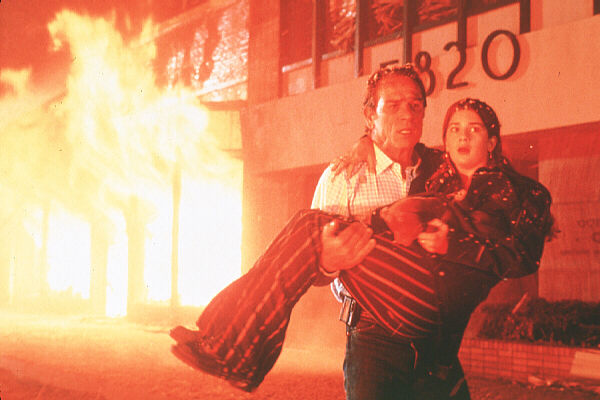
The Future of Food is the documentary equivalent to a Tommy Lee Jones disaster movie. Whereas the former is more of a “what the heck” experience, the latter is definitely an “oh shit” phenomenon. The difference is that in something like Volcano there is Tommy Lee Jones to save the day, and as a spectator there is actually nothing you can do to stop the volcano. This is not the case with The Future of Food. It is a film about large corporations genetically altering seeds and patenting them, thus privatizing the world’s food source. Sadly, when Tommy is really needed, he’s nowhere to be seen. Even Nicolas Cage is AWOL; most likely, he’s gawking at some other horrible catastrophe.

Unlike its fictional brethren, The Future of Food would like to have its audience believe that they can make a difference in the story on screen. The closing montage suggests such an illusion. A young boy bites into a lush, red, organic strawberry (the same iconography as the “evil-ones” use) and as he pulls it away - a pure, natural libation - the frame freezes. The audience is told that the choice is up to us. Cut to a shot of a dandelion, whose seeds are blowing away, reminding the audience both that natural foods are a fragile, impermanent existence, but also that they have to power to “blow” the corporations away.

This is manipulative, because if you pay attention to the entire film, emphasized over and over again is how incessant this gene research is. It is such a one-sided film, with the organic revolution represented by farmers and liberal intellectuals, and the genetic researchers represented by large tractors (that appear to be mowing down fields rather than cultivating them), men in biohazard suits, planes spreading pesticides, and the solitary title-card that reveals only a limited list of the benefits that genetic research has accomplished. The imagery falls into the classical propaganda category perfectly. For a moment, just consider how Eisenstein contrasted the chaotic, confused – emotional – civilians fleeing the mechanical, ordered – unemotional – soldiers attacking on the Odessa Steps. Man vs. Machine, with the future of humanity placed in so assuredly in man. Even Fritz Lang was worldly enough to place the blame not on technology, but in mankind’s use of it (all of his post-Metropolis films emphasize this by pitting the solitary man against the group).

But I’ve gotten away from the other point of comparing The Future of Food to a disaster movie: it is a disaster movie. Like another of its brethren, Michael Moore’s Fahrenheit 9/11, Food carries the double duty of informing the public, as well as trying to have an immediate effect. Moore’s was to influence the U.S. 2004 vote against George W. Bush; Food's is to continue the support of farmers markets, which has been on the increase for nearly a decade, as well as the on-going consumer protests against the genetic alteration of seeds, which is turning into an Orwell-esque monopoly that has the support and financing of the big “G”: government. It is this feud, between the Capra-esque “little guy” and the oppressive, Republican government that forms the emotional core of the film. And it is emotional, vehemently so. Filmmaker Deborah Koons Garcia is convinced of her film’s position, and throws at the screen every piece of evidence to help win over believers, be it the stories of farmers dogged by corporations (sued out of their retirement fund) or percentile facts – or even the simple truth that the entire EU avoids all this drama by labeling genetically altered foods. In the process, Garcia seem to forget about “the other side” to every argument; thus, the film feels more like a religious gathering than a pro-organic convention. And perhaps there is actually something to be said for that.

Friday, September 16, 2005

Corpse Bride Limp Despite Rigor Mortis


Tim Burton’s most recent venture, the animated Corpse Bride, is an experiment with macabre naivety. It’s not soulful, though, not in the way it should be. Rather than crushing children’s securities, indulging into the fascination of nightmares, Burton whittles away at the macabre like an unskilled woodcarver until all that’s left is a shapeless piece of wood, just a little smaller, a little easier to handle. More than anything, the story is smelling-salt of the Spielberg variety, where fantasies are crushed by the monstrosities of adulthood: law, order, and rational.

Necrophilia, as foreign as it sounds to children’s movies, is never quite so removed from its exoticness as in Corpse Bride: it is not so much avoided as it is ignored (not that a PG movie is the place to examine such practices). Which makes me wonder why Burton felt it necessary base his story on such an outlandishly fetishistic premise. Even the title, for chrissake, sounds like something in the backroom of sleazy, small-town video-stores.

By skirting the issues that were obviously the object of Burton and his cohorts’ desire, they don’t so much as simplify it (for younger audiences, no doubt) but dumb it down so much that it’s not a children’s film, rather than a film made with the mindset of a child. As its intended audience grows older, will they remember the fascination of its macabre tendencies with fondness? Most likely they will come to realize its absurdities, and move on to more fleshy films such as Rosemary’s Baby. Movies for kids don’t have to be so shallow, just remember the magic of films such as The Red Balloon – its wonder doesn’t float off like the balloon when one reaches adulthood. Burton’s just wasn’t thinking outside the sandbox.

Wednesday, September 14, 2005

Home is Where the Heat Is: Fritz Lang's The Big Heat


Roy Armes, in his book Film and Reality, has suggested that part of the appeal of the Western is its combination of familiar landscape and familiar story, and an ever-changing path to reach that common conclusion. With film noir, I would say there is a similar formula, but put the emphasis on an unfamiliar landscape: the path is never so interesting as when atmosphere invades and corrupts it. For example: the winter-wonderland On Deadly Ground. It is the tried-and-true story of the cop who is sick of criminals and falls for the sister of a murderer. Solving the case also means solving the mystery of his dissatisfaction: he needs love, and finds it in the sister…but in the middle of the woods? And during winter? Somehow, Nicholas Ray makes it work.

Such is the case with Fritz Lang’s The Big Heat. It’s not a snow-day cop thriller, but rather a domesticated cop thriller. The lack of harsh shadows, dark alleys and prison symbolism seems mysteriously lacking, until one realizes that Lang has imposed all of the moral decay of film noir to the family home, much like Hitchcock did in Shadow of a Doubt. Except where Hitchcock used shadows to project prison-like bars onto his protagonists, Lang throws in a doll – and I’m not using noir lingo, either.

The story is basic: a cop becomes the target of highly influential crooks that run the local politics, as well as the police. But as the film progresses, the street-drama leaves the streets and invades the home. An innocent wife is mistakenly killed. To counter this, her brother and his buddies take up guns and follow the basic creed of “guilty until proven innocent.” It is exactly this moral divergence that fascinates Lang. As we feel ourselves becoming more vulnerable, what right do we have to strike back? Where are the boundaries between aggressive and defensive? Lang also poses the question as to whether this vulnerability is paranoia, or self-inflicted. Classic Lang that permeates the entirety of his output, from Dr. Mabuse to Fury to While the City Sleeps; he is very much a director whose visual style reflects his personal concerns.

Sunday, September 11, 2005

From Fantasy to Terror: Tabu


Tabu (1931) is equal parts Robert Flaherty and F.W. Murnau: it’s two creators (even though Murnau received final directing credit). There is a transformation throughout the film, as the style shifts from the former director to the latter’s temperament; accompanying the stylistic change is an overall shift in the mood of the piece, and it is this “shift” that is the focus of the movie: how idyllic fantasy turns into guilt ridden nightmare. The images from the first half of the film reappear in the latter half, their contexts changed, the naivety corrupted. Tabu's imagery is one that continually develops throughout the course of the film, evolving as do the characters and the story.

The first part of the film is heavily Flaherty influenced, almost seeming like a remake of his 1925 film Moana. (In fact, the name of the ship is “Moana,” and there are other visual links, as well.) We are in the South Seas, on a tropical island that, like Nanook of the North and Moana, seems unaltered by time. For all we know, it is a pre-industrial time. When word arrives that one of the island’s women is to taken away and become a sacred virgin on a neighboring island. For her tribe, this is a cause for celebration; for her male lover, this means disaster. Should she not fulfill her ritual obligation, she will break the taboo and have to be killed.

When the two lovers escape to another island, there is an abrupt shift in the film. No longer the idyllic idealism of their home, the new port is bursting with the affects of modernity: economics and business, as well as integration. The land is filled with Chinese, English, and half-castes. In this new land, a whole different set of taboos develops and ensnares our protagonists.

Flaherty and Murnau were both concerned with the connections between moral catharsis and nature: Nosferatu is quelled by the morning sunrise, Nanook must continually fight weather and animals to survive, and even the lovers of Sunrise experience a rebirth after a near-drowning experience. In Tabu, one finds that economic and ritual taboos have even destroyed the hope of water’s renewal. The boyfriend goes to the water, first, to find pearls to sell in order to get he and his girlfriend out of debt; he returns to find she has left, returned with her father to finish the ritual. He then rows after their boat, jumping ship to latch on to a loose rope from their boat; while holding on, the father cuts the rope, and the boyfriend drowns.