Friday, September 30, 2005

Bergman's The Virgin Spring


Ingmar Bergman’s The Virgin Spring (1960) is as much about vengeance as any of Mickey Spillane’s novels about Mike Hammer, but whereas Spillane described a very physical revenge, an attitude of eye for an eye, Bergman describes a much more spiritual revenge based on internal elements. The film is very much a wheel of emotions, and the burden of hate passes from character to character, progressing the narrative. Essentially, the film could be broken into three parts, where the wheel passes from person to person.

The cycle begins with Ingeri, a maid several months pregnant from a rape. She is asked to accompany to church Karin, the virginal daughter of her employer’s family. Karin, naïve to the hurt and shame of rape, angers Ingeri, who abandons the trip shortly after it starts. Ingeri gets her revenge when she witnesses two brothers who rape and murder Karin, and a third brother who stands and watches.

The cycle continues with the brothers, who flee after stripping Karin of her fine clothes. They are vagabonds and orphans, physically and spiritually starved and abused. They stop the night at a farm that is, unbeknownst to them, the home of Karin. When they try to sell her mother the clothes they stole, she recognizes the garments and shows them to her husband. The cycle ends with him, who takes his vengeance on the three brothers, unmercifully so.

Essentially, the film deals with misanthropy, and questions its roots. Is it not just a projection of unfulfilled desires on to others? All of the characters experience a physical and spiritual loss, something that can’t be restored, and something incomprehensible unless it happens to you. And that is what motivates the characters: to instill in others the unexplainable pain they feel in themselves.

The difficulty of communication, which is at the heart of The Virgin Spring, is also at the heart of many of Bergman’s films, Persona (an actress who gives up speaking), Scenes from a Marriage (the process of divorce allows a couple to finally speak the truth to each other) and Autumn Sonata (a mother and daughter confront childhood dilemmas that went ignored for decades), amongst many others. To articulate honestly is, for Bergman, man’s highest aspiration, something that even God must overcome: his silence can comfort for only so long. Words, eventually, are necessary. Physicality is the hardest iteration to achieve.

Tuesday, September 27, 2005

Here's to you, Walter Reade


I got this in my email tonight. "Congratulations! You've won a copy of Donald Richie's A Hundred Years of Japanese Film."

Thank you Walter Reade and New York Film Festival. I will visit you again soon.

Thanks for making me a winner.

-Cineholla

Sunday, September 25, 2005

Burden of Dreams


"If I abandon this project
I would be a man without dreams
And I don't want to live like that
I live my life or I end my life
with this project."

-Werner Herzog on his film Fitzcaraldo

Les Blank's Burden of Dreams is the perfect companion to Herzog's body of work. It creates an analogy between Herzog's own determination to complete his Fitzcaraldo with many of his characters: Fitzcaraldo who tries to build an opera house in the Amazon jungle, Strozek who launches a fireworks assault against the sun... They don't seem crazy so much, not anymore. Blank's film has humanized them, somehow. Seeing Herzog so earnest and sincere about his own extremities somehow reflects back on to his own films. It's not insanity that seems to drive them to extremities (Herzog and his characters), but a slipping dream, an overwhelming sanity.

Monday, September 19, 2005

Off to Hell in a Handbasket...Or the Farmers Market


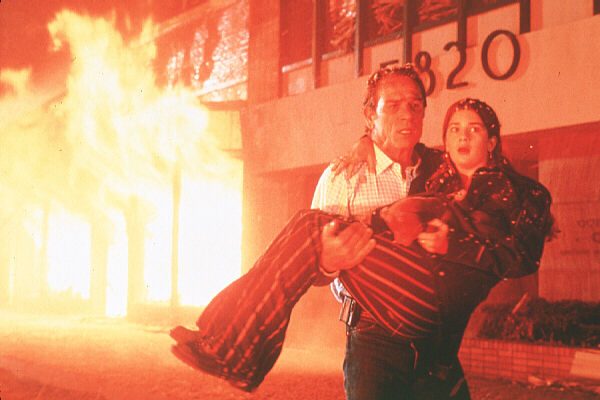
The Future of Food is the documentary equivalent to a Tommy Lee Jones disaster movie. Whereas the former is more of a “what the heck” experience, the latter is definitely an “oh shit” phenomenon. The difference is that in something like Volcano there is Tommy Lee Jones to save the day, and as a spectator there is actually nothing you can do to stop the volcano. This is not the case with The Future of Food. It is a film about large corporations genetically altering seeds and patenting them, thus privatizing the world’s food source. Sadly, when Tommy is really needed, he’s nowhere to be seen. Even Nicolas Cage is AWOL; most likely, he’s gawking at some other horrible catastrophe.

Unlike its fictional brethren, The Future of Food would like to have its audience believe that they can make a difference in the story on screen. The closing montage suggests such an illusion. A young boy bites into a lush, red, organic strawberry (the same iconography as the “evil-ones” use) and as he pulls it away - a pure, natural libation - the frame freezes. The audience is told that the choice is up to us. Cut to a shot of a dandelion, whose seeds are blowing away, reminding the audience both that natural foods are a fragile, impermanent existence, but also that they have to power to “blow” the corporations away.

This is manipulative, because if you pay attention to the entire film, emphasized over and over again is how incessant this gene research is. It is such a one-sided film, with the organic revolution represented by farmers and liberal intellectuals, and the genetic researchers represented by large tractors (that appear to be mowing down fields rather than cultivating them), men in biohazard suits, planes spreading pesticides, and the solitary title-card that reveals only a limited list of the benefits that genetic research has accomplished. The imagery falls into the classical propaganda category perfectly. For a moment, just consider how Eisenstein contrasted the chaotic, confused – emotional – civilians fleeing the mechanical, ordered – unemotional – soldiers attacking on the Odessa Steps. Man vs. Machine, with the future of humanity placed in so assuredly in man. Even Fritz Lang was worldly enough to place the blame not on technology, but in mankind’s use of it (all of his post-Metropolis films emphasize this by pitting the solitary man against the group).

But I’ve gotten away from the other point of comparing The Future of Food to a disaster movie: it is a disaster movie. Like another of its brethren, Michael Moore’s Fahrenheit 9/11, Food carries the double duty of informing the public, as well as trying to have an immediate effect. Moore’s was to influence the U.S. 2004 vote against George W. Bush; Food's is to continue the support of farmers markets, which has been on the increase for nearly a decade, as well as the on-going consumer protests against the genetic alteration of seeds, which is turning into an Orwell-esque monopoly that has the support and financing of the big “G”: government. It is this feud, between the Capra-esque “little guy” and the oppressive, Republican government that forms the emotional core of the film. And it is emotional, vehemently so. Filmmaker Deborah Koons Garcia is convinced of her film’s position, and throws at the screen every piece of evidence to help win over believers, be it the stories of farmers dogged by corporations (sued out of their retirement fund) or percentile facts – or even the simple truth that the entire EU avoids all this drama by labeling genetically altered foods. In the process, Garcia seem to forget about “the other side” to every argument; thus, the film feels more like a religious gathering than a pro-organic convention. And perhaps there is actually something to be said for that.

Friday, September 16, 2005

Corpse Bride Limp Despite Rigor Mortis


Tim Burton’s most recent venture, the animated Corpse Bride, is an experiment with macabre naivety. It’s not soulful, though, not in the way it should be. Rather than crushing children’s securities, indulging into the fascination of nightmares, Burton whittles away at the macabre like an unskilled woodcarver until all that’s left is a shapeless piece of wood, just a little smaller, a little easier to handle. More than anything, the story is smelling-salt of the Spielberg variety, where fantasies are crushed by the monstrosities of adulthood: law, order, and rational.

Necrophilia, as foreign as it sounds to children’s movies, is never quite so removed from its exoticness as in Corpse Bride: it is not so much avoided as it is ignored (not that a PG movie is the place to examine such practices). Which makes me wonder why Burton felt it necessary base his story on such an outlandishly fetishistic premise. Even the title, for chrissake, sounds like something in the backroom of sleazy, small-town video-stores.

By skirting the issues that were obviously the object of Burton and his cohorts’ desire, they don’t so much as simplify it (for younger audiences, no doubt) but dumb it down so much that it’s not a children’s film, rather than a film made with the mindset of a child. As its intended audience grows older, will they remember the fascination of its macabre tendencies with fondness? Most likely they will come to realize its absurdities, and move on to more fleshy films such as Rosemary’s Baby. Movies for kids don’t have to be so shallow, just remember the magic of films such as The Red Balloon – its wonder doesn’t float off like the balloon when one reaches adulthood. Burton’s just wasn’t thinking outside the sandbox.

Wednesday, September 14, 2005

Home is Where the Heat Is: Fritz Lang's The Big Heat


Roy Armes, in his book Film and Reality, has suggested that part of the appeal of the Western is its combination of familiar landscape and familiar story, and an ever-changing path to reach that common conclusion. With film noir, I would say there is a similar formula, but put the emphasis on an unfamiliar landscape: the path is never so interesting as when atmosphere invades and corrupts it. For example: the winter-wonderland On Deadly Ground. It is the tried-and-true story of the cop who is sick of criminals and falls for the sister of a murderer. Solving the case also means solving the mystery of his dissatisfaction: he needs love, and finds it in the sister…but in the middle of the woods? And during winter? Somehow, Nicholas Ray makes it work.

Such is the case with Fritz Lang’s The Big Heat. It’s not a snow-day cop thriller, but rather a domesticated cop thriller. The lack of harsh shadows, dark alleys and prison symbolism seems mysteriously lacking, until one realizes that Lang has imposed all of the moral decay of film noir to the family home, much like Hitchcock did in Shadow of a Doubt. Except where Hitchcock used shadows to project prison-like bars onto his protagonists, Lang throws in a doll – and I’m not using noir lingo, either.

The story is basic: a cop becomes the target of highly influential crooks that run the local politics, as well as the police. But as the film progresses, the street-drama leaves the streets and invades the home. An innocent wife is mistakenly killed. To counter this, her brother and his buddies take up guns and follow the basic creed of “guilty until proven innocent.” It is exactly this moral divergence that fascinates Lang. As we feel ourselves becoming more vulnerable, what right do we have to strike back? Where are the boundaries between aggressive and defensive? Lang also poses the question as to whether this vulnerability is paranoia, or self-inflicted. Classic Lang that permeates the entirety of his output, from Dr. Mabuse to Fury to While the City Sleeps; he is very much a director whose visual style reflects his personal concerns.

Sunday, September 11, 2005

From Fantasy to Terror: Tabu


Tabu (1931) is equal parts Robert Flaherty and F.W. Murnau: it’s two creators (even though Murnau received final directing credit). There is a transformation throughout the film, as the style shifts from the former director to the latter’s temperament; accompanying the stylistic change is an overall shift in the mood of the piece, and it is this “shift” that is the focus of the movie: how idyllic fantasy turns into guilt ridden nightmare. The images from the first half of the film reappear in the latter half, their contexts changed, the naivety corrupted. Tabu's imagery is one that continually develops throughout the course of the film, evolving as do the characters and the story.

The first part of the film is heavily Flaherty influenced, almost seeming like a remake of his 1925 film Moana. (In fact, the name of the ship is “Moana,” and there are other visual links, as well.) We are in the South Seas, on a tropical island that, like Nanook of the North and Moana, seems unaltered by time. For all we know, it is a pre-industrial time. When word arrives that one of the island’s women is to taken away and become a sacred virgin on a neighboring island. For her tribe, this is a cause for celebration; for her male lover, this means disaster. Should she not fulfill her ritual obligation, she will break the taboo and have to be killed.

When the two lovers escape to another island, there is an abrupt shift in the film. No longer the idyllic idealism of their home, the new port is bursting with the affects of modernity: economics and business, as well as integration. The land is filled with Chinese, English, and half-castes. In this new land, a whole different set of taboos develops and ensnares our protagonists.

Flaherty and Murnau were both concerned with the connections between moral catharsis and nature: Nosferatu is quelled by the morning sunrise, Nanook must continually fight weather and animals to survive, and even the lovers of Sunrise experience a rebirth after a near-drowning experience. In Tabu, one finds that economic and ritual taboos have even destroyed the hope of water’s renewal. The boyfriend goes to the water, first, to find pearls to sell in order to get he and his girlfriend out of debt; he returns to find she has left, returned with her father to finish the ritual. He then rows after their boat, jumping ship to latch on to a loose rope from their boat; while holding on, the father cuts the rope, and the boyfriend drowns.

Wednesday, September 07, 2005

Samurai Double Feature at Film Forum


Samurai Assassin (1965, Kihachi Okamoto). The last shot is worth all the suffering that the first, incoherent ninety minutes caused. Toshiro Mifune is limping off into the snowy fields, the only survivor after a bloody battle, carrying the Shogun's head on his sword. Unbeknownst to him, it is his father’s head, a father who had abandoned him at birth. The irony is Shakespearean: it is a tragedy, but also a comedy. As Mifune staggers, the narrator, speaking his last words before he, too, dies on the battlefield, announces that there were orders to burn all the records of Mifune fighting in that battle; the leaders had already planned the way it would be remembered in the future. The narrator, who was keeping records of the assassination of the Shogun, dies, and all his documents fall into a nearby stream. Even in changing history themselves, they have no control over how they will be remembered.

Zatoichi the Fugitive
(1963, Tokuzo Tanaka) tells a story too complicated for its own good. What is important, however, is that the film’s imagery is very modest and tasteful. The tendencies are toward intimidation-focused encounters, silent and slow, rather than for self-depreciatingly unrealistic massacres as would be expected. The battles are there and, yes, they are riotous in their choreography as well as in humor, but more often than not, they are curtailed and given an unexpectedly early ending. These ends, however premature, are witty and provide the proper closure for such a character-based series. Here is one such set-up. There is an ambush, and Zatoichi must clash swords with a samurai. On the first encounter, Zatoichi retreats in anguish – his arm is cut. The samurai steps back, saying that they are even (getting Zatoichi back for one-upping him in public with a sword trick). Just then, the samurai puts his sword back and notices his arm, too, is cut. Zatoichi, once more, is one up.

Tuesday, September 06, 2005

Herzog's Little Dieter Needs to Fly


Everything about Werner Herzog’s work is extremely individualistic. As a director he is aggressive, thus his imprint is intrinsic. The world feels fresh and unique in a Werner Herzog film, sand seems as particular to him as it is, in actuality, common. There are few directors who can really make the world seem their own.

His protagonists, fictional or real, are just as individualistic, and Herzog prides himself (modestly, of course) on conveying their personal nature with as much authenticity as possible. He does not pass judgment, and when Herzog finds himself disagreeing with his subjects, he offers his objection as his own opinion, never imposing at as the core of his argument, never overshadowing his character, and never without having first conveyed the core of his characters.

There are no such disagreements in Little Dieter Needs to Fly; here, both filmmaker and subject are in complete accordance. Made in 1997, Little Dieter is a documentary on Dieter Dengler, a German pilot (on the American side) who was shot down over Laos on his first mission in 1965. It’s really a metaphysical film, about how one man’s passion and intensity came to motivate his survival after being taken captive, how hallucinations of his dreams and ancestors led him to freedom. It is a war story that is beyond politics.

Dieter exhibits the same determination as an Aguirre, a Fitzcaraldo, a Timothy Treadwell, though for a change obsession does not destroy the spirit; rather, it keeps the spirit alive in the most horrendous of circumstances: war, capture, torture, and rampant hopelessness. But the dream of flying always kept Dieter on the go, even after he escaped and was lost in the jungles for weeks on end. The dream finds roots in his childhood spent in Germany during WWII, of planes attacking his small town and swooping in front of his window. Already, the contradiction of fascination and horrification is apparent, as is the strength of a passion that overcomes fear.

Dieter’s greatest strength is his dream: to fly again. That a dream can be so determined as to provoke an unceasing optimism is nothing short of inspiring.

Saturday, September 03, 2005

Fire and Sand Abound in Werner Herzog's "Lessons of Darkness"


Amidst the burning oil fields of Kuwait featured in Werner Herzog’s documentary Lessons of Darkness is a world turned mute: an environment that can no longer speak. Save for the constant musical score, there are almost no other sounds. The image is on mute, and Herzog keeps his narration to a minimum. Of the two interviews in the film, one of them is with a Kuwaiti woman who, after witnessing her children’s torture and murder, lost the ability to speak; the other is with a mother holding her child, who after being stepped on my soldiers spoke only once more to his mother: he told her that he never wanted to learn to speak.

This lack of speech is the central metaphor in the overall dehumanization that Herzog sees displayed in the aftermath of Desert Storm. It is a theme that permeates all aspects of the film in a natural, intrinsic manner. Even Herzog’s photography of the landscape, shooting from a moving helicopter, cannot belie the alien land it has become. It is impassable by even foot. The oil industry first began the land’s transformation; the bombs secured its beyond-this-world sense of ruin. The ignition of the oil, the final act of the Iraqi soldiers, was also the final act of abandonment.

Key, also, is how Herzog does not muddle the apocalyptic poetry of the images with political and historical double-speak. He blames no one and sides no one. The aftermath, the affected landscape, is what concerns Herzog, not the politicians’ justification for destruction. Everything seems to be beyond the scope of words; the human victims will not speak, all the while the land refuses the shut up: the oil keeps burning, keeps raining. It is both a regressive situation, returning the land to the earth, and one decidedly futuristic. The pools of oil reflect not their true self, but the skies above; oil drizzles down from the sky; the air is black with smoke and toxic fumes; and groups of men wearing facemasks and helmets drag in long hoses and heavy machinery. Not one element is in its place.

That Herzog is able to draw ties-that-bind through his historically eclectic body of work, ranging from conquistadors to Kuwait, only confirms his suspicion at the end of Lessons of Darkness: that man cannot live without the fires, and that we will always keep them burning steadily so we have something to extinguish.

Thursday, September 01, 2005

Ingmar Bergman's The Silence


With every Ingmar Bergman film I watch, I inevitably do not understand the character motivations, but then again, I never question them, either. Every line the characters say seems to be the right thing; there is never any hesitation on their part. That is why watching a Bergman film is a physical experience for me, something completely visceral. My mind detects themes, but my gut takes all the punches, feels all the emotion, and that is where the real storytelling happens.

The Silence (1963) is one of those films that defies comprehension but is undeniable accurate. Its construction is so minimal that it almost resembles fantasy. There is a post-apocalyptic emptiness that pervades every scene, desperately realistic in its outlook. Looking out the window of a train, a boy sees only a parallel train carrying tanks into the city; when it has passed, the landscape is empty, so empty that it appears as though the train is hardly moving. Traveling with him are his mother and her sister, experiencing the last throws of a disparate relationship about to collapse. Their emotional destruction mirrors their destitute, hollow surroundings. Even the hotel they stay at is empty, save for a troupe of theatrical dwarfs and an elderly bellhop. By the end of their stay, the mother and sister say their final words; mother and son retreat back to the train, while the sister stays on in the hotel, living out her last days diseased and alone.

Bergman’s jump-off seems to be that even during wartime, we’re still capable of doing even greater damage to each other. The soul is what concerns Bergman, and when it seems to be the only vestige of humanity that war hasn’t stolen, the film portrays characters that are more interested in destroying it than preserving it. The philosophy is certainly pessimistic, but Bergman does end on a hopeful note, because the son seems to realize the cold-heartedness of his mother, and is beginning to resent it. So rather than giving up on life, Bergman shows both the capability of our moral collapse, as well as the seed of a new possibility.

"Ten Day Wonder" Two Hours Later...Still Wondering


Claude Chabrol’s Ten Days Wonder tries to replace mystery with ambiguity, and it never works the way he wants it to. Ambiguity isn’t so mysterious as it is deficient. Even though he co-wrote the first book on Hitchcock, he didn’t learn the most valuable lesson from Hitch, which is that audiences need information in order to be interested. Hitchcock’s method of audience engagement is based on desire, implication and guilt, all of which Chabrol worked into the psychological conception of his film but not into his directing, which is the ultimate flaw of Ten Days Wonder: the audience is left wondering what it was all about.

Structurally, the story is non-committal. The film changes focus with every plot twist, losing track of all the previous threads, some of which are never picked up and given closure at all. The opening scene, with Anthony Perkins hallucinating about jellyfish and realizing he is covered in his own blood, is the initial mystery of the film – why is he bleeding? jellyfish? – and it is never concluded. This turns into a mysterious absence of four days of which Perkins cannot recall anything. This, too, is forgotten once it serves its purpose and leads the film into a new direction.

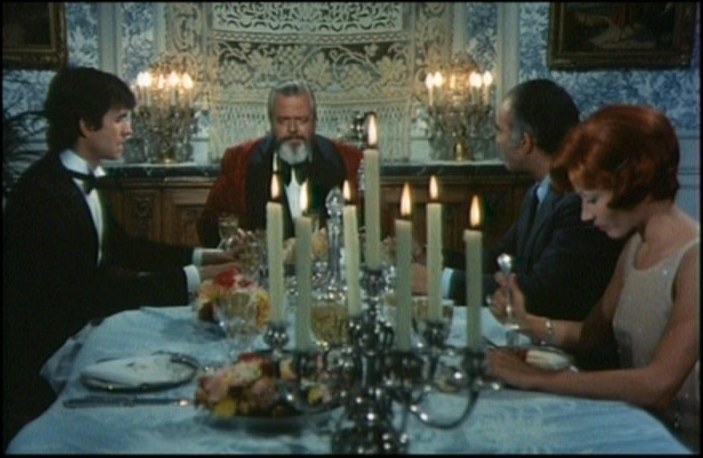
This new direction is into an oedipal situation involving a rich, controlling father (Orson Welles), his young wife who has fallen in love with their adopted son (Perkins), and Perkins’ trusted teacher (Michel Piccoli) whom Perkins asked to figure out his loss of memory. Chabrol must suffer from the same sort of amnesia, because he never gets around to fulfilling the mysteries of the film’s first thirty minutes. Ultimately, the solution that Chabrol gives revolves around a Christian guilt complex induced by the Ten Commandments. It is a perfect textbook answer, but as all students come to realize, textbooks are more rational than people are. Our neuroses are never that clear-cut, and their answers are never that satisfying, thus neither is Chabrol’s closure to Ten Days Wonder.

Wednesday, August 31, 2005

My First Encounter With Louise Brooks


It was a mistake to make a movie with Louise Brooks: she was too beautiful for it ever to work. In Pandora’s Box director G.W. Pabst films her in such a way that puts her on an entirely different level from the rest of the cast. She acts with the camera, never with the other actors. Her features are too striking, too distinctively iconographic – with her pageboy hair, helmet-like in its stillness, she was made to be statuesque – for her to exist on the narrative level; she transcends it onto the plain of mythology (in the way that Barthes describes Garbo’s face as mythological).

Pabst’s name is inseparable from his star Brooks because she is the real art of his films; he put all of his effort into making her an immortal presence on screen. The plot of the film isn’t worth the bother. It is nonsensical on screen, and I do not wish to indulge in paragraphs of ridicule the way Andrew Sarris often does – I get his point quickly and skim until he gets back to his job: criticism.

The other problem with the film is that Pabst is neither Muranu nor Lang, his two major contemporaries at UFA in the late 1920s, and he also seems to be caught in the middle of their styles. Pabst can neither pull off the almost exclusively image based films of Murnau (with only one or two title-cards) or the elegant scripts of Lang. Thus, Pandora’s Box has minimal titles, but weak ones at that, and they are never up to their task. His usual long-shots do not convey much information, and when title-cards are intercut, it is up for grabs as to whose lines they are. If it weren’t for Louise Brooks, there wouldn’t be any faces to remember after the film ends. Then again, if she weren’t in the film, perhaps the other actors wouldn’t have been eclipsed and forgotten so easily.

Monday, August 29, 2005

Blowing the Lid off "American Pop"


Right at the core of American Pop’s problems is its uneven writing. It’s premise is weak – all of twentieth century America shown through a family of musicians in 96 minutes, and all done through animation – but writer Ronni Kern gives up on it halfway through the movie. The first half of the movie covers 1900-1950, roughly, in a fleeting, disconnected manner. Then, settling into the 60s and 70s, periods from the Kern and director Ralph Bakshi’s own lifetime, the film begins to lag. The entire second half is dedicated to drugged-out, insipidly surreal Rock and Roll hallucinations; in those twenty years, history seems to have stopped, save for a brief interlude of a few bombs dropping in Vietnam.

But there are deeper problems with the film, as well, especially it’s attempted portrayal of history. Both World Wars and Vietnam are handled in a similar manner; archival footage is crosscut with animated sequences of dancing and music. This dialectic is immature in design, and falsely implicational in meaning. It is no secret that Europe and Asia was ravaged throughout the twentieth century through wars that America was involved in. More than just mere involvement, though, America is to blame for many atrocities. (Hiroshima and Nakasaki are never mentioned in American Pop, by the way.) If the dialectic went no further than this, it could be written off as sophomoric. But what it really does is navigate around America’s own history book and replace it with shallow images of more global conflicts. The Atom Bomb, the Great Depression, Civil Rights, Women’s Suffrage – the list goes on – none of them were even hinted at in the film.

Essentially, Kern and Bakshi have reduced everything to the stereotype or the cliché. When one character wanders around 1970’s Harlem looking for drugs, the only scenery is a couple Superfly’d dealers in red fur. The ghetto doesn’t exist, and neither does poverty or racism. Actually, yes they do, but only as regards White Russians. The stars of the film fled a pogrom in Russia, only to come to America impoverished and without work. They also lead jazz bands backed by black musicians. The more proper title for this film would be America Russian Style.

Sunday, August 28, 2005

Werner Herzog: The Enigma of Kaspar Hauser


Kept in a basement well into his adult years, Kaspar Hauser never learned to communicate - he never met another soul save for his keeper. Unexpectedly released one day, Hauser is introduced into a village that does not know him. Over the next few years, Hauser learns to speak, to think, and engages in society in a totally unexpected and original manner. Not taught to accept, he naturally questions, and Hauser is immediately a controversial figure.

Watching Werner Herzog's The Enigma of Kaspar Hauser, I kept thinking about the way that society tried to pin him down. They wrote him off as a potential criminal, a lunatic, a could-be threat, an idiot, an overgrown child – all because he remained to them an enigma, something that couldn’t be pinned down with words and classifications, and that scared them. Kept in that basement for years with bread, water, and a toy horse, Hauser had nothing to question for he knew no else; even the difference between an empty cup and one filled he does not learn until he is abandoned/liberated. Between abandonment and liberation there is no difference, for they serve the same purpose to Hauser: self-reliance. Confronted with the never-ending possibilities of life, Hauser begins to learn unaffectedly. His logic is his own, as it should be; his rationale doesn’t fit with the intelligentsia.

The Enigma of Kaspar Hauser
is Werner Herzog’s declaration of non-conformity. Even though Hauser’s attire changes through the film, he always resists the uniform; resists the definition; resists accuracy. As Herzog said in his latest project Grizzly Man, “The natural order of the world is chaos.”

-Cullen Gallagher

Saturday, August 27, 2005

Fassbinder's Beware of a Holy Whore


Every shot in Rainer Werner Fassbinder’s Beware of a Holy Whore is replete with onlookers; their gaze is apathetic and bored. They watch everyone, waiting for someone to begin their job, for within the symbiotic machine of movie making, one cannot do their job unless someone else is pulling their end; yet no one seems to be able to start work. This perpetuating indecision finds its genesis with the director, played by Lou Castel, who refuses to direct those who cannot work without direction. Ideally, our actions are to be executed independent from others. Fassbinder’s characters cannot live up to this, their own fantasy concocted to protect them from committing fully to a relationship; they discover that in any relationship there isn’t a balance of power: the scale is always a variable skew.

Fassbinder’s preoccupation with pestilent relationships has been extrapolated here, and it seems as relevant to business as it does to personal relationships. But Fassbinder has always been interested in the relationship of love and money – there is always a logical side to relationships to balance the illogic of passion and whim. With production halted, the movie’s set, a regal palace, is turned into a stagnant oasis. Castel sits at the bar drinking his night away, prolonging any decision as long as he can. Finishing his drink, he smashes the glass and says (something to the effect of), “If I don’t have glasses to smash, life isn’t worth living.” Combustion needs fuel; creative temperament needs an outlet and artists, for Fassbinder at least, may be brilliant, but they are destructive as well.

The ensemble casting has always been a favorite of Fassbinder, who likes to work with microcosmic societies. Aside from Castel, there is Hannah Shygulla, French actor Eddie Constantine, Fassbinder himself, and a handful of colorful actors that might ring a bell from the hoards of other Fassbinder movies out there. But with so many people and so many relationships, Fassbinder avoids possible saturation (and didacticism) and bleeds these themes evenly over all the characters: no one is wasted.

Friday, August 26, 2005

TCM Classics: Ride the High Country


The Western genre, with its roots in the changing landscape of the American west, is the perfect allegory for history’s pervading tempest. Sam Peckinpah’s Ride the High Country (1962) picks two old-timers caught on the cusp of change: Joel McCrea, the moralistic loser searching for pride, and Randolph Scott, the side-show gunslinger who’s self worth is as empty as his pockets. McCrea hires Scott and his young cohort to transport gold from the mine to town, while Scott has plans of converting his old friend and running off with the gold. It’s a story of camaraderie, fading glory, missed opportunities, and the disillusionment of living to see your youth wither and amount to nothing. The themes are the same as Peckinpah’s later film The Wild Bunch (1969), but neither film seems to stepping on each other’s toes. Whereas Ride the High Country adds to the mix a young buck, nervy cowboy out to sow his oats, making Peckinpah’s story multi-generational, The Wild Bunch lets the cowboys die off; there are no inheritors, and nothing to inherit.

More than the birth of a new society, Ride the High Country is about the death of an aging one. Modernization is equated with the depersonalization of the West, and the dismantling of a community founded on your self-worth. You are only as big as your name, and there’s no room to rest on your laurels; this extends beyond gun slinging and bank-robbing and into less glamorous territories such as friendship and trust. But Peckinpah makes it seem less cheesy than that. His narrative style is, by this point, well oiled. As Andrew Sarris points out, the film lacks the infinite supply of bullets of so many Westerns, as well as other mythologies so readily accepted. Instead, this film strives for a less romantic realism, mixed with a less saturated vision of violence that would become Peckinpah in only a few more years. In retrospect, one can already feel the Western genre begin to feel its age; it doesn’t slow down, and Ride the High Country is perhaps a peak in the genre, but like the characters that Scott and McCrea portray, they realize they are in a changing society that will never go back to the way it once was.

Thursday, August 25, 2005

At the Walter Reade... Allegro Non Troppo


Bruno Bozzetto’s Allegro Non Troppo is more Fellini than Disney. If the intent was to pay homage to Fantasia, so be it, but Allegro surpasses the original in every way. Where Disney's characters are often naïve and classical, Bozzetto’s are perverse and iconoclastic. In one segment, Bozzetto indulges in Bosch to portray a satyr chasing women; if it were a Disney film, the man would be lonely and looking for a platonic mate; Bozzetto portrays the satyr as an old lecher out to rape a young fairy maiden. The film is amoral, something Disney has never understood. To them, a film is a lesson to be taught. Not so for Bozzetto. To hit the point home, Bozzetto dedicates an entire sequence to a man whom everyone copies. The search for identity turns to a fascistic control. Just when our Benito-to-be thinks he has full control, his “army” surprises him: they turn and drop their pants. Morality really makes an ass out of a movie.

Also: but for a few intelligible yammers (a very few that are quite forgivable) there are no talking animals.

In Memory of Tonino Delli Colli


Tonino Delli Colli, the magnificent cinematographer, passed away August 17th. He was 83.

He worked closely with some of the world's greatest directors. He photographed almost all of Pasolini's movies, starting with Accatone right up through Pasolini's final film, Salo. He worked with Sergio Leone on both The Good, The Bad and the Ugly, as well as Once Upon a Time in the West and Once Upon a Time in America, with Louis Malle on his short William Wilson and Lacombe, Lucien, Fellini on Intervista and The Voice of the Moon, and with Roberto Benigni on Life is Beautiful, Tonino's final film.

Tuesday, August 23, 2005

Recent Watching: Lady in the Lake


Lady in the Lake was an attempt to make a first-person film, to accurately convey through film the experience of reading Raymond Chandler’s book of the same name, where the reader encounters everything through Phillip Marlowe rather than just reading about him. In literature, this means that that “he said” is replaced by “I said,” and that it is a little more difficult (and out of place) to have scenes occur where the main character isn’t around. It is much more difficult to transpose onto film. The camera must be the main character, thus Marlowe isn’t so much a face than a voice, except when the camera passes in front of a mirror and there has to be a body there to be reflected (a camera’s reflection certainly wouldn’t do!).

Since the camera is Marlowe’s eyes, it can’t cut back and forth, or cut out time through ellipses – scenes must be played out in real time. Director/star Robert Montgomery does a good job of handling such a narrative technique, one that is more precocious than tried-and-true. The best scenes are the ones that are the most complicated in terms of staging and directing. It is not that they are merely flashy, but that they fully realize the potential and difficulty of the first-person camera.

The use of mirrors, particularly, requires quick, subtle editing. The use of a real mirror would reflect the camera, so while the camera pans from a girl, for example, to a mirror, there must be a cut while the girl and Marlowe step inside an empty mirror frame. While the camera pans away from the mirror, another cut must be made, as well. If the editing seems a bit obvious nowadays, it doesn’t deter one bit from either the story of the effects they were reaching for. More than forgivable, it is admirable.

The downside to the film is the stagy acting. Since the actors are acting with a camera, rather than an actor, there is an inherent monologue quality, as though they were reciting lines rather than performing a scene with other actors. As an aside, characters in film noir never seem too sincere, but in this film I feel it is even more drastic and noticeable. One scene in particular is so hammy that you could cut it, if the knife were sharp enough: the bad cop is about to shoot his girlfriend who is wanted for murder. She throws up her limbs and strikes the pose; he shoots; her arms mechanically jitter back and forth like a robot; finally, after a fittingly tragedian death, she stops moving, but not before tragedy turns into farce.

Something I didn’t mention before is the music. It is quite uncommon for its time both for its sparseness, and because it is primarily choral. The subdued and atmospheric quality of the singing is ethereally creepy, and separates it from the melodramatic symphonic scores that dominated films of that era.

-Cullen Gallagher