Saturday, April 08, 2006

Recent Watching: Brick (2005)

A roguish, nerdy looking adolescent, spectacled and unkempt, trots across the parking lot to a gang of kids camped around a convertible. Their focus is on the letterman trumpeting about his football skills, the coach who refuses to acknowledge them, and the team that he could whoop single-handedly. As the rogue, Brendan Frye (played by Joseph Gordon-Levitt), sits on the edge of the convertible, the car sinks slightly, and all eyes turn on him. He stands up to the letterman the only way a nerd could: after hearing the letterman say, "Yeah," a half dozen times repeatedly, Brendan tells him to look it up in the thesaurus: "It’s under 'Y'," Brendan reminds him. Challenged to a fistfight, the roguish nerd trumps the letterman again, leaving him bruised on the pavement. Walking away, a late spectator asks him, "Was there a fight?" Brendan coolly replies, "Yeah, there was."

If this scenario seems like the fantasies of a marginalized high-schooler with a fondness for all things hardboiled, then you’re dead on: Rian Johnson's Brick (2005) assumes the semi-important mindset of adolescence and runs with it. The film is deliberate--for better or for worse--about everything in it. It's a series of winks at the audience and nods to Mickey Spillane and Dashiell Hammett, and a thousand-and-one black and white gems that make up the film noir canon.

In the first moments of the movie, we are privy to a hidden moment that stays that way until well into the movie. Brendan discovers a blonde dead in the gutter--a secret grotto in front of a darkened cave. Rian Johnson, the film's writer and director, takes us back two days earlier to a phone call Brendan received from the blonde in the opening scene. She's scared out of her mind, too much so to tell him why, but she wants his help. The remainder of Brick centers around the who, what, when, where, why and how of all this: the movie is about answering questions.

What unfolds is a veritable checklist of noir must-haves: femme fatales, tough guys and lingo that exists purely for the reason of fulfilling some hardboiled desires that were aroused in the public consciousness sometime in the late 1920s and have yet to be fulfilled. Much like Mike Hammer in Spillane's Kiss Me Deadly, Brendan uncovers a seedy drug ring among the elite--this time high school rich kids rather the Mafia big-shots--with a missing bundle of dope at the center of it all.

In midst of this fantasy, classes, teachers and parents seem to be almost lost. They appear only occasionally: a mother who serves Brendan apple juice after being beaten by her son in the basement; a principal who tries to tap Brendan for information; and, in the dialogue, references to homeroom and parent-teacher conferences. Humorous asides out-of-place within the genre, they are supposed to signal self-awareness within the film, reminding us that movie is taking itself in stride, and we should take it likewise.

Only I can't. Its derivations and allusions make the film trite, not intelligent. Brick is not so much a part of any foundation for new cinema as it is another piece on the top of a firmly established pile. It doesn't so much explore a genre as much as transplant it, the way a spoof or satire would. In fact, Brick functions in the gray area between Godard's Band of Outsiders (1964) and your friend's gangster movie you acted in during high school.

Where Brick runs astray is when it eschews the organic for the contrived, when it opts to do what has been done before even when it is not in the story's capacity to do so. Brendan's motivation, for instance, remains unconvincing: does he seek out the woman's killers because he loves her, or because it is neccesary for the story to unfold? (Just as it unnecessarily for the protagonist to have a brainy know-it-all, ironically named Brain, and for every woman to be sex-crazed...) The characters that make up the drug-ring seem to be in such a spiral that Brendan's presence hardly has an impact: it is as though the shoot-out climax would have happened regardless of Brendan's involvement (only without him, the camera would not have been there).

What a film like David Cronenberg's A History of Violence (2005) offers that Brick does not is a complex mystery that works above the level of referential hee-haw that the latter is content with. There is a moment of revelation in Cronenberg's film that completely changes the main character; a similar revelation in Johnson's film is nowhere near as enlightening: when the darker side is revealed, it may be unexpected, but it certainly doesn't change much, expecting a few more issues that remain aggrivatingly unexplored.

Ultimately what was so unsatisfying about Brick is that its high-school, middle-class setting, which the film calls attention to so often, isn't dealt with in any insightful manner. Excepting for a few minor jokes (the funniest being an unknowing mother serving milk to a group of thugs crowding her living room in the middle of the night) it remains painfully in the background. The story, and especially the characters, are low-relief in the worst way: they're shallow because of flaw, not because of circumstance. And this is one facet that, regardless of intention, is inexcusable.

Saturday, March 18, 2006

Rigid Individualism or Rigid Masculinity: The Fountainhead

King Vidor's The Fountainhead (1949), adapted by Ayn Rand from her own novel, feels more like dialogue from a pamphlet than a movie script. It's easier to take as overt allegory, too, because little of narrative is well written enough to swallow as straight drama. Howard Roark (Gary Cooper) is a non-conformist architect that wades in obscurity until given the chance to make art on his terms: a contract to design a gas station. It's enough to get him started, and he makes a name for himself. This portion of the story--the architect's struggle--is a pleasant enough allegory for any artist to relate to (for any individual in any field, as a matter of fact): down with the critics who pander to the masses and never recognize "real art." (What is it that Estragon says to Vladimir in Waiting for Godot that is so insulting? "Crritic!" But critics are artists, too, no?)

The end of the film is pleasant enough, too, when Roark dynamites his own building after the contractors have their own way with his original idea. The ensuing trial isn't as much about his destroying property as it is about whether an artist has a right to his own ideas, or he has to work for the greater good of the community. Anti-communist rhetoric is clearly at work here (HUAC is doing to Hollywood what the critics were doing to Roark), and Rand is all for the individualist. Vidor and his actors, however, seem to be on a different track. They don't seem to care much for Rand's politics: they're more interested in the relationship between Cooper and Patricia Neal. All the references to jack-hammers and structures seem more sexual symbols than political ideals.

I liked Gary Cooper's performance quite a bit, partly because he's an odd casting choice. He emanates a soft-spoken conservatism, whereas Roark seems to be a radical liberal in many ways. Roark chooses aesthetics over functionality, high-brow over low-brow; he drafts plans for an apartment complex for another architect without taking any credit or payment because he's all about personal gratification rather than public, and he'd rather be proud than rich. Perhaps, though, Cooper is perfect for the fundamentally anti-Communist tone that Rand wanted to lend her story, because he bleeds a lot of the radicalism out of the role. (Dynamiting public property still seems pretty radical to me, even after seeing the movie.) Ultimately, Cooper's understatment helps keep the film from stepping too far from the Mason-Dixon line that separates politics and entertainment. Rigid individualism or rigid masculinity? The Fountainhead plays both hands like a Siamese twin playing against itself.

Sunday, March 12, 2006

Ask the Dust: The Wrong Fit

Ask the Dust (2006) fits like a glove on the wrong hand. In many ways, it still performs the function is supposed to, but the cloth is taut where it shouldn't, and it's immobility infringes on its usefulness. Yet it's still better than no glove at all, and a mediocre movie of John Fante's novel is better than no movie at all. Writer/Director Robert Towne tries to play Fante's game by Hollywood's rules, using dialogue that is sharp only in that points in one direction. The story of Arturo Bandini doesn't fit the Hollywood mould, and the movie feels like a struggle between apathetic whim and strained predictability. But that even a strain of whim works its way into the film makes it worthwhile. Bandini (played by Colin Farrell) is a young writer from small-town Colorado recently relocated to the Bunker Hill region of L.A., an area full of "old ladies and weak men" as one woman describes it. The woman is Camilla Lopez (Salma Hayek), a Mexican waitress at a nearby diner. Days after I've seen the movie, I still can't pin-point their relationship: one moment he's busy playing (badly, at that) the cool, detatched, semi-belligerant writer (and she does her part to instigate it), and the next they're in a beach-front shack while he teaches her how to read English. But neither extreme is out of Bandini's capacity, nor out of Camilla's, which marks Ask the Dust several steps above the typical Hollwood romances.

Sunday, March 05, 2006

Transience Prolonged: Woman is the Future of Man

Hong Sang-Soo doesn’t confuse reverie with nostalgia. The two never come close to colliding in Woman is the Future of Man (2004), and the result is a thankfully unsentimental romantic semi-comedy. Having graduated from an American film school, Hunjoon (Kim Tae-Woo) returns to Korea for the first time in many years. He reunites with MunhoYu Ji-Tae), an old friend currently teaching art at a local university. The two share lunch, and then go off in search of Hunjoon’s old girlfriend, Sunhwa (Seong Hyeon-A).

The ensuing search and reunion occupies the second half of Woman, which is just less than 90 minutes total. The film’s conclusion is as inauspicious as its beginning, as Munho and Hunjoon stand on the sidewalk under falling snow, unable to find any rhyme or rhythm in conversation. The ending finds them separate and alone, not so aware of any great change, but with a few memories that won’t be leaving them anytime soon.

Memory is key to Woman is the Future of Man. Ironically, these men can’t see into the future: their vision is blurred by inextricable memories of humiliation and regret. A passing woman wearing a purple scarf sends both of them into their pasts, as they remember how horribly they treated Sunhwa. Their trip to see her isn’t so much about finding a lost friend as it is about wiping out these old memories, finding some moment of reconciliation. Given the chance, they screw it up once again.

As a storyteller, Hong is more in tune with chance and coincidence than genre and plot. A scene’s importance may not seem readily apparent, and it may never shake its shroud of seeming insignificance, but to Hong such moments are things of beauty. The science of transience is Hong’s specialty, and he knows how to film a movie like writing between the lines.

Tuesday, February 14, 2006

Trapped by Sound: Pabst's Threepenny Opera

Sound is to Pabst what a tack is to a bicycle tire: it still runs, but the ride is bumpy and it takes too long to get there. G.W. Pabst's The Threepenny Opera was filmed in 1931 when sound recording techniques still had much to be desired, and much of the film's failing has to do with just that. Lacking the freedom that camera's were allowed in the silent era (when microphones were not an issue), Pabst reverts to tableaux shots and long takes: the scenes are static, and the actors hardly move. This isn't the usual Pabst who constructs his stories in lurid, penetrating close-ups. What he is able to carry over from his silent films are his love of decor and stylized sets. The acting, however, is uninspired, and it's as though the actors are reading the lines to themselves before they go to sleep. Just as their movements are static, there is nothing kinetic about their voices. As many early sound pictures proved, movies may have learned to talk, but they had still to learn how to move once again.

Sunday, February 12, 2006

King of Hearts (1966)

If ignorance is bliss, then what is insanity?

Phillipe de Broca's King of Hearts (1966) finds the Germans retreating from a small French village at the end of the first World War. Before they do, however, they trigger the town to blow-up when the clock strikes midngight. Logically scared for their lives, the townspeople evacuate, leaving the local asylum unguarded. When Scottish officer Alan Bates arrives in town, he finds the town overrun by the innamtes, and he is soon crowned the King of Hearts. But the Scots and Germans haven't gone for good, and when they show up back in town, it's hard to tell who's the whacko.

And that's the point--that the soldiers, and the world at large, is crazier than anything inside the gated asylum. The loonies are much happier amongst themselves, remaining oblivious to anything so "overly dramatic" as fighting (as one of the inmates describes an impromtu battle between the two armies).

De Broca directs with such a subtle grace that many of the scenes seem to be set to an imaginary music that only the characters can hear. I'm thinking particularly of the three Scottish soldiers, stepping in unison, swaying right and then left, peering around corners to see if the Germans have gone. And the sequence when the inmates let loose in the abandoned town exhibits an understated sense of humor: the accustomed ease with which they pick up lipstick and clothes betrays the excitement that one would expect.

One of the most pleasant things about King of Hearts is its comedic pacing: it never goes for the quick guffaw, instead the movie feels rather understated, as though its humor can only heigthen with familiarity.

Saturday, February 11, 2006

Deceitul, Murderous Delight: The Two Mrs. Carrolls

Barabara Stanwyck and Humphrey Bogart aren't their usual selves in The Two Mrs. Carrolls (1947). She is not the femme fatale, and he isn't the hardboiled private eye. Lovers after a chance encounter, Bogart and Stanwyck wed shortly after Bogart's first wife passes away. This second Mrs. Carroll begins to bore Bogart, however, as she fails to inspire his paintings as she once did. However, a new muse has entered his life, played by Alexis Smith. Soon, Mrs. Carroll falls ill, with symptoms much like the first Mrs. Carroll's before she passed away...

Director Peter Godfrey, while delivering a solid noir-melodrama, reuses much of the imagery and tension that Alfred Hitchcock used in his film Suspicion (1941): the shot of Bogart holding the poisoned glass of milk is a straight copy of Cary Grant in the earlier film. Both films, however, distinguish themselves in different ways. Hitchcock's film is a family-sized red herring served on a silver platter; Godfrey, on the other hand, consummates the tale of deceit and delivers a murderer at the end of the film. Thomas Job's script (from the play by Martin Vale) is excellently written, with smart dialogue and a handful of wry stock characters (the grumpy maid, the elderly fisherman) that, as often is the case, are the most memorable parts of the film.

Friday, February 10, 2006

Vamp-Camp: A Fool There Was

"A Fool There Was" (1915), the film that made a star out of star Theda Bara, is a poorly dramatized piece of vamp-camp that lingers over Bara's exotic sexuality. This is what the attraction of the film was in 1915, and that is still the main reason to see it today: Bara's sinful ways are as exaggerated as Mary Pickford's innocence, and its extremity is what makes it exciting. Her eating a grape out of her lover's mouth still carries erotic appeal; and her lifting the hem of her dress off the floor to show her ankles--this should also be cherished as a sign of the times, and as an early lifting of the sexuality's veil. (And those hems seem to have been getting higher ever since.)

Though coming fifteen years before Josef Von Sternberg's "The Blue Angel" (1930), "A Fool There Was" tells a similar story of a successful, respected man turned wayward and ruined by his lust. The object of his obsession is Theda Bara, known only as "The Vampire," a woman whose sole preoccupation is with bringing men to ruin: poverty, death, and suicide meet all of her former lovers. Called to England as an ambassador, John Schuyler (Edward Jose) books passage alone on a boat. On board, he becomes the next victim of "the Vampire," and off they go to Italy. Away from his family, Schuyler misses them terribly, but cannot live without his new mistress. Returning home (with Bara in tow), Schuyler fails to balance both his familial responsibilities and his desire for Bara and ends his life in utter ruin.

Director Frank Powell uses flowers as a symbol of female sexuality in the manner of Georgia O'Keefe. At one point Bara even thwarts a jealous lover's pistol with her long stemmed flower. But in other aspects of the film, Powell's direction isn't so successful. The introduction of the family is confused, with too many persons introduced too quickly with little to distinguish them. He doesn't exhibit the same flair for composition or editing that Thomas Ince or D.W. Griffith concurrently used in their own films: Powell's seem flat and unassured compared to them. The story, too, feels undeveloped beyond the bare bones of the plot. It is Bara's image that receives all the attention of the filmmaker, and her expressionistic glamour must have been a shock to audiences used to the Pickford curls. Bara's rampant seduction is domineering compared to the submissive roles played by Lillian Gish. This is not to sleight either Pickford nor Gish, nor to place Bara on a higher platform than either of them, but merely as context with which to compare Bara's character, for hers was the original vamp, the first femme fatale--but if that is all she represents, then "A Fool There Was" would not be worth much. Bara's value comes in her character, complete in vision and in action, which allows her to rise above a mundane script, and separate her from all its mediocrity.

Communal Poetics: Maureen Gosling's Blossoms of Fire

Maureen Gosling’s documentary, Blossoms of Fire (2000), goes behind the mythic “Juchitan matriarchy,” a Mexican town that is supposedly run all by women. The myth is only half wrong: women run most of the local businesses, but it is a gender balance based on a mutual work ethic that has evolved over centuries. From here, Gosling’s story spirals outward, expanding until it encompasses all members of the villages, all aspects of their history and culture—and it’s amazingly fascinating. She approaches Juchitán in the tradition of Robert Flaherty, with expert attention to the customary poetics in their cooking, their clothes, their crafts. Local musicians color the film on-screen and on the soundtrack; one memorable scene involves a man singing and playing harmonica while playing a bass improvised out of a stick, a string, and a bucket. Where Gosling deviates from Flaherty is in the town’s present and future: Flaherty was obsessed with tradition and ritual in a pre-industrial state; Gosling is fascinated with Juchitán’s resistance to globalization and the influx of corporate influence—which the town has thwarted so far successfully through vibrant protests. And this is the key thread of the film: a town that has held on to its roots, and continues to preserve them. The school still teaches the local dialect; Juchitán also elected the first liberal, local government during the reign of the one-party system; after Elle Magazine slandered local women in an issue, the town brought libel charges against the French magazine. What Gosling has found in this small town is a community that stands up for itself and wants to preserve its own unique image and history—it doesn’t want to be like everywhere else. It resists all aspects of modernization: human-made craftsmanship over mass production, homegrown over laboratory foods, the local marketplace over the supermarket. Gosling, with her detail-oriented camera, observes the intimate kinesis of a community at work and translates it on to film fluidly.

Wednesday, February 01, 2006

The Maltese Falcon: Two Adaptations

Dashiell Hammett's 1929 novel "The Maltese Falcon" was turned into three films in one decade: Roy Del Ruth's 1931 The Maltese Falcon (later retitled Dangerous Woman), William Dieterle's 1936 Satan Met a Lady and John Huston's 1941 The Maltese Falcon.

****

The 1931 version plays much like Roy Del Ruth's other pre-Code gems, such as 1930's Lady Killer with James Cagney: the sensation of comedy and cruelty, with an unmistakable affection for the sleazy and the lurid. An abridged version of the novel, private dick Sam Spade is still the protagonist (though Del Ruth really emphasizes the "public" over the "private"). After his partner is killed on a case, Spade is drawn into a free-for-all over a mystery jeweled falcon--femme fatales, young gunmen, exotic foreigners, fat old men and the coppers--the film is everything film noir would come to be, but The Maltese Falcon is not quite there yet. It is not as dark or cynical as 1940s harboiled films would be; instead, there is a certain lightness about this Maltese Falcon--perhaps its the way that Spade (played by Ricardo Cortez) always has this conniving grin on his face, and can't say anything straight. Duplicity does not expose the darker side of humanity, but the funnier side of things: with no one telling the truth, any absurdity can pass through someone's mouth. It's almost the aesthetic of a Marx Brothers film, but without the slapstick action.

***

Satan Met a Lady, too, feels like a Marx Brothers film--but not in a good way. It feels like the "straight" scenes, the little bits of plot that try and form a cohesive action, but utterly fail dramatically. Satan, however, has none of the comic relief of a Groucho, nor the sarcasm of Roy Del Ruth's 1931 adaptation. The plot retains the core of the story, but with some excess baggage, such as Spade being an exiled detective, run out of every town by various "public morality groups." The story, however, is so streamlined (to make room for new additions), that in its 76 minutes it hardly finds time to cohere. Duplicity is never so much an issue as unbelievablity: the acting is not convincing of anything but a poor script.

Wednesday, January 18, 2006

I Married a Witch: The Wrong Aisle For Some Viewers

Rene Clair’s I Married a Witch (1942) is stupefyingly schlocky. Veronica Lake plays a 290-year-old witch that was burned by the puritans and buried under an oak tree that is to contain her spirit for eternity. A lightning bolt strikes the tree in the 1940s, however, releasing Lake’s ghost. Vengeful, she singles out Frederic March, whose ancestor was the one to burn Lake centuries earlier. She foils his marriage, clinches his election for governor, and then takes him down the aisle for herself. It should be ridiculous, but handled at Clair’s breakneck pace it finishes as fittingly absurd. Still, his earlier works such as À Nous La Liberté (1931) and Paris Qui Dort (1925) need less justification for their comedy to work. With I Married a Witch, you have to keep telling yourself, “Veronica Lake doesn’t look half bad for someone George Washington’s age.”

Tuesday, January 17, 2006

You Can’t Teach an Oldboy New Tricks

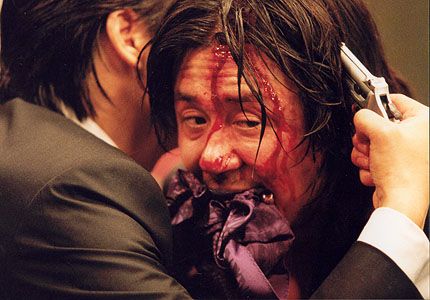
Oldboy (2003) would be a whodunit, only the “who” is revealed before the film’s halfway point. So—it’s more of a whydunit, with a highly unsatisfying “why.” The story concerns a man who is mysteriously imprisoned for fifteen years, and then released. Hunting down his captor, the prisoner rediscovers the youthful guilt that so inspired his captor’s revenge, Neither party can live with the guilt; one commits suicide, and the other undergoes hypnosis. Vengeance is whine.

The Racket: Robbed of all Potential

The Racket (1951) is one of those movies that should have been a lot better than it was. It has a great cast (Robert Ryan, Robert Mitchum and Lizabeth Scott), but because of flaccid directing and dialogue copped from even worse pictures, this cops and crooks story is robbed of all potential. There is one great line, though: says Ryan to Scott, “You cheap, clip joint canary.” Typecast as the brutal criminal, Ryan was unable to make the better of his role in this picture. He plays the head of a racket that is paying off cops and politicians. Mitchum, playing the honest cop, is out to get Ryan first on the stand, then convicted, and finally behind bars. As the plot runs its course, the gangsters shoot all their cronies before they can confess, and the cops shoot all the gangsters before they can, too. So—in the end, it’s not like anything’s changed.

Flight of Fancy Crashes in Latest Kong Remake

You can’t have your chorus girl and eat her, too. Kong made his choice. Peter Jackson apparently hasn’t.

King Kong (2005) director Peter Jackson thinks big. He does big, too. Everything about his vision is big, and because of this he often overlooks the smaller, more important details of his movie. His rendition of the classic tale of filmmakers shooting on a mysterious island who discover a larger-than-life ape whom they bring back to NY only for it to escape and go on a rampage—all for the love a girl (Naomi Watts)—is even less believable than the original.

With a three-hour-plus running time, there should be ample room for even the slightest bit of character development, yet this is exactly what is missing from the film. Naomi Watts, as the actress, and Adrien Brody, as the writer, seemingly hate each other at first sight. At second, however, they are immediately in love. Brody, however, is no match for the ape, and Watts quickly chooses brawn over brains. These typical clichés clutter the movie more than its excessive action sequences.

On the other hand, with so little attention paid to the characters, it would seem as though it would be easy enough to achieve consistency. Here, too, Kong fails. Cheesiness and hokieness abound, it is difficult to tell whether the movie is supposed to be a spoof or a classic adventure picture. So much of the dialogue and so many of the scenes appear to mock 1930s cinema, the era in which the original King Kong (1933) appeared. Jackson seems to have watched the wrong 1930s movies, because his script has none of the wit or sharp commentary of an Anita Loos.

Perhaps most disappointing of all is how un-original Jackson’s re-vision is. Not that is takes so much from the original King Kong, but from movies like Tremors, Star Wars, Predator, Starship Troopers and his own Lord of the Rings trilogy. The choreography of the action scenes will make you scratch your head in wonder: where have I seen this before? The dinosaur stampede, with all those Tyrannosaurus Rexes, is decidedly reminiscent of Jurassic Park.

And the nameless, fat man with glasses still dies.

One could congratulate Jackson on the enormity of his picture, on its monstrous special effects and on its technological breakthroughs—they must be there, I just don’t know what they are—but this is what I’d like to know: what is the point of making the fantastic more realistic if, in the process, the story becomes even less so? The pathos for Kong is forced, and there are more last minute rescues than in a D.W. Griffith movie.

Jack Black, however, is very funny as the villainous director with the “heart of darkness.” (Yes, there is a character reading Conrad’s novel on-board the ship). But overtones such as these—turning flights of fancy into philosophical levitations—mar the comedy with a contrived seriousness.

Saturday, January 14, 2006

Caché: Suspense Unfettered by Closure or Cell-Phones

It’s been a while since I heard an audience scream like that.

Not like the thrill-shriekers that love horror films like they love roller coasters, but like an audience watching Henri-Georges Clouzot’s Diabolique (1955)—exactly like that—and you either have seen the movie and know exactly what I mean, or it would be disastrous for me to spell it out.

Watching Michael Haneke’s latest Caché (Hidden) (2005) is very much like watching a Clouzot picture, but Haneke differs in one crucial way: there is no resolution to the story, no villain to pin it on, no explanation to the mystery. If you are one who needs this type of closure, then Cache is not for you. Haneke provokes us through his unconventional storytelling and demands that we appreciate the vibe of mystery for its own sake. “It’s the beauty of the mystery that allows us to live sane as we pilot our fragile bodies through this demolition-derby world,” writes Stephen King in the afterward to his novel The Colorado Kid.

King’s words ring ironic throughout Caché, because the films characters are unable to live with the mystery, and their wits are whittled away by the invisible hand of a blackmailer. Georges (Daniel Auteuil) and Anne Laurent (Juliette Binoche) begin receiving videotapes of them entering and leaving their house accompanied by child-like drawing of bloody faces. The threat is there, but not explicitly. Neither husband nor wife can figure out what the blackmailer wants from them, nor what he is blackmailing them about.

Is it even blackmail? Another videotape shows Georges’s childhood home; still another a hotel room. Georges tracks down the hotel room and discovers a childhood memory long forgotten: Majid, the son of two servants that worked for his family. Georges surmises that Majid and his son are behind these videotapes, but where is the proof, and where is the motive—and what are they after?

The suspense genre has been constantly evolving over the past fifty years. Think back to Diabolique: the mystery is resolved. Virtually all mystery/suspense pictures before the 1960s had a large degree of closure. Beginning in the 1960s, the genre began to show signs of dissent. Blow-Up (1969) leaves us wondering if he really photographed a murder, or whether it was David Hemmings’s imagination. Haneke continues the evolution by making the threat real, but by leaving the characters so far out in the cold that there’s little chance they’ll ever find the right path. The right path, in fact, never appears in the movie: all trails are as futile to Haneke.

The way the film develops, then, is through Georges’s psychological reaction to the tapes. Unsure of their intended meaning, his mind goes rampant through his subconscious, digging up all the guilt and shame that he had hidden for so long. The footage of him walking in and out of his house is meaningless, harmless, really, save for the fact that someone is nearby with a camera. Much like in Rear Window (1954) when Scottie’s gaze is returned by Thorwald, Georges’s subconscious becomes his outer-shell. His and Anne’s need for a reason, for a motive—needs much like the audience’s—surfaces their own lack of trust in one another.

The reason why Haneke is successful with Caché is that he hits at such a mundane vulnerability in us: there is nothing spectacular or fantastic about the terror; in fact, it seems to be created as much by Georges as it is by the mysterious cameraman. The mere sight of himself on film sets off a whole globe of paranoia.

Stephen King continues musing on the nature of mystery in his afterward: “Wanting might be better than knowing.” With cinematic villainy becoming increasingly more deranged and pathological, too, the stakes for the victims is changing as well. The innocent girl played by Ida Lupino in Out of the Fog (1943) that is being harassed by John Garfield is no longer the case: innocence no longer exists, except in the minds of others. Georges proves that he finds himself guilty; his struggle for exoneration is as much about proving his innocence to his wife as it is proving himself guilty to himself.

Haneke’s direction is fitting. He utilizes static shots that leave the audience wondering, “Is this going to be a videotape or not?” Flashbacks, too, are subtly intertwined as to avoid easy pinpointing. With the villain a filmmaker himself, Haneke has fun toying with the audience as to who is filming which shot.

It is impossible for people, when talking about Caché, not to mention the end of the film. And it’s no wonder—Hakeke is prevocational up until the last shot. People in the audience began shouting, “What? Is that it?” It’s been a long time since audience reaction after a movie could drown out a cell-phone. Speaking of which, not one went off during the entire movie. It’s been a while since that has happened.

Friday, January 13, 2006

The Best of Youth (2003)

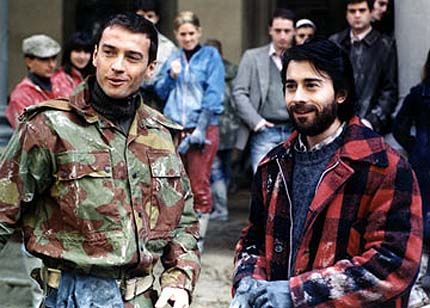
Marco Tullio Giordana’s The Best of Youth (2003) begins in 1966 with two brothers, Matteo and Nicola, at the end of another semester. After their final exams, they are to meet up with two of their buddies for a long road trip. Matteo, however, arrives with Giorgia, a girl whom he helped escape from the mental hospital where Matteo works. Giorgia has been abused while in custody, given severe doses of electroshock therapy that Matteo deplores. Postponing their trip for two days, Matteo and Nicola try to bring Giorgia to safety.

They fail, however, and she is taken into custody by the police. Too, the brothers fail to go on their adventure: they never meet up with their friends, Matteo runs to join the military, and Nicola heads out on his own to Norway.

From the start, The Best of Youth structures its story on interruption, allowing for a whimsical feel that, for the most part, eludes feeling contrived and structured. That’s a hefty feet for such an epic film—it runs just over six hours—but a quality necessary for the film to succeed.

Much of its success it due to the writing by Sandro Petraglia and Sefano Rulli, who balance the audience’s want for drama, but also their plot-weary mentality. Brought up on movies, audiences can spot impossibilities like liver spots, and but for a few moments, the writing is sincere enough that even the best plot guessers won’t mind if they’re right, once in a while. The few moments I speak of are at the beginning of the second half, when the characters’ political alliances begin to clash: Matteo is with the police and Nicola’s wife is a member of the radical group the Red Brigades. However, this conflict doesn’t become the main focus of the film.

Instead, the film smartly focuses on family, playing close attention to every character and not allowing any of them to fall to the wayside. In many ways, The Best of Youth is similar to that other familial Italian epic The Tree of Wooden Clogs. That film, written and directed by Ermanno Olmi in 1978, tells the story a family of Italian peasants, working hard to make a living at the end start of the 20th century. Both films share a concentration to everyday survival, and the role that chance plays in determining our paths.

Too, the film develops thematically, not relying on only one to permeate the film. Hours into the film, new themes continually re-assert themselves, harkening back to moments from early on in the film. Photography is a key element to the film. Matteo speaks of his own ideas about photographing people, and how one should look for the mystery in gestures, markings that might escape our eyes. Early on in the film, it is Matteo’s eye that noticed scars just above Giorgia’s ears, and it is his photographs of them that first engage Nicola’s sympathies for the girl.

Director Giordana clearly shares this philosophy. Like Fellini, Giordana has a fondness for faces, and while they may not be as exaggerated as Fellini’s are, each character is given an individualistic look which helps distinguish them in such a long movie with so many different people.

Mental illness and politics all share time on screen, but the movie never falls back on didacticism for effect. They may surface throughout the film, but neither is the main point that The Best of Youth seems to be making. In fact, the point of the film is somewhat of a mystery that takes the whole film to fully evolve on screen. Ultimately, there are a lot of lessons that would sound hokey if I spelled them out to be found in The Best of Youth, but a pervasive capriciousness and pathos make them seem sincere—so that’s all right.

In the end, we get the feeling that we have actually seen the characters in The Best of Youth live, and thinking back to the beginning of the film, forty years or six hours earlier (depending on how you judge time) seems a lifetime ago--which is the way its supposed to be.

Wednesday, January 11, 2006

Hitchcock Double Feature: Strangers on a Train and I Confess


I feel a certain futileness when describing "Strangers on a Train": my words are deficient in describing its excellence. Too, I am having great difficulty calling attention to a detail here, or a detail there, when so much of the picture was handled with great care. A pervasive humor seems to reach out from behind the screen and pinch us, reminding us (as Alfred Hitchcock oft said), "It's only a movie." For one thing, the writing balances within the story both drama and comedy, morbid jokes and adventure: the potentially ridiculous story of Guy Haines and his stalker Bruno Anthony could have more easily been moribund than lively. Guy, played by Farley Granger, is a stuffy sort of hero, stuck with the guilt of a murder he had nothing to do with. Bruno, a wickedly charming Robert Walker, is the real murderer: he strangled Guy's wife and is ready to pin it on him if Guy doesn't scratch Bruno's back (for a favor Guy never asked for): what Bruno wants is a murder in return.

Alfred Hitchcock's symbolic directing feels very much at home in "Strangers on a Train." He uses the camera to create parallels between characters and emphasize notions of guilt and anxiety. The casting is also full of animated faces, character actors like Leo G. Carroll and Hitch's own daughter, Patricia Hitchcock. She seems to be the omnipotent presence of director Hitchcock himself, pointing out all the morose details and giggling all the while.


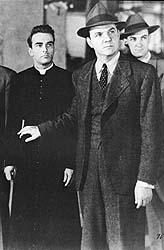
"I Confess," on the other hand, suffers from being too heavy with not enough comic relief (the light touch that Hitchcock normally exudes). Hitchcock here falls prey to the severity of his subject, a priest (Montgomery Clift) who overhears a murderer's confession in the church is himself accused of the murder, only vows keep the priest from revealing what was said in the privacy of the confessional. The picture circles around this conflict very closely, rarely steering away from it, but with little to distract the audience from the story, they have ample time to find all its contrivances and plot holes. Much of the picture is wasted because of this: the writers spent too much time amassing superficial evidence as to why Clift looks guilty, and then how he ironically can't confess the truth because of his vows. In many ways, the film is as stiff as a corpse.

The film isn't entirely bad--its mainly the writing--and there is plenty to admire and entertain. The opening sequence of the film is inspired, however, by Hitchcock's deft handling of shadows and intrigue: the murderer, in priests clothing, hurries down the alley in true film noir fashion, with the garment's hem hovering just above the cobblestone street. Clift, as well, is the right actor for the role, and he executes the tension between guilt, shame and loyalty fittingly. Karl Malden, too, is wonderful as the smug cop, his squashed nose and pinched eyes working to their full advantage. Melodrama, as much Hitchcock's forte as mystery, suspense or comedy, proves overpowering in "I Confess" With little comedy or adventure to filter out the melodramatic pungency, the film ultimately lacks many of Hitchcock's usual touches. It seems as though his mind was someplace else during this movie.

Friday, January 06, 2006

This Week's Highlights


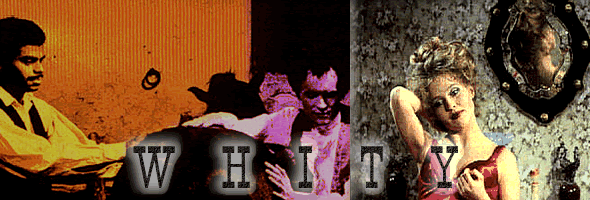
Even on the fifth viewing, Fassbinder's Whity (1970) gives me a sense of total dislocation. It's so hard to define its time and place--it avoids any attempt at pinning it down. Fassbinder works his magic in and out of the Western genre, mixing English slang with German dialogue, 19th century period costumes and 1970s glamour, and a soundtrack that references Morricone, Brecht and late '60s West Coast rock.

***

James Cagney plays a small-time, big-city gambler that hits it big: falling for Mae Clarke's scam and losing fifty bucks at a "nice, friendly game of cards," Cagney offers his services to her entourage, and together they make a killing off the city. All goes well until the killing becomes real and Cagney has to flee to California. Picking up the pieces as a Hollywood extra, he works his way to the top of the studios, only to be felled when his gang shows up wanting a piece of the action.

There's something a little raw about the humor of Roy Del Ruth's 1933 Lady Killer. Consider when Cagney returns home to his Hollywood mansion to find Clarke waiting in bed for him: in a single shot, he grabs her by the hair, and drags her across the room and into the hallway. Before the production code of 1934 (which upped the morals while lowering the morale), movies could get away with such brutality. Too, the bad guys could win. Such is how Cagney is implicated in murder, stealing, assault, theft, gambling and booze (the prohibition was on), and in the last frame still be on his way to Cuba to get married with his lover (guilty of the same crimes).

***

Anna Magnani carries Amore (1948) all on her own. The film, directed by Roberto Rossellini and scripted with the help of Federico Fellini, among others, comprises two short films. In the first, "A Human Voice," Magnani is the only actor on screen, save for a dog that is in no more than a few shots. Magnani is on the phone with her lover, far away and recently departed. This, it seems, is to be their last conversation. The second film, "The Miracle," was banned in the US and taken to the Supreme Court. Magnani plays a poor woman who meets a man in the woods one day who she takes to be Saint Joseph. He gets her drunk and, once unconscious, rapes her. Convinced that he was Saint Joseph, Magnani informs the town that her pregnancy was an immaculate conception. Ridiculed and run out of town, Magnani flees to the hills to bear her child alone.

The common theme seems to be one of faith, both secular and religious. In the first film, Magnani is dealing with her obsession for her lover, whom she shall never see again. Through the course of the conversation, she realizes that he has been lying to her: that he is not "at home" alone, and that he is cushioning the truth in order to make the separation easier. The facade breaks and her delusions fall away. Faith has to do with trust and fidelity, as well as our own projection of others, what they think and how they feel. In "The Miracle," the townsfolk and church do not buy into Magnani's tale, and they reject her own religious experiences. To them, she is a sinner, a liar, a whore, a hyprocrite, and a lunatic.

Communication, too, seems to be of concern. In "A Human Voice," the telephone is the only means of connection between the lovers, and the line keeps going dead--or does he hang-up? With the partner absent (literally, in the film, for even his voice is absent), so much is left to the imagination. And in the second--no one believes her. Her faith is ridiculed and since it doesn't conform to the mass's conception, then it is not accepted.


***

There is something cruel about Nicholas Ray's films, this inward hate that infests his characters. James Dean in Rebel Without a Cause, punching the desk, hoping that any expression of violence will curb its tendencies for the time being. Or Sterling Hayden in Johnny Guitar, the gunslinger who traded his pistols for the guitar, only to find his hand still goes for the nearest gun when trouble resounds. Too, in the same movie, Joan Crawford refuses to leave town, even though she knows the puritanical lynch-mob (headed by Mercedes McCambridge) is out to get her; when a young man accused of robbery is found hiding in her saloon by the mob, Crawford encourages the young man to lie and implicate her in the robbery if it would save him from the gallows. Self-destruction and circularity permeate Ray's films, with no easy exits provided.

Tuesday, January 03, 2006

Grand Central Murder: Half Hardboiled, Half Hyperbole


S. Sylvan Simon's Grand Central Murder (1942) is a yarn so good you might consider knitting a sweater out of it. It would make a great hand-me-down if it was anything like the movie--which I'd feel more comfortable recommending than a lot of better movies, such as Antonioni's noir-influenced Story of a Love Affair. Grand Central Murder is a comedy about a money-crazed actress found dead in her private train car. Sam Levene plays the detective assigned to the case. He rounds up the usuals--the understudy, the fiancé, the ex-husband, and the maid--as well as Private Dick Van Heflin, seen snooping around the crime scene around the time of the murder. The whole crew gets together and, in between accusations and heart attacks, recalls the downed diva's past life and a thousand reasons why she should be murdered. The conclusion to the tale is wonderfully anti-climactic: it is a quick "in and out" comic touch that differentiates from dramatic spectacle. Many such touches grace the film, including the liquor-starved Levene who is stuck with a dozen bottles of soda (and drinking straws, of course), and the cigar-smoking Swedish masseuse who was the deceased's maid. And then there's Van Heflin, the smart-ass P.I., who with great skill carefully balances hardboiled and hyperbole.

Monday, January 02, 2006

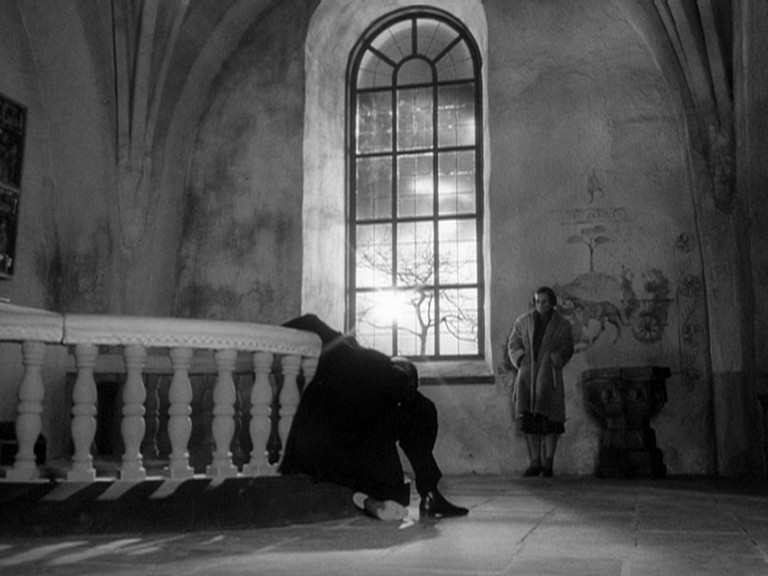
On Nykvist's Cinematography in Bergman's Winter Light


The first time I saw Ingmar Bergman’s Winter Light* (1963) it was during the peak of the summer in New York City. I had just moved into my apartment, and there were no shades in the window: the sun dusted by face like so many brooms. I would awake dazed, my head baked from the glaring sun. The title remained a mystery, and the photography little more than ‘beautiful.’

When I revisited the film, however, it was during a Maine winter, and certain things about Sven Nykvist's photography became clearer. There is a tendency—especially when it snows—for time to seemingly stop. Morning and afternoon all share the same, gray light: muted, but blinding. 6AM and 4PM do not seem so different. The shift to night is sudden and equally enigmatic. There is a larger sense of stasis in winter than in summer because it is more difficult to distinguish the hours from one another.

It is this stasis, a dislocation with life and time, that affects the characters in Winter Light: they are trapped and cannot any exit, and solution to their problems. A pastor, Tomas (Gunnar Bjonstrand), confronts his waning congregation and loss of faith, both in fellow people and in religion. Jonas (Max Von Sydow) approaches the pastor with his own loss of faith, and his increasing distress over nuclear proliferation. He seeks comfort, but the pastor is too caught up in his own problems to provide sufficient guidance. Parallel to Tomas’s spiritual rejection of Jonas is his physical rejection of Marta (Ingrid Thulin), the atheistic schoolteacher in love with him.

Dispersed throughout the film are long, still shots of nature: trees, frozen ponds, snowy fields: nature under the heavy weight of snow. Bergman’s direction, then, calls particular attention to the relationship between the photographic elements of the film and the story. Contrary to Peter Cowie, who described Bergman as, “eschewing the mechanics—the magic—of the cinema,” with Winter Light, I feel Bergman is achieving something intrinsically cinematic: elements of time, movement (or lack thereof) and photography combine to create an environment filled with meaning (118). These characters are at once in a barren, open landscape, but one that is seemingly endless with no exit. With their loss of faith, the physical world is their only life, yet for them it is a trap they are unable to escape.

---

*According to http://www.bergmanorama.com/films/winter_light.htm, the original title Nattvardsgästerna means "The Communicants". The relationship of cinematography to the story does not change, however. The English title of the film served as a lens for examining the film, not as the metaphor itself.

Cowie, Peter. Antonioni/Bergman/Resnais: Three Monographs. Holland: International Film Guide, 1963.

-Cullen Gallagher