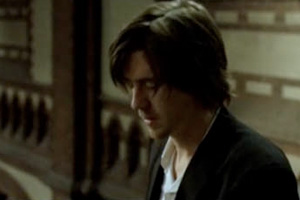
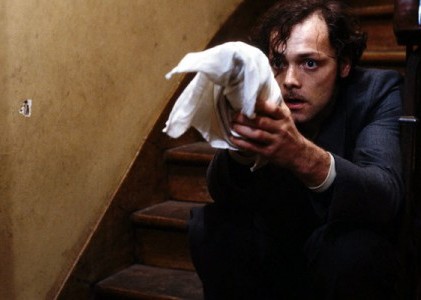
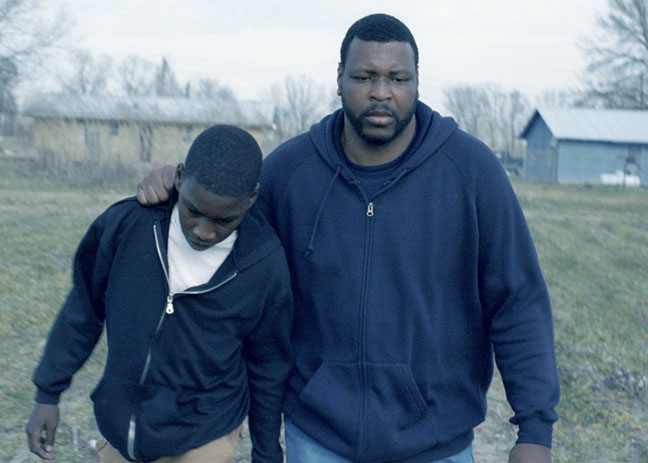
Unlike the exaggerated characters in even the best high school movies, there’s something unshakably authentic to this fifteen year-old-kid from Brunswick, Maine with a rat tail who wears trucker t-shirts with cut-off sleeves. And it’s not just because Billy the Kid is a work of non-fiction, but rather that director Jennifer Venditti has managed the incredible feat of both finding and conveying cinematically a character who is absolutely singular and unique, and at the same time exists as an “everyman” who sums up our collective adolescence.
Tuesday, October 28, 2008
Monday, October 27, 2008
Night and Day (Bam gua nat) (2008)
"Hong’s latest film, Night and Day, extends his career-long preoccupation with the confused male psyche—though, at this point we could almost say that Hong’s films are exercises in ritual emasculation: social experiments in which his male protagonists are given center stage to exercise their libido, only to expose (or, in some cases, to reaffirm) their impotency and inadequacy. At the start of Night and Day, several successive intertitles set up the context for the story: Sung-nam, a forty-something Korean artist, smokes marijuana (for the first time) with an American exchange student, who is subsequently arrested and divulges the artist’s name. Fearing incarceration, the artist abandons his wife and flees to Paris, where the film begins."
Wednesday, October 22, 2008
Zidane: A 21st Century Portrait (2006)
"The span of the film is an entire soccer game, yet the camera never diverts its gaze from the French soccer phenomenon Zinedine Zidane. Eschewing the God-like perspective of broadcast sports, the film zeros in on Zidane, voyeuristically watching him watch the game. Unlike conventional biopics, Zidane appears less a character than a series of gestures and movements. Directors Douglas Gordon and Philippe Parreno do not seek explanations so much as exhibitions, and their film is thankfully less of a soccer genre-pic than a deconstructionlist essay-film."
Read my full review of Zidane: A 21st Century Portrait here at The L Magazine.
http://thelmagazine.com/6/30/Film/feature6.cfm?ctype=2
Tuesday, October 21, 2008
Troubled Water (2008)
"Norwegian director Erik Poppe’s third feature, Troubled Water (De Usynlige), garnered both the Jury and Audience Awards for Best Narrative Feature at the 2008 Hamptons International Film Festival. Well deserving of both, it’s an arresting probe into morality and forgiveness that leaves one stunned not only by its emotionally stark performances, but also by the film’s complex, musical structure that quietly underlies the narrative and binds everything together..."
Tuesday, October 14, 2008
The Curse of Bigfoot (1976)

"Seemingly a cinematic Frankenstein’s Monster, the film feels like parts of several unfinished movies that were strung together using bits of stock footage and excessive voice-over narration. The title is certainly misleading: only a fraction of the footage has to do with Bigfoot, and there isn’t a curse anywhere to be found. Missing from the title are: a zombie; a mummy; a movie-within-a-movie; an educational lecture; an archeological dig; and Canadian logging… lots of logging, and all of it purportedly in Canada."
Read my full review of The Curse of Bigfoot here at Not Coming to a Theater Near You.
http://www.notcoming.com/reviews/thecurseofbigfoot/
Wednesday, October 08, 2008
I'm Gonna Explode (Voy a explotar) (2008)
"I’m Gonna Explode is a playful concoction from the blender of cinephile/director Gerardo Naranjo—a little Pierrot le Fou, a dash of Badlands, a hint of Harold and Maude, and garnishes from a slew of other entries in the lovers-on-the-run genre. But there’s also something else in there, something unique to Naranjo, and it’s what saves the film from drowning under its many references. In fact, I’m Gonna Explode magically floats on top of a wave of teenage angst, ecstasy, and rebellion. Naranjo abides by the same blend of impulsiveness and uncertainty that the characters live by...."
Read my full review of I'm Gonna Explode (Voy a explotar) here at Not Coming to a Theater Near You.
http://www.notcoming.com/reviews/imgonnaexplode/
Lola Montes (1955)
"Max Ophüls’ Lola Montès: the cinematic analog to Charlie Parker with Strings or, better yet, the second movement of Beethoven’s Sonata No. 32 (when a whimsical 19th-century sway glides into a heavy ragtime swing, long before such a genre was even around). Like those two musical works, Lola Montès is a near perfect marriage of classicism and modernism. The real-life rise and fall of an aristocratic femme fatale who ends up as a circus attraction (literally), the film’s formal elegance has rarely been matched, and yet the borders of its expansive CinemaScope frame can scarcely contain the director’s kinetic visuals. With every frame saturated with unreasonable grandeur, Lola Montès is nothing short of an Ophüls-explosion..."
Read my full review of Max Ophüls’ Lola Montès here at The L Magazine.
http://thelmagazine.com/6/28/Film/feature3.cfm?ctype=2
Wednesday, October 01, 2008
The Last Command (1928)
The Last Command stands on the precipice of two auteurs. On the one hand, it is distinctly the vision of director Josef von Sternberg, with his overly romantic sense of narrative expression, which privileges style above all else. At the same time, the film is undeniably under the influence of its star, Emil Jannings... He came to represent a dying breed, the final remnant of classical German respectability that had been disappearing since the country's loss in World War I and the ensuing economic depression... Change was blooming and so was Jannings’ career—his characters, however, were most certainly wilting.
Read my full review of The Last Command here at Not Coming to a Theater Near You.
http://www.notcoming.com/reviews/thelastcommand/
The Dead Don't Die (1975)
"It’s a hybrid of the wrong-man convicted story á la Cornell Woolrich (in which a relative of the incarcerated has to prove them innocent) mixed with Val Lewton and Jacques Tourneur’s I Walked With a Zombie (voodoo lore and cheap sets masked by dark lighting and excessive fog). And as charming as the precision-timed fade-outs are – lingering shots of an actor’s face wearing the expression of shocking, new information, meant to cue intrusive commercials – The Dead Don’t Die is far more than just a piece of retro TV ephemera."
Read my full review of Curtis Harrington's The Dead Don't Die here at Not Coming to a Theater Near You.
http://www.notcoming.com/reviews/thedeaddontdie/
Tuesday, September 23, 2008
Häxan (1922)
"Delineating between documentary (the research-based lecture), fiction (the narrative segments), and meta-commentary (asides referring to events that may or may not have occurred during filming), Benjamin Christensen has created an enquiry into both the historical and contemporary role of “the occult” and “religion” in society. At the same time, he has also crafted an extraordinarily detailed example of the macabre, one that revels in dark corners, shadowy figures, hallucinatory specters, gnarled corpses, and grotesqueries that had rarely been seen before, and even now – eighty six years later – can hold its own against any modern computer generated effects. Häxan’s power to fascinate, disturb, entertain, and enlighten, have only grown over time, the true sign of a masterpiece."
Read my full essay on Häxan here at Not Coming to a Theater Near You.
http://www.notcoming.com/reviews/haxan/
Friday, September 19, 2008
Taking Father Home (2006)
Taking Father Home is a marvel of low-budget filmmaking: a debut feature film shot on a borrowed video camera for less than $5,000, using friends and non-professionals for actors, and all without the permission of the Chinese government. Director Ying Liang trumps every technical and economic limitation through his highly refined visual sensibility, as elegant as it is imaginative. And yet it’s rather limiting to consider the film only in terms of its “limitations”—Ying makes no excuses for its rough-around-the-edges quality, which only adds to its DIY attitude.
Read my full review of Taking Father Home online here at Hammer to Nail.
http://www.hammertonail.com/?p=378#more-378
Friday, September 12, 2008
Robert Flaherty Film Seminar at BAM
"Whereas the nurse of Casa de Lava and the narrator of Cargo represent the gaze of outsiders looking in, Kent MacKenzie’s docu-fiction hybrid The Exiles (1961) represents the insider speaking out. Examining the everyday lives of a Native American community in 1960s Bunker Hill, Los Angeles, the narration of The Exiles is culled from interviews with the film’s subjects. Recently rescued from obscurity by Milestone Films, The Exiles is nothing short of a revelation: a West Coast Shadows (1959), of sorts, in which MacKenzie captures the anxieties of assimilation and the tensions surrounding ethnic identity in a big city melting pot."
Read my full coverage of the Robert Flaherty Film Seminar at BAM online here at The L Magazine.
http://www.thelmagazine.com/lmag_blog/blog/post__09110808.cfm
Thursday, September 11, 2008
David Lean Retrospective at Film Forum
"Celia Johnson appeared in Lean’s next film (and first solo directorial effort) This Happy Breed (1944). Johnson is perfect as Lean’s middle-class muse, wide-eyed with dreams that would eventually be crushed by domestic disappointment. Ronald Neame’s creamy Technicolor photography elevates this story of “common people” to tragic heights: after his return from the first world war, a husband and his wife set down roots in a small town and start a family. Instead of the idealistic happiness of their dreams, the husband and wife become witnesses to their children’s disappointment, disaster, and even death. In This Happy Breed, the home becomes a landscape of human suffering, discontent, and uncertainty, all rendered through Lean’s exquisite direction and restrained performances of the cast."
Read my full essay on David Lean online here at The L Magazine.
http://www.thelmagazine.com/lmag_blog/blog/post__09100809.cfm
Monday, September 08, 2008
We Can't Go Home Again (1973-1976)

"The line between what is and is not real in We Can’t Go Home Again is more than just a blur: it’s downright schizophrenic. And not just to the extent that its narrative mirrors the circumstances in which it was made – Nicholas Ray, weary after decades of Hollywood filmmaking, assumes a teaching position at the State University of New York at Binghamton and instructs his students through a collaborative feature-film endeavor – but to the possibility that what we are witnessing is the manifestation of Ray’s own mental breakdown."
Read my full essay on We Can't Go Home Again online here at Not Coming to a Theater Near You.
http://www.notcoming.com/reviews/wecantgohomeagain/
Sunday, September 07, 2008
The Janitor (1974)

"The Janitor is at once the result of a few days of furious filmmaking, working through the night, and inspired improvisation, and the accumulation of a lifetime of preoccupations, neuroses, and anxieties. Like his previous film, We Can’t Go Home Again, The Janitor continues to push the divide between the new and old “Nicholas Ray”—the revolutionary experimenter and the Hollywood auteur. But whereas We Can’t Go Home Again expressed Ray’s reluctant optimism—his hope for a younger generation—The Janitor is decidedly misanthropic..."
Read my full review of Nicholas Ray's The Janitor at Not Coming to a Theater Near You.
http://notcoming.com/reviews/thejanitor/
Wednesday, August 27, 2008
High Green Wall (1954)

"Like so many of Nicholas Ray’s protagonists, Henty (Joseph Cotten) is on the run, in search of an ideal space where he can be free of society’s restrictions and expectations. And, like those in Ray’s other films, Henty eventually discovers that no such space exists, and that one must create such an environment themselves. Humphrey Bogart [in In a Lonely Place] and James Dean [in Rebel Without a Cause] each pushed social boundaries past the breaking point; Henty, on the other hand, never pushed anything, but instead kept wandering until, finally, there was no place left to go. So he stopped—and the final note of capitulation is one of the most desolate endings in all of Ray’s work..."
Read my full review of Nicholas Ray's High Green Wall online here at Not Coming to a Theater Near You.
http://notcoming.com/reviews/highgreenwall/
Monday, August 25, 2008
More on "La France" (2007)
"Whereas the traditional musical (Fred Astaire, for example, or any of the other Hollywood archetypes) emphasizes the body of the performer—requiring actors lip-synch so they can concentrate on choreographed movement—La France shifts the focus to the performance itself: stationary, the actors’ focus is not on mimicking a prerecorded song, but in the organic creation of one on-screen."
Read my full review of Serge Bozon's La France here at Reverse Shot.
Tuesday, August 19, 2008
Knock on Any Door (1949)
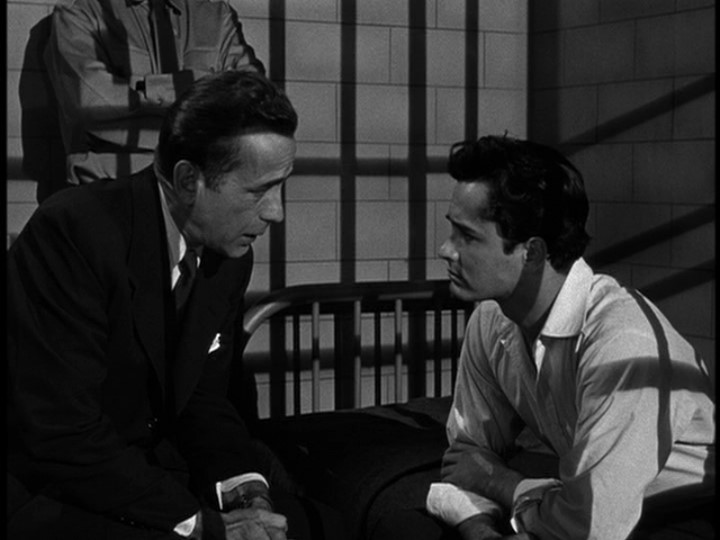
'Simply put, this is the nightmare of Nicholas Ray: “When life is based on one law: fear. An island of outrage: work and sleep and eat by command; pray by command… Look over the gray fence at the far away hill, look through the bars at the free night, without hope except someday get out, get even.” In Knock on Any Door, lawyer Andrew Morton (Humphrey Bogart), a former child of skid row who was able to overcome circumstance, may be speaking about the experience of juvenile incarceration (which he knows intimately from first-hand experience), but he could very well be enunciating the subjectivity of any of Ray’s protagonists. Fear not only the demons from without, but also from within – as much the capacity for being wronged as for committing wrong – that one may “get out” and successfully “get even"...'
Read my full review of Nicholas Ray's Knock on Any Door online here at Not Coming to a Theater Near You.
http://notcoming.com/reviews/knockonanydoor/
Monday, August 18, 2008
A Woman's Secret (1949)
"A Woman’s Secret (1949), Nicholas Ray’s second film, is arguably one of the most maligned and ignored films of his career. While the criticisms seem well deserved (it is clearly one of the director’s weaker movies), the lack of any thorough, sustained criticism on the film is certainly not so deserved. Even enthusiasts of the director’s career, it seems, either circumvent the topic or write it off a failed contract-job in which Ray had little interest—thus justifying their own dismissive evaluations... What stands out in the finished film—and what aligns it with Ray’s characteristic interest in both marginalized, countercultural characters and tension-wrought relationships—is the interaction between Gloria Grahame and Maureen O’Hara. What could have been played as a strict ingénue/director binary becomes a complex power struggle, at once male/female and mother/daughter, which overflows with sexual and adolescent undercurrents..."
Read my full essay on Nicholas Ray's A Woman's Secret online here at Not Coming to a Theater Near You.
http://www.notcoming.com/reviews/awomanssecret/
Monday, August 11, 2008
The Devil Inside: Filming Jim Thompson’s first-person pulp psychosis
Mark Ash and I co-wrote an essay on the cinematic adaptations of Jim Thompson recently for Moving Image Source. It is called "The Devil Inside: Filming Jim Thompson’s first-person pulp psychosis."
"In Jim Thompson’s America, men are born killers—they don’t have killing thrust upon them. The major forebears of Thompson’s pulp fiction, written primarily for the paperback market beginning in the 1940s and continuing until the early 1970s, were the small-town narratives of James M. Cain. But in Cain, everymen are turned into murderers by circumstance, for the sake of money or a girl; Thompson’s innovation was to turn circumstance into a psychological state. It’s not the lure of temptation or the crush of necessity that drives his protagonists to crime, but the perception of its requirement, for self-preservation or out of moral obligation."
Read the full essay here at Moving Image Soruce.
http://www.movingimagesource.us/articles/the-devil-inside-20080811
Friday, August 08, 2008
Elegy (2008)
"Evoking the deep, rich hues of Velazquez and Goya, director Isabel Coixet brings a baroque elegance to her compositions — coming close to conveying Roth’s own virtuoso display of language, if inevitably falling short. Coixet and screenwriter Nicholas Mayer thankfully make no significant compromises with Roth’s novella: no Terms of Endearment here, Elegy finds no sentimental closure to Kepesh’s mortality or his lingering insatiability for a physical existence."
Read my full review of Elegy here at The L Magazine.
http://thelmagazine.com/6/22/Film/feature4.cfm?ctype=2
Monday, July 28, 2008
"Max Linder and the Death of Bourgeois Respectability"

“Laughter is a new kind of weapon. A type of light gun, very effective in cases where there is no need to employ heavy tanks of social wrath,” wrote Sergei Eisenstein in 1937, describing his ideal vision of Socialist Comedy as a new genre. Just over thirty years earlier in France, as cinema was nearing the decade mark and Georges Méliès was exploring the fantastic and the macabre as had never seen before, Max Linder was aiming his revolutionary camera-as-gun at the bourgeoisie and their sacred rituals. He tore down pretension and ridiculed respectability. The very symbols of social refinement – clothing, manners, marriage, propriety – are the targets for his humor. The greatest victim, however, is always Linder himself...
Read my full essay on Max Linder online here at Not Coming to a Theater Near You.
http://notcoming.com/features/maxlinder/
Friday, July 25, 2008
Satantango (1994)
Ready my full review of Satantango online here at The L Magazine.
http://www.thelmagazine.com/lmag_blog/blog/post__07240806.cfm
Back to Normandy (Retour en Normandie) (2007)
Read my full review of Nicolas Philibert's Back to Normandy (Retour en Normandie) online here at Not Coming to a Theater Near You.
http://notcoming.com/reviews/backtonormandy/
Thursday, July 24, 2008
I, Pierre Rivière, Having Slaughtered My Mother, My Sister, and My Brother… (1976) and Back to Normandy (2007)
Read my full review of I, Pierre Rivière, Having Slaughtered My Mother, My Sister, and My Brother… and Back to Normandy online here at The L Magazine.
http://thelmagazine.com/lmag_blog/blog/post__07230806.cfm

Friday, July 18, 2008
Mary Ellen Bute Retrospective at Anthology Film Archives
Read my full essay on Mary Ellen Bute online here at The L Magazine.
http://www.thelmagazine.com/lmag_blog/blog/post__07170809.cfm
Wednesday, July 09, 2008
La France (2007)
Read my full review of La France here at The L Magazine.
http://thelmagazine.com/6/19/Film/feature4.cfm?ctype=2
Thursday, July 03, 2008
New Video! "My Mouth" by Modern Silent Cinema
Here's a new video for the song "My Mouth" by Modern Silent Cinema, from the album "Gets Hiccupy." Email if you want a copy of the album.
www.myspace.com/modernsilentcinema
Thursday, June 12, 2008
Frederick Wiseman's "Manoeuvre" (1979)
Read my full review of Frederick Wiseman's Manoeuvre online here at Not Coming to a Theater Near You.
http://notcoming.com/reviews/manoeuvre/
Wednesday, June 11, 2008
Monsieur Verdoux (1947)
Read my full review of Monsieur Verdoux here at The L Magazine.
http://thelmagazine.com/6/16/Film/feature4.cfm?ctype=2
Sunday, June 08, 2008
Frederick Wiseman's "Basic Training" (1971)
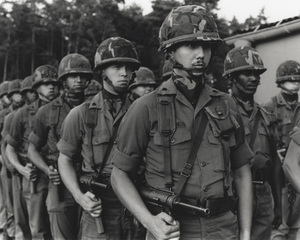
Read my full review of Frederick Wiseman's Basic Training online here at Not Coming to a Theater Near You.
http://notcoming.com/reviews/basictraining/
Wednesday, May 28, 2008
New Song! New EP! Modern Silent Cinema!
Just posted a new song called "Than Burning" on MySpace from my upcoming EP, "Gets Hiccupy." The artwork (featured here) is by Mat Hinkel of Mat Design. I think he did a pretty awesome job. Check out his page and give him some applause! Anyway, check out the song, leave some comments, let me know if you want a copy of the album.www.myspace.com/modernsilentcinema for more info.
Wednesday, May 14, 2008
Little Fugitive (1953)
Read my full review of Little Fugitive online here at The L Magazine.
http://thelmagazine.com/6/13/Film/feature3.cfm?ctype=2
Sunday, May 04, 2008
Idiots and Angels (2008) Tribeca Film Festival Preview
Read my full review of Bill Plympton's Idiots and Angels online here at The L Magazine.
http://www.thelmagazine.com/lmag_blog/blog/post__05010804.cfm
Thursday, May 01, 2008
Sita Sings the Blues (2008) Tribeca Film Festival Preview
Read my full review of Sita Sings the Blues online here at The L Magazine.
http://www.thelmagazine.com/lmag_blog/blog/post__04300806.cfm
Wednesday, April 30, 2008
Modern Silent Cinema - "For Every Mave (There's Some Poor Sap)"
New video for Modern Silent Cinema's "For Every Mave (There's Some Poor Sap)" from the new album "The Curtain Lecture." More info at www.myspace.com/modernsilentcinema
Tuesday, April 29, 2008
Katyn (2007) Tribeca Film Festival Preview
Read my full review of Andrzej Wajda's Katyn online here at The L Magazine.
http://thelmagazine.com/lmag_blog/blog/post__04280809.cfm
Monday, April 28, 2008
The Caller (2008) Tribeca Film Festival Preview
Read my full review of The Caller online here at The L Magazine.
http://thelmagazine.com/lmag_blog/blog/post__04240818.cfm
A President to Remember (2008) Tribeca Film Festival Preview
Read my full review of Robert Drew's A President to Remember online here at The L Magazine.
http://thelmagazine.com/lmag_blog/blog/post__04240817.cfm
My Winnipeg (2007) Tribeca Film Festival Preview
Read my full review of Guy Maddin's My Winnipeg online here at The L Magazine.
http://www.thelmagazine.com/lmag_blog/blog/post__04240813.cfm
Wednesday, April 23, 2008
Roman de Gare (2007)
Read my full review of Claude Lelouch's Roman de Gare online here at The L Magazine.
http://www.thelmagazine.com/6/11/Film/feature7.cfm?ctype=2
Tuesday, April 22, 2008
Toby Dammit (1968) Tribeca Film Festival Preview
Read my full review of Toby Dammit online here at The L Magazine.
http://www.thelmagazine.com/lmag_blog/blog/post__04220801.cfm
Monday, April 21, 2008
Confessionsofa Ex-Doofus-ItchyFooted Mutha (2008) Tribeca Film Festival Preview
Read my full review of Melvin van Peebles' Confessionsofa Ex-Doofus-ItchyFooted Mutha here at The L Magazine.
http://www.thelmagazine.com/lmag_blog/blog/post__04210802.cfm
Wednesday, April 16, 2008
Alberto Cavalcanti and Henry Wulschleger's "Captain Fracasse" (1929)
"What’s shocking about the conclusion of Captain Fracasse is its unbridled sobriety: coming after a fanciful series of swordfights in which no one actually dies, the stark reality of a single death is chilling...So much of Captain Fracasse can be written off as a fairy tale, which is why this execution scene is so powerful, because it is a moment when the fantastic façade of the fiction falls away to reveal a gritty reality: that actions have consequences, and while the rich are allowed to live a fairy tale existence, those less privileged do not always retain the authorship of their own destinies..."Read my full review of Alberto Cavalcanti and Henry Wulschleger's Captain Fracasse online here at Not Coming to a Theater Near You.
http://notcoming.com/reviews/captainfracasse/
Silent Ozu (Eclipse Box Set)
Read my full review of the Silent Ozu Eclipse DVD Box Set online here at The L Magazine.
http://thelmagazine.com/6/10/Film/feature5.cfm?ctype=2
Wednesday, April 09, 2008
Street Kings (2008)
Read my full review Street Kings online here at The L Magazine.
http://thelmagazine.com/6/9/Film/feature4.cfm?ctype=2
Wednesday, March 26, 2008
Water Lilies (Naissance des pieuvres) (2007)
Read my full review of Water Lilies online here at The L Magazine.
http://thelmagazine.com/6/8/Film/feature6.cfm?ctype=2
New Directors New Films 2008
More capsule reviews on this year's New Directors New Films series online here at The L Magazine.
http://thelmagazine.com/6/8/Film/feature9.cfm?ctype=2
Boarding Gate (2007)
Read my full review of Olivier Assayas' Boarding Gate online here at Not Coming To a Theater Near You.
http://notcoming.com/reviews/boardinggate/
Wednesday, March 12, 2008
Le Grand Franju
Read my full review of Anthology Film Archives' George Franju retrospective online here at The L Magazine.
http://thelmagazine.com/6/6/Film/feature2.cfm?ctype=2
Monday, March 03, 2008
Subscribe to:
Posts (Atom)