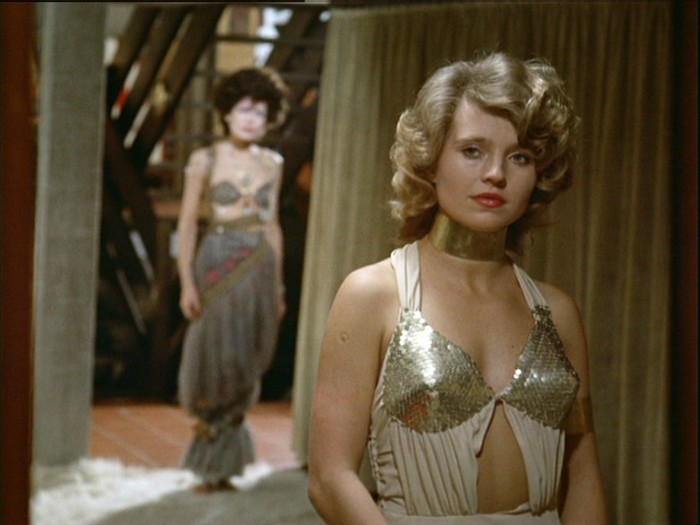
Most pleasurable of all, however, is Charles Butterworth, one of the funniest character actors in all of 1930s cinema, but also one of the least recognized. Butterworth is the chosen victim whom Lillian Harvey must try to seduce and marry. He also happens to be as asexual as a carrot chomping stamp collector can be and still be an executive in the brassiere business—in fact he most definitely lowers the prerequisite, if ever such a man existed! His ever oblivious self, confused about the sexes and charmingly inept to the point of being a genius, Butterworth’s finest moment is while being seduced by Lillian Harvey. As she sings to him, “Gather Lip Rouge While You May,” Butterworth sounds off about how a trombone is better looking than a derby and cane, and how a fiddle would come in handy during a flood. Exasperated at his unresponsiveness, Harvey kisses him and begins panting incessantly. Butterworth, in a gesture that makes the entire film worthwhile, holds out his glasses for her to fog up before cleaning them on his shirtsleeve.
Sunday, December 17, 2006
"My Weakness" (1933)
Most pleasurable of all, however, is Charles Butterworth, one of the funniest character actors in all of 1930s cinema, but also one of the least recognized. Butterworth is the chosen victim whom Lillian Harvey must try to seduce and marry. He also happens to be as asexual as a carrot chomping stamp collector can be and still be an executive in the brassiere business—in fact he most definitely lowers the prerequisite, if ever such a man existed! His ever oblivious self, confused about the sexes and charmingly inept to the point of being a genius, Butterworth’s finest moment is while being seduced by Lillian Harvey. As she sings to him, “Gather Lip Rouge While You May,” Butterworth sounds off about how a trombone is better looking than a derby and cane, and how a fiddle would come in handy during a flood. Exasperated at his unresponsiveness, Harvey kisses him and begins panting incessantly. Butterworth, in a gesture that makes the entire film worthwhile, holds out his glasses for her to fog up before cleaning them on his shirtsleeve.
Tuesday, December 12, 2006
"Chandu the Magician" (1932)
There’s a charming directness to the plot of Chandu the Magician, an earnestness that is not betrayed by any pretensions by its co-directors William Cameron Menzies and Marcel Varnel. It’s as if the plot is merely a vehicle for action and adventure spectacle and all the exoticization of Egypt as one can imagine. And in between bouts of cliché and inanity, I found myself entranced by the film’s sideshow-like sense of spectacle. There’s a real effort to “wow” audiences, and while Tony Scott may be able to afford explosions a hundred times the size of anything in Chandu, I much prefer seeing Edmund Lowe firewalk through a humble, yet effective, blaze of burning coals. It’s not the “quaintness” of older special effects that make them so charming, but that because of the limited economic means of B-movies and the primitive nature of technology (as compared to now) there seems to have been more emphasis on the actual image and the physical environment of the set. A sense of craftsmanship, if you will, that seems lost in today’s overabundance, and over exaggerated sense, of the fantastic.
Friday, October 13, 2006
"The Black Dahlia" (2006)
The rest of the film is equally flawed: Josh Friedman’s screenplay seems focused solely on the film’s ending, where in a series of unforeseeable (and unintelligible) revelations Short’s murderers are exposed (no such resolution has been reached regarding Short’s case in real life). But for the rest of the film, the script fails to offer any scenes where the characters can act beyond the details necessary to forward the plot. The film’s subplot, a love triangle formed by Hartnett, Eckhart and his wife (played by Scarlett Johansson), never so much as shows a single spark: the torrents of love are decidedly absent. Likewise, Hartnett and Eckhart go through no gradual descent when it comes to obsession: it’s not there in one scene, and it is there the next. The sudden shift from “normal” to “obsessed” is so quick that it, like so much of the movie, is hardly credible. Whenever the script falters, the actors do not pick up the slack. Their readings rarely emote any veracity or believability. One may credit Johansson the way she wears her slacks up around her bellybutton, but Hartnett wears his trousers so low and his suspenders so long that he looks more suited to a contemporary swing-revival band than to a 1940s police force.
Brian de Palma’s directing is so excessive it often achieves caricature when it is trying for realism. Critic Phillip Lopate praised Good Night, And Good Luck (2005) for avoiding “fetishization of vintage props,” something which de Palma does not understand: for all of The Black Dahlia’s painfully detailed sets and costumes, their abundance is so overwhelming is cannot help but feel artificial. People are less characters than objects: women’s lips are of a red, red attraction, and men’s fedoras are always properly tipped as though a spoof of film noir than a dramatic story set in the 1940s. A more exaggerated moment is outside of a shady motel, where a man and woman, drunk, silently mimic conversation on some stairs, only their gestures are so overly articulated that it is obvious they are not actually engaged in conversation, merely props to create atmosphere. Only in detailing the grotesque is de Palma effective: a vertiginous shot of two men falling from a banister to their death, and the re-creation of Short’s decimated and disemboweled body, are the film’s two most impressionable moments.
Those familiar with L.A. Confidential (1997), based on another Ellroy novel, will recognize many familiar tropes within The Black Dahlia: vintage Hollywood with its underbelly exposed, with corrupt and brutal cops who’d quicker punch a guy than take him downtown; dreamy-eyed starlets who have turned to smut when their big shot never came; and gangsters who run the city more than the politicians do. But where L.A. Confidential succeeds is in effectively detailing a story of moral and economic corruption, with actors whose gestures do more than mimic the past: they inhabit that particular grace of timelessness. The Black Dahlia is dead by comparison.
Friday, September 29, 2006
"I Loved a Woman" (1933)
In director Alfred E. Green’s I Loved a Woman (1933), a moralistic period piece set at the close of the 19th century, Edward G. Robinson is the young, idealistic president of a meat canning company who is seduced by the ambitious opera singer Kay Francis. Under her influence, Robinson not only cheats on his philanthropist wife (Genevieve Tobin), but also tosses his ideals to the wind and starts canning “impure” meat which, according to the headlines, results in more deaths in the Spanish-American War than bullets. A grand jury indictment forces Robinson, in his old age, to flee to Greece sans wife, mistress, and canned beef. An unusual story that is less socially conscious that it would like to admit. Any peculiarities to the story are made up for by conventional formula and predictable outcome. The script is less inspired than required—and you can say the same about the acting and directing. Two things of note in this picture, the first of which is a piece of wisdom from a board member: “There isn’t so much difference between a Rembrandt and a pork packer.” The second: Key Francis singing “Home on the Range” ala Maria Callas, whilst Robinson’s eyes float toward the heavens and his mouth towards the floor.
Thursday, September 28, 2006
Kissing Before Breakfast: All Fall Down (1962)
The script, written by William Inge (of Picnic fame) and based on James Leo Herlihy’s novel, is remarkable in how it effectively renders the story through a series of small moments, delicate and precise, that pinpoint the emotion but pull away before it fully develops. Such emphasis is placed on the characters who are so complex and contrary, and so far removed from discernable archetypes, that there is not just one storyline running throughout the film. The story isn’t about heroes or villains, but the shades of defeat that reside in everybody.
Director John Frankenheimer (who in the same year directed The Manchurian Candidate [1962] and Birdman of Alcatraz [1962]) undercooks every scene, so even at All Fall Down’s climax—when the family discovers that Berry-Berry has driven a young woman to suicide—it doesn’t quite feel like a climax, restraint is so evident. One could rightly argue that such a moment isn’t even the climax of the film, that perhaps it is a much smaller moment when Berry-Berry wakes up his brother Clinton to ask permission to date Echo (Eva Marie Saint), a 31-year-old woman staying with the family whom Clinton has an obvious crush on. Clinton suffers such an unspoken disparity, knowing well that he is fifteen years younger than the woman he loves, as well as that his brother has been jailed twice for battering women. The scene seems to beg for an ironic and melodramatic interpretation, yet actors Warren Beatty and Brandon De Wilde place so little emphasis on the woman and instead play up the brotherly bond—a theme that underscores the entire film, from the opening to the closing scene.
What it says about brothers is that the bond isn’t always reciprocated. Clinton is clearly compromised when his brother approaches him about Echo—not only has he no chance with such an older women, but Berry-Berry reminds him, “She wants me.” Berry-Berry’s gesture, as symbolic as it is, is an empty. Much like the parents’ adoration of Berry-Berry, Clinton, too, is holding on too tight to a relationship that has long dissipated.
Frankenheimer displays a great deal of subtlety with the staging. Be it how Ralph retrieves various bottles of liquor he’s hidden in the basement, or how Annabell frets over how Clinton sleeps with his feet exposed, the gestures of domestic life are presented authentically and without caricature. This must have been especially difficult with Angela Lansbury’s character—the overbearing mother—but she pulls it off without falling into parody. Especially moving is a short scene over the breakfast table where she confides in Ralph how unhappy she is now that Berry-Berry has fallen in love with another woman other than herself—the irony being, of course, that he hasn’t loved his mother for ages. Once again, the scene’s power comes not from any revelation, but from the character’s suppression of it: Annabell still cannot admit that her eldest son has moved on long ago.
Perhaps Annabell would have admitted as much to Ralph had Echo herself not come bursting into the kitchen, aglow and beaming—but then again, she might not have. Speculation isn’t so important as that Annabell wasn’t permitted the time or space for such revelations: the mother of the house rarely is. Following Echo is Berry-Berry, and as they sit down at the table, they reach over and kiss each other. Ralph, delivering one of the greatest lines in the film, says, “Kissing before breakfast. It must be love.” It’s a brand of homespun philosophy, yes, but it lacks any sense of golly-gee-ness usually associated with it. Typical of Inge’s script, the line completely understates its symbolic rebellion: kissing before breakfast is kissing before the mother’s meal, and it means putting another woman before his own mother.
All Fall Down is rife with such moments that so expressively capture the domestic sensibility, but also unpack all the emotional stock invested in it.
Saturday, September 23, 2006
Phantom Raiders (1940)
Friday, August 11, 2006
"The John Garfield Story" (2003)
The documentary, narrated by Garfield’s daughter Julie, runs a brief one hour but thoroughly covers the actor’s life from his rough beginnings in Manhattan’s Lower East Side through his tenure with the revolutionary Group Theater during the Depression, his quick rise to stardom in Hollywood, and his early death from coronary thrombosis in 1952. Many believe his death, due partly to a weak heart that afflicted the actor for many years, was brought on by the vicious anti-communist crusade that pilfered Hollywood in the 1940s and 50s: the House of Un-American Activities Committee (HUAC). Garfield was never a member of the party himself—his wife was, his collaborators were (writer/directors Robert Rossen and Abraham Polonsky), and association was more than enough to land you a place on the Blacklist. Ironically, Garfield’s own patriotism was used against him: a USO visit to Yugoslavia marked him as a Communist (that the country was not official Communist when he visited, nor that the government sent him there, impacted the accusation).
The film’s strongest points are exploring the political, cultural and artistic context that surrounded Garfield. Director/co-writer David Heeley, along with co-writer Joan Kramer, use choice clips that display not only Garfield’s talent, but are also indicative of Warner’s strangulating type-casting, and Garfield’s struggle to break through. Clips from Body and Soul (1947) and Force of Evil exhibit the progressive attitude of Garfield’s own production company, Enterprise Productions. Actor Danny Glover, interviewed for the film, discusses the importance of casting Canada Lee as co-star for Body and Soul in a time when no studios would allow a black actor the same opportunities allowed white actors.
While Glover’s commentary is enlightening, many of the interviews featured in The John Garfield Story are merely dead weight. Actors Richard Dreyfuss and Joanne Woodward are so overzealous and melodramatic with their enthusiasm for Garfield that their sincerity is compromised. Excessive gushing is the plight of many documentaries, particularly biographies, where one is apt to overpay ones respect for the subject, and often the opposite is achieved: the interviewees draw too much attention to themselves and offer little insight into the subject. So inarticulate are some of the interviewees that it is as though the mere thought of John Garfield renders them speechless—the act is overwrought and embarrassing, and not a proper act of deference deserved of such a talent as Garfield’s. However, Glover, along with Hume Cronyn (who acted alongside Garfield in The Postman Always Rings Twice) and film scholar/historian Robert Sklar, illuminate Garfield’s complex history, his intricate acting abilities, and his radiating influence that continues to resound, never diminishing.
Tuesday, August 08, 2006
"Crack Up" (1946) Needs Doctoring
Pat O’Brien stars as George Steele, an art lecturer at a Manhattan museum who is convinced that he was in a train wreck. The police, however, report that no trains have crashed in months. Undeterred, Steele is convinced that someone has covered up the train wreck in attempt to make him seem crazy. His investigation, aided by Terry Cordell (film noir queen Claire Trevor), uncovers an international art forgery scheme, and it looks to him like his museum is the one behind it. As Steele gets closer to solving the mystery, the police close in on him (convinced that he is crazy), as do the forgers, who will do anything to protect their secret and their secret cache of rare paintings.
The script, written by John Paxton, Ben Bengal and Ray Spencer and based on Fredric Brown’s story “Madman’s Holiday,” is incorrigibly convoluted, poorly plotted, and rife with situations beyond human interest. Compared to other hardboilers from the same time, it lacks the wit of The Big Sleep (1946), the intelligence of Laura (1944), and the intrigue of This Gun For Hire (1942). Other than a plot driven by improbability and coincidence, Crack-Up offers little for us to go on.
Character motivations lack all likelihood. The forgers’ impetus for targeting Steele is that he asked that the museum buy an x-ray machine so that he can see beneath the surface of paintings and uncover previous works that had been painted over. Now, the man behind the forgeries happens to be one of the higher-ups at the museum—one who could easily veto Steele’s request, or fire him for his uncouth, anti-modernist lectures (that are already unpopular with the board of directors). By setting up Steele to make him seem insane, they are only pointing fingers in their own direction.
More importantly, there is nothing compelling about the characters to keep our interest. The villains lack any sinister facets, other than the basest element of committing a crime. Likewise, our hero Steele’s only motivation seems to be proving that he is not insane—even a hackneyed love interest would spruce up this picture. As for Claire Trevor and the rest of the near-anonymous cast, their roles are so vague that they spark only the most peripheral of interest. Likewise, director Irving Reis has only the slightest presence in the movie—the direction is functional, but Reis seems to take little interest in what is happening in front of the camera.
The most interesting moment in the film—a sign of the times, no less—occurs during one of Steele’s lectures. After ostentatiously dismissing modernist art, a German-accented patron with a small, square moustache under his nose—ala Hitler, if wasn’t obvious enough—creates a stir, dismissing Steele as behind the times and old-fashioned, before being carried off by museum security. World War II had been over one year when Crack-Up was made, but anti-German sentiment still resounds quite clearly in this scene. The coupling of Nazism and modern art is fascinating, if slightly disconcerting and off-putting. Considering that the notorious Armory Show in New York occurred in 1913—an exhibition of impressionist and cubist paintings that spurred President Theodore Roosevelt to comment, “That’s not art!”—and that Salvador Dali, the painter obviously referenced by the faux-surrealist painting in the film, was working with Hitchcock in Hollywood on Spellbound in 1945, Crack-Up can only be considered conservative in its views on modern art. Retrogressive and conventional might be more apt—so much so that they perfectly describe Crack-Up as a whole.
Sunday, August 06, 2006
F.W. Murnau's The Last Laugh (1924)
Jannings is, perhaps, most famous for magnificently playing Professor Rath in Josef von Sternberg’s The Blue Angel (1930). In The Last Laugh, he similarly plays a tragic character that suffers a loss of face and respectability. Whereas in The Blue Angel it was his lust for Marlene Dietrich’s Lola that brought him down, Jannings is in no such control of his fate in The Last Laugh. The doorman’s fall is inescapable: the body grows weak and weary with age, and less useful in the competitive work world. Jannings, with his full chest and long, elegant moustache that extends from his nose all the way up the side of his face, is the embodiment of dignity and pride. Expertly, he uses his posture and facial expressions to subtly convey his deepest thoughts: it is as though his body were an expression of his soul. So convincing is his performance and appearance that Jannings’ doorman has become one of the lasting images of film history.
Written by Carl Meyer (who also penned the 1919 classic The Cabinet of Dr. Caligari), the story achieves a rare reticence that eschews convoluted plot for direct simplicity. Were the same story to have been directed by Vittorio De Sica, The Last Laugh could easily have been a Neorealist film along the lines of De Sica’s classic Umberto D (1952), which tells the story of an elderly man who’s pension isn’t enough for him to rent a room but who is too ashamed to beg for money. Both films handle the universal theme of how difficult it is to endure the loss of one’s dignity, and the unjust personal humiliation that follows.
In the case of The Last Laugh, we experience the inner anxieties of Emil Jannings. In one of the film’s most famous scenes, Jannings’ hotel seems to fall forward, crushing him as he runs away after having stolen his uniform back. The montage of his neighbors gossiping about his demotion highlights gestures—a mouth moving, a hand behind an ear—like a magnifying glass. But for all its magnifications, there are moments of equal subtlety, such as Jannings flipping up his collar after leaving work for the first time without his uniform. Framed in a long-shot, his body seems tiny against the mammoth building, and his flipped collar even more insignificant. Futility abounds, but as the wind rocks his white hair, the determination of his gesture arouses great sympathy within us.
Friday, July 21, 2006
Recent Watching: Gabrielle (2005)
The acting is high caliber all around, with every performer believable in her their role. Isabelle Huppert lives up to her legendary reputation as one of international cinema’s greatest living actors. Pascal Greggory recalls Lancaster’s performance in Visconti’s The Leopard (1963), conveying aristocratic nobility with such grace that it seems absolutely genuine. More than authentic, his airs do not seem forced, nor are they over-played, which makes his own egoism less reactionary and more convincingly realistic.
Monday, July 17, 2006
Recent Watching: Time To Leave (2005)
The film is, essentially, a series of goodbyes. Romain visits his parents, his grandmother, his sister, and his boyfriend, secretly concluding their relationship and setting things straight before he dies. Each scene ends with the same ironic touch: Romain snapping a photograph for keepsakes. His stoicism isn’t so much poignant as it is pitiable. We recognize the futile gesture in taking the photograph, and it pulls at our heart strings, begging us to feel some sort of emotion for this dying character—but does the film really have to try so hard and use (and re-use) such a gesture until it becomes a gimmick?
The best moment of the film is the scene between Romain and his grandmother. When she asks why he chose to only confide in her, he says, “Because you, like me, will be dying soon.” This touch of fatalism is sobering, because it isn’t trying to make us cry or feel nostalgic in any way. Its motivations are unadulterated by sentiment.
As the grandmother, Jeanne Moreau is fantastic. But she’s on-screen for a sparse few minutes. It’s a shame, because hers is a character that intrigues and vies for our attention, something that very few other characters manage to do. Likewise, Marie Rivière, the charming star of Eric Rohmer’s Summer (1986) and Autumn Tale (1998), appears onscreen for only one scene as Romain’s mother, and her character is given no opportunity to grow beyond the periphery of importance. This is the pervasive problem with Time to Leave: the characters are not fleshed out enough to be compelling.
RIP, Mickey...
Tuesday, July 11, 2006
Recent Watching: Pirates of the Caribbean 2: Dead Man's Chest (2006)
Like hidden treasure, the plot is buried deep within a chaotic structure filled with too many ghost ships, sea serpents, island cannibals and conniving British exporters—only once you dig up the plot, you discover how little it is worth. Squid-faced ghoul Davy Jones (Bill Nighy) is out collecting on Captain Jack Sparrow’s (Johnny Depp) soul. Meanwhile Sparrow, with Will Turner (Orlando Bloom) and Elizabeth Swann (Keira Knightley) in tow, is in search of buried treasure—a chest that contains Jones’ still beating heart. Whoever is in control of this is in control of Jones and, in turn, the seas that he still haunts. However, Sparrow isn’t the only one who wants the treasure: Will Turner has his own reasons for assisting Sparrow, as does the tyrannical East Indian Trading Company, who wants to create a monopoly on trade waters.
The film tries to maintain a sense of humor throughout, but often it feels out of place. Instead of being witty, the writers often resort to anachronisms: modern jests that are out place in the movie’s historical setting, such as Depp sprinkling paprika under his arms as though he were in a deodorant commercial, or the way in which characters slip out of their stylized dialect to say lines in a more contemporary manner. During these winks at the audience, the historical façade drops, and it seems that neither the actors nor the writers are up to the challenge of creating authentic pirate humor.
As often happens when too much attention is given to special effects, they cease to be neither special nor effective. Such is the fate of Pirates’ densely grotesque visuals, particularly Davy Jones and his salt-water zombies, whose scaly flesh writhes as though it were still living. Director Gore Verbinski and his special effects crew have painstakingly integrated live-action footage and computer animation seamlessly, but they lay it on so often that the spectacle soon loses its impact. It might be archaic of me, but with blockbusters becoming increasingly reliant on CGI, I long for another filmmaker like David Lean who is able to create epics without all the artifice and gloss. In films like The Bridge On the River Kwai (1957), Lawrence of Arabia (1962), and Doctor Zhivago (1965), Lean was able to craft visceral, exciting images using actual landscapes, and the simplicity is effective and immediate. I find the spectacle of reality more invigorating than any computer generated sea monster, which is not to say that the two are mutually exclusive and cannot share the multiplex together, but just that they don’t anymore. Blockbusters like Pirates and superhero movies dominate theaters, and I am left to look elsewhere for other varieties of cinema.
Sunday, July 09, 2006
"Born to Kill" (1947): Dead on Arrival
The opening ten minutes are the movie’s finest moments. The story begins in a boarding house owned by the elderly, beer-guzzling Mrs. Kraft (Esther Howard), one of those colorful, eccentric personalities that old Hollywood specialized in—and if only there were more characters of this sort in Born to Kill, because most of the rest of the characters are far too serious to be enjoyable. One of the tenants, Laurie Palmer (Isabel Jewell), is two-timing her boyfriend Sam Wilde (Lawrence Tierney), and when he finds out, he murders both her and her other beau. Killing the girlfriend is one of the archetypical noir plots, and Tierney is well suited to this sort of raw violence with his steadfast and unperturbed demeanor. Director Robert Wise films the scene without a hint of melodrama or exaggeration, setting a precedent that is disregarded for the rest of the picture.
The biggest problem with this story is its lack of focus: the film awkwardly switches gears and is unable to efficiently combine its multitude of conflicts. There is the issue of Sam’s psychosis, which seems to just be the result of a bad temper. Likewise, Helen’s attraction to violence is an unexplained anomaly (it is never sufficiently explained why she doesn’t call the police when she discovers the bodies). Under the surface there is sub-plot about Sam marrying for money, and how Helen is jealous of her sister’s inheritance (of which Helen received none), but like many of the undercurrents in Born to Kill, they are more underdeveloped than subtle.
Versatile director Robert Wise, who early in his career edited Orson Welles’ Citizen Kane (1941) and later went on to direct such classics as The Set-Up (1949) and West Side Story (1961), stoically commands the unsteady script, but seems unable to balance all its deficiencies. The performances are, by and large, professional and convincing (Tierney and Trevor, in particular), and occasionally brilliant (such as Mrs. Kraft, the landlady). Still, Born to Kill lacks the cohesiveness of something like This Gun for Hire (1942), where the script and story is rock steady and can provide a solid foundation for the actors to build upon. Born to Kill, with occasional flashes of excellence, lacks the foundation necessary for consistency.
Friday, July 07, 2006
The Narrow Margin (1952)
Now, for the kicker: the hit men don’t know what the woman looks like—but they know what the cop looks like, so they’ll identify her that way. Talk about un-organized crime: she’s the wife of someone in their own racket, yet they don’t know what she looks like, and are unable to find a photograph of her. They even know where she lives, because in the opening scene they arrive at her apartment to knock her off; a gunfight with her police escorts results only in the death of Brown’s partner. This impossibility wouldn’t be so onerous if it were not reiterated every few minutes, or play such a big role in the plot—and there’s even a “mistaken identity’ plot twist waiting for you at the end of the line, and it’s a real doozy.
The script, written by Earl Felton from a story by Martin Goldsmith and Jack Leonard, is a mixed bag of half-baked plot and hardboiled dialogue, the sort that has become indicative of the whole film noir genre. Lines like, “She’s a 60-cent special: cheap, flashy, and strictly poison under the gravy,” are some of the highlights of the movie. Actually, that line is pretty classic, and ranks up among some of the best hardboiled quotes.
Wednesday, July 05, 2006
Saraband (2003): Ingmar Bergman's Most Recent Masterpiece
Marriane’s impetus for visiting Johan is one of the biggest mysteries of the film—several times Johan even asks Marianne, but she is unable to come up with an answer—and, in some ways, I think it remains a mystery to her even when the film ends. Sitting at her desk (as she was in the opening shot), she tells of how she had to leave his house to get back to work as a lawyer and, while for some time they kept in touch over the telephone, eventually they lapsed out of communication once again. The circularity of the story is a fatalistic gesture to end the movie on: by not bringing closure to all of the characters in Saraband, Bergman acknowledges the lack of resolution that exists in our own lives, the loose ends we all let go of at some point.
Monday, July 03, 2006
Elegy for the Aged Gangster: "Choice of Arms" (1981)
The story’s foundation is secure, but on the whole the writing seems uneven: some characters and scenes feel extraneous, and the first half of the film doesn’t flow too well. Partly, this might be because the American cut is only 114 minutes long, 21 minutes shorter than the European cut. But while the first half of the film seems awkwardly assembled, with characters and situations lacking the necessary exposition, the second half is tight and gives new depths to the characters, Noel Durieux in particular.
Knowing that the cut I saw wasn’t complete, I want to believe that all of Choice of Arms’ faults would somehow be fixed if the 21 minutes were reinserted, but the most I can do is speculate. As it stands now, the biggest flaw is with Nicole Durieux. Catherine Deneuve has proven herself as one of the world’s strongest actors in such films as The Umbrellas of Cherbourg (1964), Repulsion (1965), and Belle de Jour (1967), but here she isn’t given a chance to lend her talent: hers is only a peripheral role. It seems that whenever Mickey shows his face around the house, Noel is forever telling Nicole to deal with the horses. Thus, all the important scenes take place between Montand and Depardieu—Deneuve is never given a chance to develop any rapport with them.
Depardieu, however, gives a magnificent performance as Mickey. He delivers his dialogue with such immediacy that pre-meditation seems impossible. It is this unpredictable quality that makes his scenes so rife with anxiety. One of the highlights of the film is a scene where Mickey gets into a scrape with a female gas station attendant. When he pulls his gun on her, she keeps right on at him, screaming and provoking him still further. In a way, her cheeky impudence is rather humorous, but after having witnessed him kill before, we can’t help but think she’s asking for it. Instead, Mickey gets back in his car and backs into the front window of the store.
Contrary to Depardieu’s wired performance, Yves Montand plays his character as stoic and aloof. There’s an unnerving calmness about Noel, even when Mickey is running around the room firing off his pistol: it is as though Noel has seen this before, and knows exactly how to handle the situation. Noel inspires in us a murderous confidence, knowing well that if he has to, he will go to the farthest measures to assure he and his wife’s safety. Which is not to imply that Noel is a trigger-happy retiree: like Michael Corleone in The Godfather: Part III (1990), Noel is happy to be out of the game and not at all anxious to get back in it, but that doesn’t mean he’s forgotten how to play if need be.
As effective a story as Choice of Arms is, it still follows the gangster movie code in many ways. Aged gangsters are always calm, cool and collected—Noel in this film, Tony le Stephanois (Jean Servais) in Jules Dassin’s Rififi (1955), Jean Gabin’s Max in Touchez Pas Au Grisbi (1954), and Marlon Brando’s Don Corleone in The Godfather (1972) amongst many others in the genre. The young gangsters are always too hotheaded, as well—Depardieu in this film, Sonny Corleone in The Godfather, and the list continues. These archetypes, clichés though they have become, are almost essential to the genre: an inherent way to communicate generational conflict, nostalgia for the past and uncertainty for the future. There is always something elegiac about these stories, the we watch the old generation, so staid, unable to pass on quietly; it is as though the world is so unstable in the hands of the young that the old cannot leave well enough alone. This is really the core emotional conflict of Choice of Arms, with Mickey being a threat to the security that Noel has established. Such a timeless theme that permeates multiple genres and such disparate films such as La Dolce Vita (1960) and Treasure of the Sierra Madre (1948), Choice of Arms may not be the most original movie ever, but Yves Montand and Gerard Depardieu really make the film worthwhile.
The Visual Artistry of Fassbinder's "The Bitter Tears of Petra von Kant (1972)
Friday, June 30, 2006
The Stunted Growth of "Superman Returns" (2006)
Picking up somewhere in the middle of the Superman series, the movie opens with Superman (Brandon Routh) returning to Earth after several years of absence. Old flame Lois Lane (Kate Boswoth) is now in love with Richard White (James Marsen) and has a child, Jason White (Tristan Lake Leabu). Lex Luther (Kevin Spacey) has a plan to form a new continent out of crystals, drown North America, and defeat Superman. The outcome—he’s not called Superman for nothing.
Plot-wise, Superman Returns is a variation on a classic theme: guy wants girl, but a bunch of other guys keep getting in the way. The faults lie not in the basic structure, but in the details specific to the film. Most importantly, the film’s logic does not hold up to scrutiny. For example, if Kryptonite cripples Superman’s powers, then why doesn’t he drown after several minutes of being underwater? Too, if Lex Luther’s island is made of Kryptonite, then why is Superman able to carry it into space—shouldn’t he be powerless? These are only two of many questions that weren’t answered sufficiently during the film’s 154 minutes.
The script, written by Michael Dougherty and Dan Harris, is simply excessive (a facet that is, after all, inherent to all areas of multi-million dollar, superhero blockbusters). In terms of dialogue, it is both unnatural and unnecessary. For example: the scene in which Superman is drowning in the ocean and is saved by Lois Lane, David and Jason, needs no words. The dialogue is merely eventful, with phrases like “He’s over there!” and “I see him” as the trio flies their seaplane over the drowning hero. All of this: not needed. It could easily be accomplished with a cut from Lois and David looking out the window to Superman in the water; or—there are many ways, none of which require dialogue. At the moment, such pointless words serve only as vessels of bad acting. Instances such as this abound in Superman Returns, and the title of an article by the great German filmmaker F.W. Murnau, written at the end of the era of silent films, comes to mind: “The Ideal Picture Needs No Titles.” Transposed to modern times, it would read, “The Ideal Pictures Needs No Dialogue.” Or—at least “less” dialogue.
The film’s look—the cinematography, the directing, and the special effects—is so stunning that it has stunted its growth. Its beauty—which would otherwise be in quotes except that the movie does possess a glossy, artificial allure akin to Botox, facelifts and such—is sterile and cold. There is not a grain of physicality in the landscape: the buildings, even when on the verge of collapse during an earthquake, are not frightening. Partly the reason they are not so imposing is that we know Superman will be by to save the day. Largely, however, the reason is that the terrain lacks any intimacy: the danger is too aestheticized to feel real. What Superman Returns lacks is the simplicity of something like Vittorio De Seta’s Bandits of Orgosolo (1961), a film whose cinematic look resounds in physical imposition and destitution. De Seta (who also photographed the film) illustrates an intimacy with Sicily’s mountainous terrain that cannot be faked, and its authenticity cannot be completely explained in words (in which case it could be easily copied). Physicality is the key, and realism plays a big role, as well: when the shepherds carry injured sheep on their backs across the mountains, the weight on their shoulders and the rocks jutting through their soles is communicated to the audience, but I still have no physical empathy with the pedestrians of Superman Returns, nor with Superman himself. Superman Returns is a fantasy, whereas Bandits of Orgosolo embraces documentary realism—but perhaps the genres are not so disparate, after all, Superman Returns director Bryan Singer could learn a lot from Vittorio De Seta.
I began this review by acknowledging that I am disagreeing with the majority audience I saw the film with. I’m perturbed by the existing dichotomy between critics and audiences, as though they are somehow separate. Critics are audience members, and the audience is a pool of critics. The separation is none. A critic may not speak for an entire audience, but neither does the critic speak for all critics. As regards Superman Returns, I was bored and unexcited. It was obvious what to expect: you could see it coming from a mile away and, after all, it is a Superman movie—of course he is going to save the day. Is there any other outcome that could be expected? Superman has too many strengths and not enough weaknesses for me to hold my breath for long enough to swallow any of it.
Tuesday, June 27, 2006
Recent Watching: Wassup Rockers (2005)
The story focuses on Jonathan and his friends, all of them from the same neighborhood in South Central Los Angeles and who love to skateboard. The first half of the movie is rather whimsical, a series of vignettes about their daily lives: waking up, lifting weights, band practice, girlfriends, and plenty of skateboarding. These are actions without consequences, and the lack of heavy-handed drama is a welcome relief. At the same time, there is an element of grit that separates Wassup Rockers from the majority of teen fluff that circulates movie theaters: these skaters fall down when attempting tricks, they don’t blow their lid wondering if a girl likes them or not, and they don’t complain about their parents pressuring them into college. Freddie Prinz, Jr. is absolutely nowhere in sight.
When the group heads off to Beverly Hills for some skating, the film’s idyllic quality turns juvenile. Their adventures turn into a series of “crash moments” with different white people (who are really just variations on the same theme): cops (both un-hip and racist), girls (who think Hispanic boys are just so cute) and guys young and old (who want to beat/shoot the skaters on sight). These racial conflicts are of the shallowest variety, and the clichés aren’t handled with enough irony for them to be funny. Too, the situations begin to lose their veracity and often degenerate into absurdity—the epitome of which involves a drunk, rich white woman who, after Kiko (Francisco Pedrasa) flees from her bubbly bathtub, falls into the bathtub herself. The sequence ends with her reaching up to grab onto the chandelier to hoist her up, only the chandelier falls into the tub and she gets electrocuted. The joke is juvenile, and rather pointless. Her death carries no significance and only clouds the narrative: so is Kiko going to be wanted for murder? This narrative strand is never followed through, and it remains only one of several such divergences that are never cleared up.
The visual element of Wassup Rockers is an improvement over its narrative. Director Larry Clark is at times intimate (such a close-up of a girl’s goosepimpled arm), while often he exercises his skill through extended skating sequences. In one such sequence the boys perform tricks on a staircase. While a couple kids land safely, most of them fall and injure themselves. The spectacle is nothing so new or innovative—you can see bad skaters on any street corner—but it is precisely this unimpressive quality that is so attractive. Whereas most skating sequences seek to impress with flashy moves and slick camera movement, Clark opts for unembellished, minimal camera movement that more closely resembles something the boys would shoot themselves.
With Wassup Rockers, Clark is attempting to re-envision Hispanic youth and skater culture from its current cinematic state. A similar (and more successful) undertaking was Justin Lin’s Better Luck Tomorrow (2002), which undertook the teenage Asian-American stereotype. Where Lin’s film succeeds is in it’s writing: the ensemble cast features distinctive characters and situations, whereas Clark’s characters are largely anonymous types. This is the ultimate irony of Wassup Rockers, that instead of realistically representing his characters, Clark has really only succeeded in not portraying them like everyone else.
Monday, June 26, 2006
Revolutionary Tapastry: Fassbinder and Fengler's The Niklashausen Journey (1970)
Thursday, June 22, 2006
"Murderers Are Among Us" (1946), the German Neorealist Masterpiece
Staudte's story (co-written with his father Fritz Staudte) concerns what awaits those who return home after the war, a problem faced by both civilians and soldiers. Murderers Are Among Us focuses on Susanne Wallner (Hildegard Knef), who is returning home to Berlin after spending several years in a concentration camp. Her apartment building is still standing, but all around her the city is in collapse.
Though much of the movie is steeped in pessimism, the film ultimately is one of hope and optimism. Retribution is not achieved by the last shot, it is only dreamt of. A concluding montage foreshadows a just and lawful Germany, and an end to the toil of everyday living. Didactic, but well meaning, the film’s earnestness is balanced out by its frank detailing of post-war depravity.
Sunday, June 18, 2006
Flashing Lights are Classic... The Big Clock
Subscribe to:
Posts (Atom)