Thursday, April 15, 2010

"The Moonlighter" (1953)


"The third pairing of Barbara Stanwyck and Fred MacMurray finds the duo in the midst of a messy, 3-D oater written by Niven Busch, whose novel The Furies had been adapted into the 1950 film also starring Stanwyck, a far superior film than this dusty reunion proves to be. Problems arise as soon as the credits finish rolling, with MacMurray reprising his hardboiled sneer for a voice-over narration that reminds of Double Indemnity but with none of the pulpy bite. He is in jail for “moonlighting,” that is, roping and stealing cattle by moonlight. While the crime wins the respect of many for the necessary lassoing skills, it angers even more. As he calmly chain-smokes on his bed, a lynch mob gathers outside his cell intent on putting a noose around his neck..."

Read my full review of The Moonlighter here at Not Coming to a Theater Near You.

Thursday, April 01, 2010

Janet Gaynor at MoMA and Film Forum


"For a decade she was one of Hollywood’s highest-paid actors, but in the seventy years since she retired from the limelight, Janet Gaynor’s legacy has been overshadowed by the work of her collaborators, her contemporaries, and especially her two best directors: F.W. Murnau and Frank Borzage, both of them visual stylists of the highest caliber. The very characteristics that endeared her to audiences—her delicate charm, and an innocence seemingly out of place with the Jazz Age that created her—may also provide clues as to why she has gone overlooked and underappreciated in the annals of film history. Her wholesome image doesn’t fit the loose girdles and looser morals of Pre-Code Hollywood that modern audiences are eating up these days. However, two current screenings—a three-day matinee run of Borzage’s Street Angel (1928) at the Museum of Modern Art (3/31-4/2) as part of their Auteurist History of Film series, and a weeklong residency of Murnau’s Sunrise (1927) in a new 35mm print at Film Forum (4/2-4/8)—remind us of Gaynor’s reticent grace, in twoand how integral her performance was to both of these masterpieces of the silent screen..."

Read my full essay on Janet Gaynor here at The L Magazine.

Monday, February 08, 2010

No Blade of Grass (1970)

Directed by Hollywood actor-turned-filmmaker Cornel Wilde, and scripted by Wilde and Sean Forestal from John Christopher’s novel, No Blade of Grass is a distopic narrative of an ecological crisis that leads to the fall of civilization. A mysterious virus is destroying grass all around the world, causing a global panic over food shortage. Crops are in short supply. Cattle are drowned in rivers when there is nothing left for them to eat. Man-made pollution has contaminated rivers and poisoned fish. Bombs are being dropped on cities in order to deplete the population to sustainable levels. In London, citizens get word of the impending extermination and overthrow the government. In the midst of chaos, one-eyed veteran John Custance and scientist Roger Burnham flee with their families to the country in search of John’s brother’s farm, a haven that promises food, shelter, and hope.

Read my full review of No Blade of Grass here at Not Coming to a Theater Near You.

Monday, February 01, 2010

Taken (2008)

While the xenophobic anxiety of Americans abroad isn’t a new subject (even Alfred Hitchcock approached the topic in his 1956 remake of The Man Who Knew Too Much), it’s difficult to watch certain scenes in Taken without thinking of contemporary parallels. It is moments like these in which the politics of action heroism reveal their hidden complexity. With the line between “good guy” and “bad guy” blurred, we allow the action hero to cross certain moral boundaries that would otherwise be prohibited.

Read my full review of Taken here at Not Coming to a Theater Near You.

Wednesday, December 09, 2009

James Whale at Film Forum

A special case needs to be made for James Whale. Though not exactly forgotten—a pair of genre-defining horror masterpieces (Frankenstein and The Invisible Man) and two satires (The Old Dark House and Bride of Frankenstein) have kept him in circulation—he is certainly misremembered. Instead of the easily definable horror-auteur that history would prefer, Whale was an artist of many mediums (theater, cinema, painting, drawing), genres and sensibilities, but the unavailability of the majority of his body of work, either in theatrical revivals or on home video, has prevented audiences from fully understanding him. Encompassing the full range of Whale's style, from gothic to modern and screwball to macabre, Film Forum's 16-film retrospective will do much to restore the director's lopsided legacy.

Read my full essay on James Whale here at The L Magazine.

Wednesday, November 18, 2009

M. Hulot's Holiday (1953)

Simply put, Jacques Tati's M. Hulot's Holiday (1953) is one of the most delightful cinematic experiences I have ever encountered, and it is now showing at Film Forum in a restored 35mm print. Like the film's infectious, amiable theme song—whose breezy melody fluidly passes from saxophone to guitar to vibes to piano without interrupting the phrasing—Tati, his camera and his on-screen alter-ego Hulot flit amongst the beachfront tourists like a fellow vacationer. With his perennial floppy hat and a pipe protruding from his lips, Hulot putters into town in his rustbucket and proceeds to join his compatriots in an attempt to enjoy some rest and relaxation under the sun.

Read my full review of M. Hulot's Holiday here at The L Magazine.

Friday, November 13, 2009

Migrating Forms' Half-Inch Half-Life: "Tracy the Outlaw" (1928)

This past summer, I was invited to participate in Migrating Forms' Half-Inch Half-Life, self-described as "a semi-intimate, public viewing room showcasing a 43-hour marathon of selections from the personal VHS archives of artists, critics, curators, scholars and other devotees to the medium, on a large, media-appropriate television set." My contribution was a rare VHS tape of Tracy the Outlaw. Below are my program notes which accompanied the exhibition.
Tracy the Outlaw is a silent Western from 1928. An independent production by Foto Art Productions, it doesn’t look like most movies we remember from that same year – it neither has the artistic touches of Victor Sjostrom’s The Wind, the stylizations of The Docks of New York, or any of the technical or narrative proficiency that was the Hollywood standard by that time. And that’s exactly why Tracy the Outlaw is important: Hollywood isn’t everything, and outside of it were independent producers and distributors, making raw, unkempt, flawed, and wonderful movies.

But lacking stars, polish, prestige, and any sort of critical status, Tracy the Outlaw isn’t likely to make any appearances at revival houses, or even in history books. It’s a miracle that it was even brought to VHS (and in a pretty decent print) by Videobrary, one of many companies during the 1980s-1990s who specialized in overlooked niches of early cinema, including B-Westerns. There was also Sinister Cinema, Hollywood’s Attic, Nostalgia Family, and Grapevine, to name just a few. (The last two are still around, releasing material on DVD.) There was something special about those small VHS distributors – some sort of magic that seems to be lost in the age of internet. When I was 12, I ordered a video from Facets in Chicago, and suddenly I began receiving black-and-white photocopied catalogs and typewritten lists of old movies on VHS. They were coming from small towns in Maine like Thomaston. I have no clue how I got on this mailing list circuit, but I was flooded with titles I had never heard about. Sadly, I never kept them, as I’d love to see all the great movies I passed up on because of lack of access/information.

But now many of those companies are gone. I no longer receive those wonderful lists. Once in a while, I come across a trove of old Grapevine releases, or some other company. That’s how I found Tracy the Outlaw – three dollars, stuck on a shelf between such other potential gems as Ghost Patrol (a sci-fi Western from 1936) and Border Romance (a musical Western about fugitives from 1929) (both films were released by Sinister Cinema, by the way). The audience for these films was probably small when they came out, and it’s only dwindled in the passing decades. No major home video distributor would ever take these on – the chance of making a profit would be slim. That’s why Grapevine, Videobrary, and all those other companies were – and continue to be – so vital.

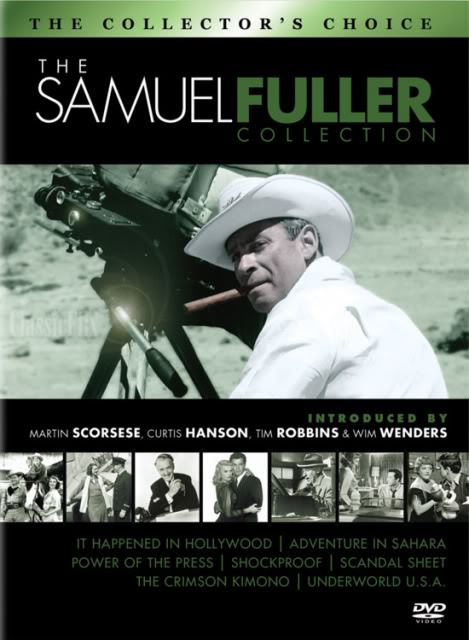
The Samuel Fuller Collection

Samuel Fuller's movies are equal parts street corner and gutter, a combination of two-inch-headline journalistic hullabaloo and pulp poetics. Andrew Sarris called him "an authentic American primitive," while Dana Polan described him as "the opposite of graceful; his style seems to suggest that in a world where grace provides little redemption, its utilization would be a kind of lie." This one-of-a-kind, immediately recognizable persona is on full display in Sony's seven disc box set The Samuel Fuller Collection, which pulls together seven hard-to-find films that the cigar-chomping filmmaker was involved in, none of which were previously available on DVD...

Read my full review of The Samuel Fuller Collection here at The L Magazine.

Friday, November 06, 2009

Death In the Garden (1956)

A drifter, a prostitute, a priest, a miner, and his deaf-mute daughter walk into a South American jungle. It sounds like the start of a joke, but it happens to be the set-up for Luis Buñuel's anti-colonialist adventure-satire Death in the Garden (1956), just out on DVD from Microcinema International. When Chark (Georges Marchal, of Buñuel's Belle de Jour and The Milky Way) stumbles through a town square past a firing squad, he finds himself in the midst of a revolution.

Read my full review of Death in the Garden here at The L Magazine.

Wednesday, October 28, 2009

Interview with Vagabond, director of "Machetero"

Machetero, which screens this Thursday, Oct. 29 at the New York International Independent Film and Video Festival, is a film whose guerrilla production matches both the film's visual aesthetic and its narrative. It tells two stories concurrently: one in which imprisoned revolutionary Pedro Taino (Not4Prophet) is interviewed by a journalist (Jarmush regular Isaach De Bankolé, pictured), and the other about the political awakening of a young man (Kelvin Fernandez) on the streets of New York. As directed and written by Vagabond, Machetero's radical politics extend to the film's non-linear narrative, and its use of on-screen titles, foregrounding the revolutionary literature passed amongst the characters, as well as lyrics from the soundtrack by the NYC-based band Ricanstruction (of which Not4Prophet is the lead singer). Recently, I spoke to Vagabond about the film's intersections of art and politics.

Could you say a little about the word "Machetero," where it comes from, and why you chose it as your title?
The direct Spanish translation of the word "machetero" is someone who works with a machete. However, there is a cultural definition to the word that is unique to Puerto Rico. The "Macheteros" were sugarcane field workers who fought against Spanish colonial rule, and when the US invaded Puerto Rico in 1898 during the Spanish-American war, they fought against the Americans as well. In the late 1960s, Puerto Rican independence leader Filiberto Ojeda Rios started a clandestine armed organization called "Ejercito Popular Boricua" ("Popular Puerto Rican Army"). Puerto Ricans throughout the Diaspora called them "Macheteros".

The title of the film comes from a saying the Macheteros had, "¡Todo Boricua Machetero!" ("All Puerto Ricans Are Machetero!") which connected Puerto Ricans to their revolutionary past. When I thought more about that saying, it seemed to me that what the EPB was trying to do was to create this idea of the Machetero as warrior and protector of the Puerto Rican people in much the same way that the Samurai is in Japan.

Read the full interview here at The L Magazine.

Thursday, October 22, 2009

Black Rain (1989)

It seems grossly obvious to lump adjectives like "haunting" and "harrowing" onto Imamura's narrative about Hiroshima survivors dealing with bodily and psychological strain in the aftermath, particularly when the film is most affecting when it is least direct. The opening sequence of the bomb dropping is undeniably powerful, but the simple shot of black rain landing on a young girl's face is even more so. Restraining even reticence, Imamura cuts the shot short, limiting the possibility of catharsis through the symbolic image. What is shown on the surface is never so important as what is not, Imamura suggests throughout the movie, and that the most devastating wounds are those beyond visibility...

Read my full review of Black Rain here at The L Magazine.

Monday, October 19, 2009

Daniel and Abraham (2009)

Typically, when we speak of film as a collaborative art form we mean that the production process involves so many people (be it dozens or hundreds) that, at some level, assigning individual credit is insufficient and misleading. No one element in a completed film exists on its own: always it is interacting with other sights, sounds, and processes. Daniel and Abraham takes this notion of collaboration to an ambitious, minimalist extreme. The entire crew of this feature film consists of three people: director Ryan Eslinger, and the film’s sole actors David Williams and Gary Lamadore. All three shared writing duties, as well as all the other behind-the-scenes responsibilities. However, this stripped-down, DIY production style makes for more than just an interesting back-story to relate in interviews and post-screening Q&As. Instead, it’s an ironic counterpoint to the film’s narrative of deep-seated mistrust and human disconnection. The intense participation and investment of the makers comes through loud and clear on-screen.

Read my full review of Daniel and Abraham here at Hammer to Nail.

Friday, October 16, 2009

Interview with Charles Silver

Last month, the Museum of Modern Art embarked on one of its most ambitious and exciting film series in recent years, An Auteurist History of Film. Curated by Charles Silver, the two-year-plus series takes as its organizational principle the Auteur Theory (which posits the director as the primary author of a film), and aims to cover pre-cinema (such as “magic lanterns” and other early visual and photographic technologies) all the way to the present day. The breadth of its programming is highly promising, with opportunities to revisit and reevaluate more canonical works, as well the chance to see long-neglected and often non-commercially available films (such as Benjamin Christensen’s The Mysterious X from 1914). Recently, I had the pleasure of speaking with Charles Silver about the guiding principles of his latest series, as well changes in the New York City film scene over the past several decades.

The L Magazine: What was the motivation for doing this series now?
Charles Silver: It seems like as good a time as any. I’ve been at The Museum of Modern Art for almost 39 years now, and I’ve been going to the movies for close to 60 (or maybe more) and I thought it would be good to go back and survey our film archive (which begins in the 1890s and goes up to the present day) and try to define the Auteur theory through the collection. There have been, in the past, other film history cycles at the museum, so it is not totally novel, but I thought that approaching it from the Auteur Theory would make the most coherent expression of film history, at least up until the point that the studios broke down, and we had films really by committees and computers. It is hard to argue that a lot of current movies could be the expression of individual artists although I think there are many exceptions.

Read my full interview with Charles Silver at The L Magazine.

Mother (2009)

Bong Joon-ho’s films have been characterized by bizarre humor (Barking Dogs Don’t Bite) tinged with dark political commentary (Memories of Murder) in the guise of cross-genre experiments (The Host). Bong’s fourth feature, Mother, continues this trend, and while its examination of (in)justice bears certainly similarities to his second movie, Memories of Murder, it is by no means a repetition. As his latest film shows, Bong able to hit all the notes that audiences have come to expect in his movies while still developing his narrative techniques and visual aesthetic.

Read my full review of Mother here at Not Coming to a Theater Near You.

Wednesday, October 14, 2009

Marlene (1984)

Marlene is not your typical non-fiction celebrity portrait—and really, how could it be when your "star" refuses to appear on-camera? Dietrich herself admits that "Documentary is a thing that connects the voices that are talking," so what happens when that seemingly crucial connection is severed? Schell uses this disjunction between sound and image to explore the star persona of "Diectrich" to see what, if anything, it reveals of the "real" Dietrich that she so desperately tried to hide from the camera.

Read my full review of Marlene here at The L Magazine.

Wednesday, October 07, 2009

Crossroads of Youth (1934)

Viewing Crossroads of Youth in its intended presentation format, the way Korean audiences would have when it originally premiered in 1934, was like encountering an entirely different art form. All that I thought I knew about how to watch silent cinema—forgiving improper frame rates that make the actors’ movement cartoonish, or understanding that live accompaniment may have differed not only from theater to theater, but from performance to performance at the same venue—was not sufficient to prepare me for how to take in the wide array of sights and sounds—yes, sounds—of this special New York Film Festival screening.

Read my full review of Crossroads of Youth here at Not Coming to a Theater Near You.

Munyurangabo (2007)

I first saw Lee Isaac Chung's Munyurangabo (2007) at New Directors/New Films in 2008, and was struck both by the film's reticent morality as well as by Chung's subtle yet perceptive direction. Considering its political context (the cultural memory of genocide in Rwanda), the film could have easily flown off in the direction of heavy-handed earnestness. Instead, Chung managed to reign in "the message" and focus more on a narrative that is hauntingly empathetic in its exploration of cultural clashes, without giving in to easy answers or reductive symbolism. For the work of first-time filmmaker working with non-professional actors and improvising scenes based on a brief scenario in a language he doesn't speak, it's extremely impressive that Munyurangabo is as nuanced and discerning as it is, in both its political content and cinematic sensibility.

Read my full review of Munyurangabo here at The L Magazine.

Tuesday, October 06, 2009

The Fall of the House of Usher (1928)

Literary adaptations for the silent screen pose certain difficulties. Limited to intertitles and images, how then to cinematically “translate” text-based literature onto the screen without turning the movie into an illustrated manuscript? For an author like Edgar Allan Poe, there is the issue of not only plot, but also the cadence of his language, which gives so much flavor and atmosphere to the stories. For his film of The Fall of the House of Usher, Jean Epstein took a bold approach, not so much following Poe’s directly as moving parallel to it, using cinema’s distinct capabilities to create something analogous to what Poe was doing with language. As Jean-André Fieschi wrote of Epstein, “he is less interested in the expressive possibilities of visual writing than in a certain degree of autonomy pertaining to it.”

Read my full review of The Fall of the House of Usher here at Not Coming to a Theater Near You.

Saturday, October 03, 2009

Wild Grass (2009)

The ever-playful Resnais continually reinvents his movie throughout the story’s progression (quite literally up until the last frame, with a truly bizarre final shot!) with red herrings, plot reversals, false endings, and other sudden tonal shifts. At age 87, and with over sixty years of directing behind him, Resnais is still one step ahead of the audience, and his filmmaking remains as vigorous and youthful as ever.

Read my full review of Wild Grass here at Not Coming to a Theater Near You.

Thursday, October 01, 2009

Police, Adjective (2009)

One of the great ironies of the detective-centered plot is that, more often than not, it is the observer who is being observed. And not just by other characters in the narrative, but primarily by us, whether we are watching a movie or television show, or reading a pulp yarn. From the Continental Op to Veronica Mars, it has been the detectives themselves more than their cases that have commanded our attention. It is this attraction that is under scrutiny in Corneliu Porumboiu’s Police, Adjective, a movie that bends, as much as it obeys, the genre’s conventions.

Read my full review of Police, Adjective here at Not Coming to a Theater Near You.