Wednesday, August 27, 2008

High Green Wall (1954)


"Like so many of Nicholas Ray’s protagonists, Henty (Joseph Cotten) is on the run, in search of an ideal space where he can be free of society’s restrictions and expectations. And, like those in Ray’s other films, Henty eventually discovers that no such space exists, and that one must create such an environment themselves. Humphrey Bogart [in In a Lonely Place] and James Dean [in Rebel Without a Cause] each pushed social boundaries past the breaking point; Henty, on the other hand, never pushed anything, but instead kept wandering until, finally, there was no place left to go. So he stopped—and the final note of capitulation is one of the most desolate endings in all of Ray’s work..."

Read my full review of Nicholas Ray's High Green Wall online here at Not Coming to a Theater Near You.

http://notcoming.com/reviews/highgreenwall/

Monday, August 25, 2008

More on "La France" (2007)


"Whereas the traditional musical (Fred Astaire, for example, or any of the other Hollywood archetypes) emphasizes the body of the performer—requiring actors lip-synch so they can concentrate on choreographed movement—La France shifts the focus to the performance itself: stationary, the actors’ focus is not on mimicking a prerecorded song, but in the organic creation of one on-screen."

Read my full review of Serge Bozon's La France here at Reverse Shot.

Tuesday, August 19, 2008

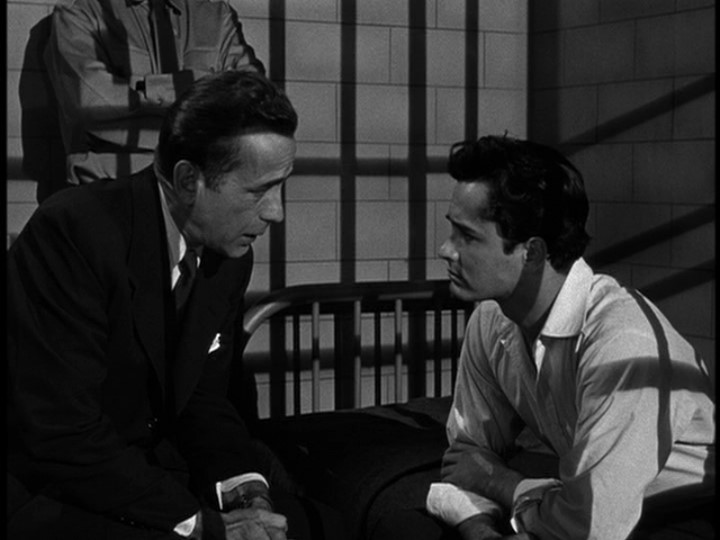
Knock on Any Door (1949)


'Simply put, this is the nightmare of Nicholas Ray: “When life is based on one law: fear. An island of outrage: work and sleep and eat by command; pray by command… Look over the gray fence at the far away hill, look through the bars at the free night, without hope except someday get out, get even.” In Knock on Any Door, lawyer Andrew Morton (Humphrey Bogart), a former child of skid row who was able to overcome circumstance, may be speaking about the experience of juvenile incarceration (which he knows intimately from first-hand experience), but he could very well be enunciating the subjectivity of any of Ray’s protagonists. Fear not only the demons from without, but also from within – as much the capacity for being wronged as for committing wrong – that one may “get out” and successfully “get even"...'

Read my full review of Nicholas Ray's Knock on Any Door online here at Not Coming to a Theater Near You.

http://notcoming.com/reviews/knockonanydoor/

Monday, August 18, 2008

A Woman's Secret (1949)


"A Woman’s Secret (1949), Nicholas Ray’s second film, is arguably one of the most maligned and ignored films of his career. While the criticisms seem well deserved (it is clearly one of the director’s weaker movies), the lack of any thorough, sustained criticism on the film is certainly not so deserved. Even enthusiasts of the director’s career, it seems, either circumvent the topic or write it off a failed contract-job in which Ray had little interest—thus justifying their own dismissive evaluations... What stands out in the finished film—and what aligns it with Ray’s characteristic interest in both marginalized, countercultural characters and tension-wrought relationships—is the interaction between Gloria Grahame and Maureen O’Hara. What could have been played as a strict ingénue/director binary becomes a complex power struggle, at once male/female and mother/daughter, which overflows with sexual and adolescent undercurrents..."

Read my full essay on Nicholas Ray's A Woman's Secret online here at Not Coming to a Theater Near You.

http://www.notcoming.com/reviews/awomanssecret/

Monday, August 11, 2008

The Devil Inside: Filming Jim Thompson’s first-person pulp psychosis


Mark Ash and I co-wrote an essay on the cinematic adaptations of Jim Thompson recently for Moving Image Source. It is called "The Devil Inside: Filming Jim Thompson’s first-person pulp psychosis."

"In Jim Thompson’s America, men are born killers—they don’t have killing thrust upon them. The major forebears of Thompson’s pulp fiction, written primarily for the paperback market beginning in the 1940s and continuing until the early 1970s, were the small-town narratives of James M. Cain. But in Cain, everymen are turned into murderers by circumstance, for the sake of money or a girl; Thompson’s innovation was to turn circumstance into a psychological state. It’s not the lure of temptation or the crush of necessity that drives his protagonists to crime, but the perception of its requirement, for self-preservation or out of moral obligation."

Read the full essay here at Moving Image Soruce.

http://www.movingimagesource.us/articles/the-devil-inside-20080811

Friday, August 08, 2008

Elegy (2008)


"Evoking the deep, rich hues of Velazquez and Goya, director Isabel Coixet brings a baroque elegance to her compositions — coming close to conveying Roth’s own virtuoso display of language, if inevitably falling short. Coixet and screenwriter Nicholas Mayer thankfully make no significant compromises with Roth’s novella: no Terms of Endearment here, Elegy finds no sentimental closure to Kepesh’s mortality or his lingering insatiability for a physical existence."

Read my full review of Elegy here at The L Magazine.

http://thelmagazine.com/6/22/Film/feature4.cfm?ctype=2

Monday, July 28, 2008

"Max Linder and the Death of Bourgeois Respectability"


“Laughter is a new kind of weapon. A type of light gun, very effective in cases where there is no need to employ heavy tanks of social wrath,” wrote Sergei Eisenstein in 1937, describing his ideal vision of Socialist Comedy as a new genre. Just over thirty years earlier in France, as cinema was nearing the decade mark and Georges Méliès was exploring the fantastic and the macabre as had never seen before, Max Linder was aiming his revolutionary camera-as-gun at the bourgeoisie and their sacred rituals. He tore down pretension and ridiculed respectability. The very symbols of social refinement – clothing, manners, marriage, propriety – are the targets for his humor. The greatest victim, however, is always Linder himself...

Read my full essay on Max Linder online here at Not Coming to a Theater Near You.

http://notcoming.com/features/maxlinder/

Friday, July 25, 2008

Satantango (1994)

"Surpassing the high-standards set by the Criterion Collection and Masters of Cinema, Facets’ long-awaited release of Bela Tarr’s Satantango (1994) is a shoe-in for one of the best DVDs of the year. Meticulously restored, the film’s deep, oceanic black-and-white images retain all of Tarr’s signature hypnotic beauty...Unfolding over the film’s seven and a half trance-inducing hours, Tarr’s extended long takes (many lasting several minutes) invoke an almost out-of-body experience in the viewer, as real-time blends with Tarr-time and the minutes on-screen encapsulate something both intimately specific and profoundly universal. Time has rarely been used more wisely in cinema..."

Ready my full review of Satantango online here at The L Magazine.


http://www.thelmagazine.com/lmag_blog/blog/post__07240806.cfm

Back to Normandy (Retour en Normandie) (2007)

"Embedded in these modest memories is the crux of Philibert’s film: the idea that cinema can act as a personal, or even communal, history, and that the images don’t just tell the narrative as written in the script, but also act as a visual record of the real people involved in the production. It’s an example of narrative cinema functioning as a home movie. Philibert waits until the final moment of the film to reveal his true motivation for making the film: his own father, recently deceased, had a small role in the film that was eventually cut."

Read my full review of Nicolas Philibert's Back to Normandy (Retour en Normandie) online here at Not Coming to a Theater Near You.

http://notcoming.com/reviews/backtonormandy/

Thursday, July 24, 2008

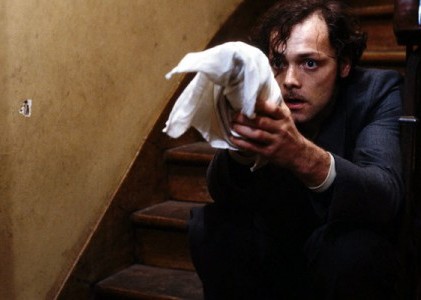
I, Pierre Rivière, Having Slaughtered My Mother, My Sister, and My Brother… (1976) and Back to Normandy (2007)

"Fusing anthropology and noir with a neo-realist aesthetic, René Allio’s cinematic adaptation of Michel Foucault’s I, Pierre Rivière, Having Slaughtered My Mother, My Sister, and My Brother… (1976) is as bleak and severe as its title suggests. Using local farmers and their families as actors, Allio shot the film on location, not far from the small French village where the original murder occurred in 1835... Blisteringly realistic and disturbingly acute in its exploration of familial betrayal and social ethics, the film is rarely screened and not available on video in the US. Its obscurity unjust, I, Pierre… is deserving of wider attention and re-evaluation..."

"Playing alongside I, Pierre… is Back to Normandy (2007), the new documentary by Nicolas Philibert (To Be and To Have [2002]), who was Allio’s assistant on the former film. An imaginative and innovative departure from the typical 'behind the scenes' documentary, the film isn’t merely interested in chronicling the production history of I, Pierre… but instead is captivated by the real-life personalities of the villagers who acted in the film..."

Read my full review of I, Pierre Rivière, Having Slaughtered My Mother, My Sister, and My Brother… and Back to Normandy online here at The L Magazine.

http://thelmagazine.com/lmag_blog/blog/post__07230806.cfm

Friday, July 18, 2008

Mary Ellen Bute Retrospective at Anthology Film Archives

Using popular pieces of classical music as a foundation, such as Copland’s “Hoedown” and Saint-Saëns’ “Danse Macabre,” Mary Ellen Bute and her alternating cast of collaborators (among them Norman McLaren and her husband Ted Nemeth) created an unprecedented cinematic sensation: an animated synthesis of music and abstracted impulses that pulsed and gyrated in organic ecstasy. There is such unbridled joy in her films — as though the images themselves were an elastic and ever-expanding dance — as well as an irresistible sense of humor...

Read my full essay on Mary Ellen Bute online here at The L Magazine.

http://www.thelmagazine.com/lmag_blog/blog/post__07170809.cfm

Wednesday, July 09, 2008

La France (2007)

"France has given us two of the most charmingly original films of the year so far, both of them fond, modernist interpretations of the musical genre. First was Christophe Honore’s tale of young love in the city, Love Songs, and now Serge Bozon’s WWI battlefield fable, La France."

Read my full review of La France here at The L Magazine.

http://thelmagazine.com/6/19/Film/feature4.cfm?ctype=2

Thursday, July 03, 2008

New Video! "My Mouth" by Modern Silent Cinema


Here's a new video for the song "My Mouth" by Modern Silent Cinema, from the album "Gets Hiccupy." Email if you want a copy of the album.

www.myspace.com/modernsilentcinema

Thursday, June 12, 2008

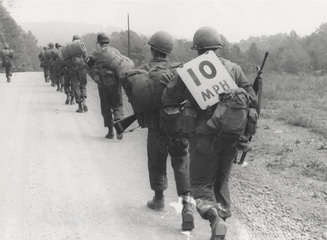
Frederick Wiseman's "Manoeuvre" (1979)

"If Basic Training documented an overly confident army (as characterized by one officer’s declaration, 'The United States Army has never lost a war,'), then Manoeuvre is documenting the aftermath of such brashness. Under Wiseman’s characteristic impartial direction, uncertainty and insecurity mar the illusion of an institution that typically presents itself as invulnerable, thus offering an unusually nuanced portrait of an institution all too often stereotyped as one-dimensional."

Read my full review of Frederick Wiseman's Manoeuvre online here at Not Coming to a Theater Near You.

http://notcoming.com/reviews/manoeuvre/

Wednesday, June 11, 2008

Monsieur Verdoux (1947)

"A murderous attack on bourgeois conventionality, Charlie Chaplin’s Monsieur Verdoux represents the apex of the artist’s subversive humor. Chaplin’s films have always been anti-establishment, favoring marginal characters cast aside by society and left to fend for themselves."

Read my full review of Monsieur Verdoux here at The L Magazine.

http://thelmagazine.com/6/16/Film/feature4.cfm?ctype=2

Sunday, June 08, 2008

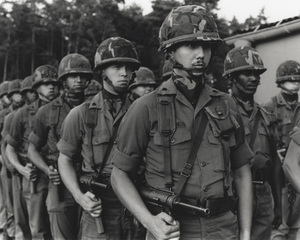
Frederick Wiseman's "Basic Training" (1971)

"Even without the presence of a subjective voice-over narration, it’s difficult not to read the repeated shots of hand-to-hand combat with stuffed dummies in light of the ultimate goal of training: to fight in Vietnam. Wiseman’s insight isn’t at all an irony, but rather an incongruity between the controlled circumstances during training and the actual circumstances in which they will have to utilize their lessons."

Read my full review of Frederick Wiseman's Basic Training online here at Not Coming to a Theater Near You.

http://notcoming.com/reviews/basictraining/

Wednesday, May 28, 2008

New Song! New EP! Modern Silent Cinema!

Just posted a new song called "Than Burning" on MySpace from my upcoming EP, "Gets Hiccupy." The artwork (featured here) is by Mat Hinkel of Mat Design. I think he did a pretty awesome job. Check out his page and give him some applause! Anyway, check out the song, leave some comments, let me know if you want a copy of the album.

www.myspace.com/modernsilentcinema for more info.

Wednesday, May 14, 2008

Little Fugitive (1953)

"Little Fugitive delicately blends documentary realism and candid-camera style photography with a sparse, unobtrusive narrative, the combination of which recalls equally the light touch of early cinema actualities and 1940s Italian Neorealism. Engel’s background with the Photo League, as well as Orkin’s newsreel training during WWII, give the film’s portrait of New York City, and particularly Coney Island, a staggering, nostalgia-inducing authenticity."

Read my full review of Little Fugitive online here at The L Magazine.

http://thelmagazine.com/6/13/Film/feature3.cfm?ctype=2

Sunday, May 04, 2008

Idiots and Angels (2008) Tribeca Film Festival Preview

"The lovingly sullen atmosphere of the film never falls into misanthropy, partially because Plympton (and his audiences) find too much joy in laughing at the characters’ ornery behavior and the bizarre way the situations resolve themselves. The detour may be long and nightmarish, but at the end of Plympton’s journey there is redemption and hope, however—as Penelope Huston said of the endings of Preston Sturges’ films—always with a Cheshire cat’s grin."

Read my full review of Bill Plympton's Idiots and Angels online here at The L Magazine.

http://www.thelmagazine.com/lmag_blog/blog/post__05010804.cfm

Thursday, May 01, 2008

Sita Sings the Blues (2008) Tribeca Film Festival Preview

As if to emphasize Sita’s relevancy for modern viewers, Paley interweaves into the narrative a contemporary story of a young woman whose boyfriend moves to India for work (just as Rama left to go hunting). Only instead of waiting behind, this woman packs her bags and moves to India of her own will. The ensuing domestic discontent becomes a counter-point to the original story, and offers a potential answer to the question of, “What does an ancient story like Sita’s have to do with today’s world?” Paley’s charming response confirms that the past can have quite a bit to say about the present.

Read my full review of Sita Sings the Blues online here at The L Magazine.

http://www.thelmagazine.com/lmag_blog/blog/post__04300806.cfm