Friday, June 30, 2006

The Stunted Growth of "Superman Returns" (2006)

Superman Returns (2006) is effrontery to everything quality cinema stands for. It satisfies all of Hollywood’s blockbuster criteria to a T, and it had the audience in my screening cheering. But my honest, gut reaction was boredom: I engaged in none of their thrills, none of their excitement and shared none of their enthusiasm. I am speaking against the crowd not as a curmudgeon-before-his-time, but as an audience member who has seen almost all of what Superman Returns has to offer before, and pessimistically wishes never to see it again.

Picking up somewhere in the middle of the Superman series, the movie opens with Superman (Brandon Routh) returning to Earth after several years of absence. Old flame Lois Lane (Kate Boswoth) is now in love with Richard White (James Marsen) and has a child, Jason White (Tristan Lake Leabu). Lex Luther (Kevin Spacey) has a plan to form a new continent out of crystals, drown North America, and defeat Superman. The outcome—he’s not called Superman for nothing.

Plot-wise, Superman Returns is a variation on a classic theme: guy wants girl, but a bunch of other guys keep getting in the way. The faults lie not in the basic structure, but in the details specific to the film. Most importantly, the film’s logic does not hold up to scrutiny. For example, if Kryptonite cripples Superman’s powers, then why doesn’t he drown after several minutes of being underwater? Too, if Lex Luther’s island is made of Kryptonite, then why is Superman able to carry it into space—shouldn’t he be powerless? These are only two of many questions that weren’t answered sufficiently during the film’s 154 minutes.

The script, written by Michael Dougherty and Dan Harris, is simply excessive (a facet that is, after all, inherent to all areas of multi-million dollar, superhero blockbusters). In terms of dialogue, it is both unnatural and unnecessary. For example: the scene in which Superman is drowning in the ocean and is saved by Lois Lane, David and Jason, needs no words. The dialogue is merely eventful, with phrases like “He’s over there!” and “I see him” as the trio flies their seaplane over the drowning hero. All of this: not needed. It could easily be accomplished with a cut from Lois and David looking out the window to Superman in the water; or—there are many ways, none of which require dialogue. At the moment, such pointless words serve only as vessels of bad acting. Instances such as this abound in Superman Returns, and the title of an article by the great German filmmaker F.W. Murnau, written at the end of the era of silent films, comes to mind: “The Ideal Picture Needs No Titles.” Transposed to modern times, it would read, “The Ideal Pictures Needs No Dialogue.” Or—at least “less” dialogue.

The film’s look—the cinematography, the directing, and the special effects—is so stunning that it has stunted its growth. Its beauty—which would otherwise be in quotes except that the movie does possess a glossy, artificial allure akin to Botox, facelifts and such—is sterile and cold. There is not a grain of physicality in the landscape: the buildings, even when on the verge of collapse during an earthquake, are not frightening. Partly the reason they are not so imposing is that we know Superman will be by to save the day. Largely, however, the reason is that the terrain lacks any intimacy: the danger is too aestheticized to feel real. What Superman Returns lacks is the simplicity of something like Vittorio De Seta’s Bandits of Orgosolo (1961), a film whose cinematic look resounds in physical imposition and destitution. De Seta (who also photographed the film) illustrates an intimacy with Sicily’s mountainous terrain that cannot be faked, and its authenticity cannot be completely explained in words (in which case it could be easily copied). Physicality is the key, and realism plays a big role, as well: when the shepherds carry injured sheep on their backs across the mountains, the weight on their shoulders and the rocks jutting through their soles is communicated to the audience, but I still have no physical empathy with the pedestrians of Superman Returns, nor with Superman himself. Superman Returns is a fantasy, whereas Bandits of Orgosolo embraces documentary realism—but perhaps the genres are not so disparate, after all, Superman Returns director Bryan Singer could learn a lot from Vittorio De Seta.

I began this review by acknowledging that I am disagreeing with the majority audience I saw the film with. I’m perturbed by the existing dichotomy between critics and audiences, as though they are somehow separate. Critics are audience members, and the audience is a pool of critics. The separation is none. A critic may not speak for an entire audience, but neither does the critic speak for all critics. As regards Superman Returns, I was bored and unexcited. It was obvious what to expect: you could see it coming from a mile away and, after all, it is a Superman movie—of course he is going to save the day. Is there any other outcome that could be expected? Superman has too many strengths and not enough weaknesses for me to hold my breath for long enough to swallow any of it.

Tuesday, June 27, 2006

Recent Watching: Wassup Rockers (2005)

Larry Clark’s latest film, Wassup Rockers (2005), opens with a promising split-screen sequence: two shots of Jonathan (Jonathan Velasquez), a Hispanic teenager, taken from different angels, as he introduces himself. The left screen, like an attentive listener, is focused on his face while Jonathan talks directly to the camera. The right screen is taken from an askew angle, and the camera does not make eye contact with Jonathan. This shot is taken from a little further back than its counterpart, and his teenage torso is the focal point. There is a voyeuristic quality to the shot, and it idealizes the teenager’s young sexuality. This tension between accurately depicting youth culture (the left screen) and idealizing it (the right screen) is a great way the start off the movie. Sadly, the conflict ends halfway through the movie when idealization and fantasy overrule reality, and the storyline waxes ridiculous one too many times for Wassup Rockers to be believable.

The story focuses on Jonathan and his friends, all of them from the same neighborhood in South Central Los Angeles and who love to skateboard. The first half of the movie is rather whimsical, a series of vignettes about their daily lives: waking up, lifting weights, band practice, girlfriends, and plenty of skateboarding. These are actions without consequences, and the lack of heavy-handed drama is a welcome relief. At the same time, there is an element of grit that separates Wassup Rockers from the majority of teen fluff that circulates movie theaters: these skaters fall down when attempting tricks, they don’t blow their lid wondering if a girl likes them or not, and they don’t complain about their parents pressuring them into college. Freddie Prinz, Jr. is absolutely nowhere in sight.

When the group heads off to Beverly Hills for some skating, the film’s idyllic quality turns juvenile. Their adventures turn into a series of “crash moments” with different white people (who are really just variations on the same theme): cops (both un-hip and racist), girls (who think Hispanic boys are just so cute) and guys young and old (who want to beat/shoot the skaters on sight). These racial conflicts are of the shallowest variety, and the clichés aren’t handled with enough irony for them to be funny. Too, the situations begin to lose their veracity and often degenerate into absurdity—the epitome of which involves a drunk, rich white woman who, after Kiko (Francisco Pedrasa) flees from her bubbly bathtub, falls into the bathtub herself. The sequence ends with her reaching up to grab onto the chandelier to hoist her up, only the chandelier falls into the tub and she gets electrocuted. The joke is juvenile, and rather pointless. Her death carries no significance and only clouds the narrative: so is Kiko going to be wanted for murder? This narrative strand is never followed through, and it remains only one of several such divergences that are never cleared up.

The visual element of Wassup Rockers is an improvement over its narrative. Director Larry Clark is at times intimate (such a close-up of a girl’s goosepimpled arm), while often he exercises his skill through extended skating sequences. In one such sequence the boys perform tricks on a staircase. While a couple kids land safely, most of them fall and injure themselves. The spectacle is nothing so new or innovative—you can see bad skaters on any street corner—but it is precisely this unimpressive quality that is so attractive. Whereas most skating sequences seek to impress with flashy moves and slick camera movement, Clark opts for unembellished, minimal camera movement that more closely resembles something the boys would shoot themselves.

With Wassup Rockers, Clark is attempting to re-envision Hispanic youth and skater culture from its current cinematic state. A similar (and more successful) undertaking was Justin Lin’s Better Luck Tomorrow (2002), which undertook the teenage Asian-American stereotype. Where Lin’s film succeeds is in it’s writing: the ensemble cast features distinctive characters and situations, whereas Clark’s characters are largely anonymous types. This is the ultimate irony of Wassup Rockers, that instead of realistically representing his characters, Clark has really only succeeded in not portraying them like everyone else.

Monday, June 26, 2006

Revolutionary Tapastry: Fassbinder and Fengler's The Niklashausen Journey (1970)

The Niklashausen Journey (1970), co-directed by Rainer Werner Fassbinder and Michael Fengler, is a dense political allegory that combines contemporary protests with the true story of Hans Bohm (Michael Konig), a shepherd who in the 15th century began a religious movement after claiming to have been visited by the Virgin Mary. Bohm’s movement picks up followers amongst the peasants, but ultimately it is suppressed by governing powers and Bohm is killed. Past and present collide in a way that is never reconciled: Hans Boehm and Johanna (Hanna Schygulla), his Virgin Mary, appear in full period costume while Fassbinder (playing the Black Monk who advises Bohm’s movement) wanders the landscape with his signature leather jacket and cigarette hanging from the corner of his lips; the police carry machine guns during the raid, and Gunther Kaufmann (playing the peasant leader) makes allusions to Fred Hampton, the leader of the Black Panthers who was murdered by Chicago police. The intersection of such distant times is draw parallels between counter-cultural movements: as Fassbinder says in the opening scene, he wishes to find success by understanding past failures.

A tapestry of cultural allusions, The Niklashausen Journey can be seen as part of a movement of politically-oriented cinema along with Jean-Luc Godard’s Weekend (1967) and La Chinoise (1967), Bernardo Bertolucci’s Partner (1968) and Vilgot Sjoman’s I Am Curious (Yellow) (1967) and I Am Curious (Blue) (1968). These films funnel the anxieties in late-1960’s European youth through a variety of lenses: Bertolucci’s film uses Dostoyevsky’s The Double as its source, while Sjoman takes documentary approach to understand the sexual morays in Sweden, though it is with Godard that Fassbinder and Fengler share the most affinities. In Weekend, Godard channels society into a series of car crashes and other surreal disasters that occur on a couple’s weekend getaway, while in La Chinoise a group of students discuss Mao and plan a violent uprising. In both of these films, as in The Niklashausen Journey, violence is handled in a blunt, matter-of-fact manner that reflects a cultural desensitization and resignation. The battle between peasants and police in The Niklashausen Journey shares more in common with television news footage of Vietnam than with the dominant strain of war films that feature an orderly, staged battle sequence.

Co-directors Fassbinder and Fengler stage the film in a theatrical manner: the characters don’t move much, and often the scenes are long dialogues taking place in a single location. Dietrich Lohmann, however, Niklashausen’s cinematographer, navigates these scenes with the utmost mobility. His camera languidly pans back and forth across a field, as characters on opposite sides hold separate conversations; while tracking through a house, the camera zooms in and out, tilting up and down, taking in the full ambiance of the rich décor; or, more simply, the camera performs a long, slow zoom up a long, stone staircase while characters at the top carry on conversation. Rarely is camera movement savored so delectably, yet there is such energy in the delicate kinetics of Lohmann’s photography that the film does not feel slow or ill paced. Like Raoul Coutard’s photography for Godard’s La Chinoise, it is Lohmann’s artistry that makes the political content of the film accessible for audiences: when didacticism and idealism seem more than one can handle, it is this artistry that keeps us attune to the movie.

Thursday, June 22, 2006

"Murderers Are Among Us" (1946), the German Neorealist Masterpiece

Wolfgang Staudte’s Murderers Are Among Us (1946) is most famous for two qualities: it is the first film to be made in Germany after World War II, and it was shot on location in the remnants and rubble of Berlin. Neither of these facts is merely trivia: the landscape plays an important role in the film (both as setting and as a metaphor for the near-capitulation of humanity during the war), and its authenticity is unmistakable; as for being the first film after the war, that it chose to deal with the present condition of everyday people is remarkable—rarely are such issues dealt with in cinema in such a timely manner. (An interesting parallel is with Roberto Rossellini, who was shooting his Neorealist masterpiece Rome, Open City (1946) at the same time under similar circumstances in Italy. Both filmmakers were grappling with not only the issue of how to represent contemporary conditions in narrative, but also the issue of how to capture the natural landscape visually.)

Staudte's story (co-written with his father Fritz Staudte) concerns what awaits those who return home after the war, a problem faced by both civilians and soldiers. Murderers Are Among Us focuses on Susanne Wallner (Hildegard Knef), who is returning home to Berlin after spending several years in a concentration camp. Her apartment building is still standing, but all around her the city is in collapse. She discovers that in her absence another tenant has moved in: Dr. Hans Mertens (Ernst Wilhelm Borchert). Stricken with severe trauma from his days as a military doctor, Hans is unable to work. Susanne insists that they share the apartment together, and the two of them forge a bond and start to rebuild their lives together. Hans’ trauma is set off when he reunites with Ferdinand Brueckner (Arno Paulsen), his old commander from the war who has returned to his former prosperity and avoided the destitution felt by the rest of the country. As Hans thinks of how to seek retribution on Brueckner for ordering him to murder hundreds of innocent civilians one Christmas, Hans’ own murderous desires begin to surface, and the question arises of whether or not justice is possible for all the horrors that war wrought on society.

Stylistically, Murderers Are Among Us combines the chiaroscuro of 1920s expressionism with a more heightened sense of realism. The collaboration between director Staudte and cinematographers Friedl Behn-Grund and Eugen Klagemann is reminiscent of the pairing of director Orson Welles with cinematographer Gregg Toland for Citizen Kane (1941), resulting in images that are not only visually arresting, but also impact our understanding of the narrative. Staudte uses extreme low-angle shots to draw parallels between the dilapidated buildings and Hans, emphasizing their vertiginous anxieties. Both the buildings and Hans seem to be on the verge of collapse—one building does, in fact, collapse on camera. A title-card at the start of the film describes Berlin as a city that has already capitulated: the buildings that have yet to crumble suffer from the anxiety of still standing, knowing well that capitulation is eminent. What is the fate of a building half blown away by bombs except collapse? These same anxieties also permeate the low-angle shots of Hans who, drunk or sober, reels as though on the verge of falling onto the camera.

Though much of the movie is steeped in pessimism, the film ultimately is one of hope and optimism. Retribution is not achieved by the last shot, it is only dreamt of. A concluding montage foreshadows a just and lawful Germany, and an end to the toil of everyday living. Didactic, but well meaning, the film’s earnestness is balanced out by its frank detailing of post-war depravity.

Sunday, June 18, 2006

Flashing Lights are Classic... The Big Clock

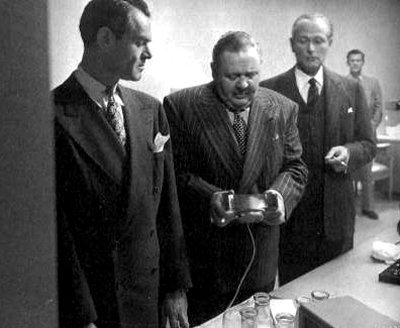
The Big Clock (1948), an adaptation of Kenneth Fearing’s hardboiled gem directed by John Farrow, stars Ray Milland as George Stroud, an editor of a crime magazine that specializes in finding and exposing criminals that have eluded the police. Through a series of events as fantastic as they are entertaining, Stroud recognizes the “missing” murderer he is looking for is actually himself—and the new question is, Who is framing him, and why? As the clues pour in, and Earl Janoth (Stroud’s boss played by Charles Laughton) and his associate Steve Hagen (George Macready) keep pushing Stroud to finger the criminal, Stroud begins to suspect that their motivations aren’t entirely editorial. The plot is indicative of the Golden Age of mystery yarns: plots so rigorously convoluted they are admirable. The Big Sleep (1946) is famous for featuring a murder that even the author of its original novel, Raymond Chandler, could not figure out. But The Big Clock (as far as I can figure) makes sense—that said, there’s always someone’s mother, such as my own, who can find holes in any plot with such ease that it’s almost their sixth sense.

The trio of Milland, Laughton and Macready are remarkable together, and they are able to sustain an almost intolerable amount of tension, in large part due to the amount of restraint they bring to their roles. Instead of blowing gaskets and waxing hysteric, all three actors exert an unsettling sense of calm. Their anxiety does not emanate from sweaty brows, blundered speech and hasty decisions, but rather from their decisiveness in situations that would typically breed anything but. Elsa Lanchester, famous for playing The Bride of Frankenstein (1935), plays a painter who gives a fair amount of comic relief to the film (a staple of the hardboiled genre). Finally, Margaret O’Sullivan plays Milland’s wife, Georgette Stroud, a character that is somewhat under-utilized, but is important in highlighting the less-flattering characteristics of Milland.

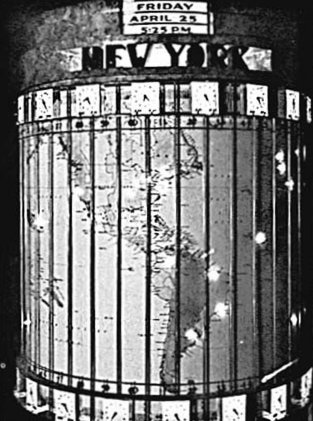
“The Big Clock” that the title refers to is a large tower in the middle of Stroud’s building:an Orwellian object that represents time, order, and logicality, it shows the exact time of every country in the world. It is the prized monolith of Earl Janoth, a man who likewise sees himself as a purveyor of dominion over his employees. Metaphorically, it belongs in the series of cinematic images of “Big Brother” and other panoptic structures. But culturally it belongs among the great, antiquated cinematic images of modernity along with Metropolis (1927). Inside the clock, a spiral staircase leads to a platform with revolving cylinders and walls filled with rows and columns of flashing lights. While neither of which seem to have any mechanic function, they seem to be indicative (especially the blinking lights) of the movies’ preoccupation with futuristic technology. Nothing about the story suggests that it is to take place in the future, yet at the core of the story is this structure that is absolutely foreign to the present. The structure’s unfamiliarity is unrelenting, and it is the impossibility of familiarity that makes it so sinister. When Ray Milland is at the top of the clock, crouched behind a console as Henry Morgan (more familiarly credited as Harry Morgan of “Dragnet”) slowly ascends the stairs with his gun drawn, the clock’s design lends an atmosphere of desolation and hopelessness. Its disconnection from the offices that we work in is a source of anxiety that we draw on, and it feeds our connection with Ray Milland’s character. It is this attention to detail, along with impeccable acting, writing (by both Fearing and screenwriter Jonathan Latimer) and directing by Farrow that makes The Big Clock such a strong film, one that stands alongside Frank Tuttle’s This Gun for Hire (1942) as an example of the hardboiled film that does not degenerate over time into satire and caricature.

Friday, June 16, 2006

Concentric Ambiguities: Walter Ungerer's The Animal (1976)

The woods are lovely, dark and deep in Walter Ungerer’s The Animal (1976), a mystery story about a couple that inhabits an isolated cabin in the Vermont wilderness during winter. Ungerer uses nature’s ambiance to full advantage, portraying it as beautiful and scenic, but also as an elusive labyrinth: this tension been attraction and repulsion lends a subtle, unsettling quality to the film. The story is minimal, shifting between the daily activities of the couple, and two mysteries that preoccupy them. The first is a set of animal tracks that lead away from the house and to the woods, and the second is a pair of children who never speak and approach only the wife when she is alone. These children seem reminiscent of the twin sisters that reappear throughout Stanley Kubrick’s The Shining (1980), made four years later, but Ungerer doesn’t divulge whether they are real or just apparitions in the wife’s mind. Before either mystery is solved, the woman disappears while cross-country skiing. Search parties go out, days pass, but in an echo of Michelangelo Antonioni’s L’Avventura (1960), the woman never reappears. The Animal can be seen as a series of concentric ambiguities: mysteries that begin but are never answered. Ungerer heads in the opposite path of the conventional mystery film, which posits a problem that is solved within ninety minutes; providing answers is part these films’ pleasures, and an even greater pleasure is figuring out the mystery on one’s own before the end of the movie. The Animal functions on an entirely different plane: we are left thinking about the mysteries, wondering how much they had to do with the story in the first place. Is the woman’s disappearance related to the animal tracks that so preoccupied the man, or was it merely a red herring that distracted us from detecting a deeper rift in their relationship? Ungerer demands that we not only question the nature of these mysteries and their importance to the story, but also their importance to the characters because it is the secrets that they keep—those not revealed—that continue to ruminate long after the movie has ended.

Thursday, June 15, 2006

The Crimson Kimono

Samuel Fuller’s The Crimson Kimono (1959) is a lesser- known film during the filmmaker’s most active period, and one that can hold its own alongside the best of his output such as Pickup on South Street (1953), Shock Corridor (1963) and The Naked Kiss (1964). The film centers around two detectives, Joe Kojaku (James Shigeta) and Charlie Bancroft (Glenn Corbett) investigating the murder of stripping sensation Sugar Torch. Historically speaking, it is most famous for being filmed on location in Los Angeles’ Little Tokyo—a rarity for its time—and the footage’s journalistic grit still emanates strongly. It is this attention to detail that most concerns Fuller, whose attitude towards the plot can only be described as ambivalent: often it seems as though the director is saying (while chomping on a cigar), “We all know the story, so let’s just get on with it.” This fast-paced, elliptical style of filmmaking was clearly an influence on the French New Wave films such as Breathless (1960) and Shoot the Piano Player (1960), films that echo Fuller’s fondness for eschewing logicality and patience for tabloid-like sensationalism. The Crimson Kimono pulses like a hot item coming over the wire, straight to the press with no time wasted on any after thoughts.

Saturday, April 15, 2006

Recent Watching: Hard Candy (2005)

The issue at hand in Hard Candy (2005)--a 32-year-old man who meets a 14-year-old girl online and takes her back to his house--is a serious one worth consideration but twenty minutes in, when the girl exchanges girl scouts for a more vengeful Mike Hammer-ish attitude, any sense of topicality vanishes. Hard Candy plays like a 17th century puritan witch-hunt but on kiddy porno: the movie revels, as did the puritans, in sadistically torturing others. It is a haughty stance, at once unsympathetic and uninsightful. The movie is not so much interested in socio-politics as it is in abusing it as a jump-off for an hour long torture sequence, as lacking in any moral standpoint as the characters are.

Since the film jettisons any serious social discourse, I’m not going to dwell on it. Cinematically, the film still belies its exploitive core with its compositions, carefully framed to keep the most disgusting moments off screen (such as the much hyped castration sequence). If on-screen the action is somewhat restrained, the soundtrack picks up the slack and delights in squishy, cringe-inducing sounds like someone hiding a whoopee cushion under their own seat during a family dinner.

What’s most enraging about Hard Candy is that its filmmakers are playing the audience for a patsy. Writer Brian Nelson and Director David Slade mask this amoral, one-note torture story with a topic that elicits extreme emotions from the audience: it tries to justify its own sadism through society’s intolerance for pedophilia. The movie waxes extremist like a moral equivalent to fascism: the demonization of the villain is aroused so easily the filmmakers hardly have to do any work. The girl,then, at once playing the hero and the psychopath, gets off the hook. This duality is not so much a contradiction as it is a necessity in the script: the movie needs a mechanism to fulfill society’s collective intolerance. Such a movie is so emotionally exploitive of the audience that we, the viewers, aren’t sure what to think: not wanting to condone the villain, and at the same time not wanting to let him get away with murder (among other crimes equally deplorable), the filmmaker has maneuvered the audience into a crossroad where personal feelings get in the way of both an aesthetic judgement of the film, as well as a more objective appraisal of how it handles social issues.

Saturday, April 08, 2006

Recent Watching: Brick (2005)

A roguish, nerdy looking adolescent, spectacled and unkempt, trots across the parking lot to a gang of kids camped around a convertible. Their focus is on the letterman trumpeting about his football skills, the coach who refuses to acknowledge them, and the team that he could whoop single-handedly. As the rogue, Brendan Frye (played by Joseph Gordon-Levitt), sits on the edge of the convertible, the car sinks slightly, and all eyes turn on him. He stands up to the letterman the only way a nerd could: after hearing the letterman say, "Yeah," a half dozen times repeatedly, Brendan tells him to look it up in the thesaurus: "It’s under 'Y'," Brendan reminds him. Challenged to a fistfight, the roguish nerd trumps the letterman again, leaving him bruised on the pavement. Walking away, a late spectator asks him, "Was there a fight?" Brendan coolly replies, "Yeah, there was."

If this scenario seems like the fantasies of a marginalized high-schooler with a fondness for all things hardboiled, then you’re dead on: Rian Johnson's Brick (2005) assumes the semi-important mindset of adolescence and runs with it. The film is deliberate--for better or for worse--about everything in it. It's a series of winks at the audience and nods to Mickey Spillane and Dashiell Hammett, and a thousand-and-one black and white gems that make up the film noir canon.

In the first moments of the movie, we are privy to a hidden moment that stays that way until well into the movie. Brendan discovers a blonde dead in the gutter--a secret grotto in front of a darkened cave. Rian Johnson, the film's writer and director, takes us back two days earlier to a phone call Brendan received from the blonde in the opening scene. She's scared out of her mind, too much so to tell him why, but she wants his help. The remainder of Brick centers around the who, what, when, where, why and how of all this: the movie is about answering questions.

What unfolds is a veritable checklist of noir must-haves: femme fatales, tough guys and lingo that exists purely for the reason of fulfilling some hardboiled desires that were aroused in the public consciousness sometime in the late 1920s and have yet to be fulfilled. Much like Mike Hammer in Spillane's Kiss Me Deadly, Brendan uncovers a seedy drug ring among the elite--this time high school rich kids rather the Mafia big-shots--with a missing bundle of dope at the center of it all.

In midst of this fantasy, classes, teachers and parents seem to be almost lost. They appear only occasionally: a mother who serves Brendan apple juice after being beaten by her son in the basement; a principal who tries to tap Brendan for information; and, in the dialogue, references to homeroom and parent-teacher conferences. Humorous asides out-of-place within the genre, they are supposed to signal self-awareness within the film, reminding us that movie is taking itself in stride, and we should take it likewise.

Only I can't. Its derivations and allusions make the film trite, not intelligent. Brick is not so much a part of any foundation for new cinema as it is another piece on the top of a firmly established pile. It doesn't so much explore a genre as much as transplant it, the way a spoof or satire would. In fact, Brick functions in the gray area between Godard's Band of Outsiders (1964) and your friend's gangster movie you acted in during high school.

Where Brick runs astray is when it eschews the organic for the contrived, when it opts to do what has been done before even when it is not in the story's capacity to do so. Brendan's motivation, for instance, remains unconvincing: does he seek out the woman's killers because he loves her, or because it is neccesary for the story to unfold? (Just as it unnecessarily for the protagonist to have a brainy know-it-all, ironically named Brain, and for every woman to be sex-crazed...) The characters that make up the drug-ring seem to be in such a spiral that Brendan's presence hardly has an impact: it is as though the shoot-out climax would have happened regardless of Brendan's involvement (only without him, the camera would not have been there).

What a film like David Cronenberg's A History of Violence (2005) offers that Brick does not is a complex mystery that works above the level of referential hee-haw that the latter is content with. There is a moment of revelation in Cronenberg's film that completely changes the main character; a similar revelation in Johnson's film is nowhere near as enlightening: when the darker side is revealed, it may be unexpected, but it certainly doesn't change much, expecting a few more issues that remain aggrivatingly unexplored.

Ultimately what was so unsatisfying about Brick is that its high-school, middle-class setting, which the film calls attention to so often, isn't dealt with in any insightful manner. Excepting for a few minor jokes (the funniest being an unknowing mother serving milk to a group of thugs crowding her living room in the middle of the night) it remains painfully in the background. The story, and especially the characters, are low-relief in the worst way: they're shallow because of flaw, not because of circumstance. And this is one facet that, regardless of intention, is inexcusable.

Saturday, March 18, 2006

Rigid Individualism or Rigid Masculinity: The Fountainhead

King Vidor's The Fountainhead (1949), adapted by Ayn Rand from her own novel, feels more like dialogue from a pamphlet than a movie script. It's easier to take as overt allegory, too, because little of narrative is well written enough to swallow as straight drama. Howard Roark (Gary Cooper) is a non-conformist architect that wades in obscurity until given the chance to make art on his terms: a contract to design a gas station. It's enough to get him started, and he makes a name for himself. This portion of the story--the architect's struggle--is a pleasant enough allegory for any artist to relate to (for any individual in any field, as a matter of fact): down with the critics who pander to the masses and never recognize "real art." (What is it that Estragon says to Vladimir in Waiting for Godot that is so insulting? "Crritic!" But critics are artists, too, no?)

The end of the film is pleasant enough, too, when Roark dynamites his own building after the contractors have their own way with his original idea. The ensuing trial isn't as much about his destroying property as it is about whether an artist has a right to his own ideas, or he has to work for the greater good of the community. Anti-communist rhetoric is clearly at work here (HUAC is doing to Hollywood what the critics were doing to Roark), and Rand is all for the individualist. Vidor and his actors, however, seem to be on a different track. They don't seem to care much for Rand's politics: they're more interested in the relationship between Cooper and Patricia Neal. All the references to jack-hammers and structures seem more sexual symbols than political ideals.

I liked Gary Cooper's performance quite a bit, partly because he's an odd casting choice. He emanates a soft-spoken conservatism, whereas Roark seems to be a radical liberal in many ways. Roark chooses aesthetics over functionality, high-brow over low-brow; he drafts plans for an apartment complex for another architect without taking any credit or payment because he's all about personal gratification rather than public, and he'd rather be proud than rich. Perhaps, though, Cooper is perfect for the fundamentally anti-Communist tone that Rand wanted to lend her story, because he bleeds a lot of the radicalism out of the role. (Dynamiting public property still seems pretty radical to me, even after seeing the movie.) Ultimately, Cooper's understatment helps keep the film from stepping too far from the Mason-Dixon line that separates politics and entertainment. Rigid individualism or rigid masculinity? The Fountainhead plays both hands like a Siamese twin playing against itself.

Sunday, March 12, 2006

Ask the Dust: The Wrong Fit

Ask the Dust (2006) fits like a glove on the wrong hand. In many ways, it still performs the function is supposed to, but the cloth is taut where it shouldn't, and it's immobility infringes on its usefulness. Yet it's still better than no glove at all, and a mediocre movie of John Fante's novel is better than no movie at all. Writer/Director Robert Towne tries to play Fante's game by Hollywood's rules, using dialogue that is sharp only in that points in one direction. The story of Arturo Bandini doesn't fit the Hollywood mould, and the movie feels like a struggle between apathetic whim and strained predictability. But that even a strain of whim works its way into the film makes it worthwhile. Bandini (played by Colin Farrell) is a young writer from small-town Colorado recently relocated to the Bunker Hill region of L.A., an area full of "old ladies and weak men" as one woman describes it. The woman is Camilla Lopez (Salma Hayek), a Mexican waitress at a nearby diner. Days after I've seen the movie, I still can't pin-point their relationship: one moment he's busy playing (badly, at that) the cool, detatched, semi-belligerant writer (and she does her part to instigate it), and the next they're in a beach-front shack while he teaches her how to read English. But neither extreme is out of Bandini's capacity, nor out of Camilla's, which marks Ask the Dust several steps above the typical Hollwood romances.

Sunday, March 05, 2006

Transience Prolonged: Woman is the Future of Man

Hong Sang-Soo doesn’t confuse reverie with nostalgia. The two never come close to colliding in Woman is the Future of Man (2004), and the result is a thankfully unsentimental romantic semi-comedy. Having graduated from an American film school, Hunjoon (Kim Tae-Woo) returns to Korea for the first time in many years. He reunites with MunhoYu Ji-Tae), an old friend currently teaching art at a local university. The two share lunch, and then go off in search of Hunjoon’s old girlfriend, Sunhwa (Seong Hyeon-A).

The ensuing search and reunion occupies the second half of Woman, which is just less than 90 minutes total. The film’s conclusion is as inauspicious as its beginning, as Munho and Hunjoon stand on the sidewalk under falling snow, unable to find any rhyme or rhythm in conversation. The ending finds them separate and alone, not so aware of any great change, but with a few memories that won’t be leaving them anytime soon.

Memory is key to Woman is the Future of Man. Ironically, these men can’t see into the future: their vision is blurred by inextricable memories of humiliation and regret. A passing woman wearing a purple scarf sends both of them into their pasts, as they remember how horribly they treated Sunhwa. Their trip to see her isn’t so much about finding a lost friend as it is about wiping out these old memories, finding some moment of reconciliation. Given the chance, they screw it up once again.

As a storyteller, Hong is more in tune with chance and coincidence than genre and plot. A scene’s importance may not seem readily apparent, and it may never shake its shroud of seeming insignificance, but to Hong such moments are things of beauty. The science of transience is Hong’s specialty, and he knows how to film a movie like writing between the lines.

Tuesday, February 14, 2006

Trapped by Sound: Pabst's Threepenny Opera

Sound is to Pabst what a tack is to a bicycle tire: it still runs, but the ride is bumpy and it takes too long to get there. G.W. Pabst's The Threepenny Opera was filmed in 1931 when sound recording techniques still had much to be desired, and much of the film's failing has to do with just that. Lacking the freedom that camera's were allowed in the silent era (when microphones were not an issue), Pabst reverts to tableaux shots and long takes: the scenes are static, and the actors hardly move. This isn't the usual Pabst who constructs his stories in lurid, penetrating close-ups. What he is able to carry over from his silent films are his love of decor and stylized sets. The acting, however, is uninspired, and it's as though the actors are reading the lines to themselves before they go to sleep. Just as their movements are static, there is nothing kinetic about their voices. As many early sound pictures proved, movies may have learned to talk, but they had still to learn how to move once again.

Sunday, February 12, 2006

King of Hearts (1966)

If ignorance is bliss, then what is insanity?

Phillipe de Broca's King of Hearts (1966) finds the Germans retreating from a small French village at the end of the first World War. Before they do, however, they trigger the town to blow-up when the clock strikes midngight. Logically scared for their lives, the townspeople evacuate, leaving the local asylum unguarded. When Scottish officer Alan Bates arrives in town, he finds the town overrun by the innamtes, and he is soon crowned the King of Hearts. But the Scots and Germans haven't gone for good, and when they show up back in town, it's hard to tell who's the whacko.

And that's the point--that the soldiers, and the world at large, is crazier than anything inside the gated asylum. The loonies are much happier amongst themselves, remaining oblivious to anything so "overly dramatic" as fighting (as one of the inmates describes an impromtu battle between the two armies).

De Broca directs with such a subtle grace that many of the scenes seem to be set to an imaginary music that only the characters can hear. I'm thinking particularly of the three Scottish soldiers, stepping in unison, swaying right and then left, peering around corners to see if the Germans have gone. And the sequence when the inmates let loose in the abandoned town exhibits an understated sense of humor: the accustomed ease with which they pick up lipstick and clothes betrays the excitement that one would expect.

One of the most pleasant things about King of Hearts is its comedic pacing: it never goes for the quick guffaw, instead the movie feels rather understated, as though its humor can only heigthen with familiarity.

Saturday, February 11, 2006

Deceitul, Murderous Delight: The Two Mrs. Carrolls

Barabara Stanwyck and Humphrey Bogart aren't their usual selves in The Two Mrs. Carrolls (1947). She is not the femme fatale, and he isn't the hardboiled private eye. Lovers after a chance encounter, Bogart and Stanwyck wed shortly after Bogart's first wife passes away. This second Mrs. Carroll begins to bore Bogart, however, as she fails to inspire his paintings as she once did. However, a new muse has entered his life, played by Alexis Smith. Soon, Mrs. Carroll falls ill, with symptoms much like the first Mrs. Carroll's before she passed away...

Director Peter Godfrey, while delivering a solid noir-melodrama, reuses much of the imagery and tension that Alfred Hitchcock used in his film Suspicion (1941): the shot of Bogart holding the poisoned glass of milk is a straight copy of Cary Grant in the earlier film. Both films, however, distinguish themselves in different ways. Hitchcock's film is a family-sized red herring served on a silver platter; Godfrey, on the other hand, consummates the tale of deceit and delivers a murderer at the end of the film. Thomas Job's script (from the play by Martin Vale) is excellently written, with smart dialogue and a handful of wry stock characters (the grumpy maid, the elderly fisherman) that, as often is the case, are the most memorable parts of the film.

Friday, February 10, 2006

Vamp-Camp: A Fool There Was

"A Fool There Was" (1915), the film that made a star out of star Theda Bara, is a poorly dramatized piece of vamp-camp that lingers over Bara's exotic sexuality. This is what the attraction of the film was in 1915, and that is still the main reason to see it today: Bara's sinful ways are as exaggerated as Mary Pickford's innocence, and its extremity is what makes it exciting. Her eating a grape out of her lover's mouth still carries erotic appeal; and her lifting the hem of her dress off the floor to show her ankles--this should also be cherished as a sign of the times, and as an early lifting of the sexuality's veil. (And those hems seem to have been getting higher ever since.)

Though coming fifteen years before Josef Von Sternberg's "The Blue Angel" (1930), "A Fool There Was" tells a similar story of a successful, respected man turned wayward and ruined by his lust. The object of his obsession is Theda Bara, known only as "The Vampire," a woman whose sole preoccupation is with bringing men to ruin: poverty, death, and suicide meet all of her former lovers. Called to England as an ambassador, John Schuyler (Edward Jose) books passage alone on a boat. On board, he becomes the next victim of "the Vampire," and off they go to Italy. Away from his family, Schuyler misses them terribly, but cannot live without his new mistress. Returning home (with Bara in tow), Schuyler fails to balance both his familial responsibilities and his desire for Bara and ends his life in utter ruin.

Director Frank Powell uses flowers as a symbol of female sexuality in the manner of Georgia O'Keefe. At one point Bara even thwarts a jealous lover's pistol with her long stemmed flower. But in other aspects of the film, Powell's direction isn't so successful. The introduction of the family is confused, with too many persons introduced too quickly with little to distinguish them. He doesn't exhibit the same flair for composition or editing that Thomas Ince or D.W. Griffith concurrently used in their own films: Powell's seem flat and unassured compared to them. The story, too, feels undeveloped beyond the bare bones of the plot. It is Bara's image that receives all the attention of the filmmaker, and her expressionistic glamour must have been a shock to audiences used to the Pickford curls. Bara's rampant seduction is domineering compared to the submissive roles played by Lillian Gish. This is not to sleight either Pickford nor Gish, nor to place Bara on a higher platform than either of them, but merely as context with which to compare Bara's character, for hers was the original vamp, the first femme fatale--but if that is all she represents, then "A Fool There Was" would not be worth much. Bara's value comes in her character, complete in vision and in action, which allows her to rise above a mundane script, and separate her from all its mediocrity.

Communal Poetics: Maureen Gosling's Blossoms of Fire

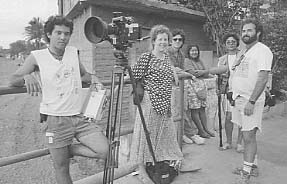
Maureen Gosling’s documentary, Blossoms of Fire (2000), goes behind the mythic “Juchitan matriarchy,” a Mexican town that is supposedly run all by women. The myth is only half wrong: women run most of the local businesses, but it is a gender balance based on a mutual work ethic that has evolved over centuries. From here, Gosling’s story spirals outward, expanding until it encompasses all members of the villages, all aspects of their history and culture—and it’s amazingly fascinating. She approaches Juchitán in the tradition of Robert Flaherty, with expert attention to the customary poetics in their cooking, their clothes, their crafts. Local musicians color the film on-screen and on the soundtrack; one memorable scene involves a man singing and playing harmonica while playing a bass improvised out of a stick, a string, and a bucket. Where Gosling deviates from Flaherty is in the town’s present and future: Flaherty was obsessed with tradition and ritual in a pre-industrial state; Gosling is fascinated with Juchitán’s resistance to globalization and the influx of corporate influence—which the town has thwarted so far successfully through vibrant protests. And this is the key thread of the film: a town that has held on to its roots, and continues to preserve them. The school still teaches the local dialect; Juchitán also elected the first liberal, local government during the reign of the one-party system; after Elle Magazine slandered local women in an issue, the town brought libel charges against the French magazine. What Gosling has found in this small town is a community that stands up for itself and wants to preserve its own unique image and history—it doesn’t want to be like everywhere else. It resists all aspects of modernization: human-made craftsmanship over mass production, homegrown over laboratory foods, the local marketplace over the supermarket. Gosling, with her detail-oriented camera, observes the intimate kinesis of a community at work and translates it on to film fluidly.

Wednesday, February 01, 2006

The Maltese Falcon: Two Adaptations

Dashiell Hammett's 1929 novel "The Maltese Falcon" was turned into three films in one decade: Roy Del Ruth's 1931 The Maltese Falcon (later retitled Dangerous Woman), William Dieterle's 1936 Satan Met a Lady and John Huston's 1941 The Maltese Falcon.

****

The 1931 version plays much like Roy Del Ruth's other pre-Code gems, such as 1930's Lady Killer with James Cagney: the sensation of comedy and cruelty, with an unmistakable affection for the sleazy and the lurid. An abridged version of the novel, private dick Sam Spade is still the protagonist (though Del Ruth really emphasizes the "public" over the "private"). After his partner is killed on a case, Spade is drawn into a free-for-all over a mystery jeweled falcon--femme fatales, young gunmen, exotic foreigners, fat old men and the coppers--the film is everything film noir would come to be, but The Maltese Falcon is not quite there yet. It is not as dark or cynical as 1940s harboiled films would be; instead, there is a certain lightness about this Maltese Falcon--perhaps its the way that Spade (played by Ricardo Cortez) always has this conniving grin on his face, and can't say anything straight. Duplicity does not expose the darker side of humanity, but the funnier side of things: with no one telling the truth, any absurdity can pass through someone's mouth. It's almost the aesthetic of a Marx Brothers film, but without the slapstick action.

***

Satan Met a Lady, too, feels like a Marx Brothers film--but not in a good way. It feels like the "straight" scenes, the little bits of plot that try and form a cohesive action, but utterly fail dramatically. Satan, however, has none of the comic relief of a Groucho, nor the sarcasm of Roy Del Ruth's 1931 adaptation. The plot retains the core of the story, but with some excess baggage, such as Spade being an exiled detective, run out of every town by various "public morality groups." The story, however, is so streamlined (to make room for new additions), that in its 76 minutes it hardly finds time to cohere. Duplicity is never so much an issue as unbelievablity: the acting is not convincing of anything but a poor script.

Wednesday, January 18, 2006

I Married a Witch: The Wrong Aisle For Some Viewers

Rene Clair’s I Married a Witch (1942) is stupefyingly schlocky. Veronica Lake plays a 290-year-old witch that was burned by the puritans and buried under an oak tree that is to contain her spirit for eternity. A lightning bolt strikes the tree in the 1940s, however, releasing Lake’s ghost. Vengeful, she singles out Frederic March, whose ancestor was the one to burn Lake centuries earlier. She foils his marriage, clinches his election for governor, and then takes him down the aisle for herself. It should be ridiculous, but handled at Clair’s breakneck pace it finishes as fittingly absurd. Still, his earlier works such as À Nous La Liberté (1931) and Paris Qui Dort (1925) need less justification for their comedy to work. With I Married a Witch, you have to keep telling yourself, “Veronica Lake doesn’t look half bad for someone George Washington’s age.”

Tuesday, January 17, 2006

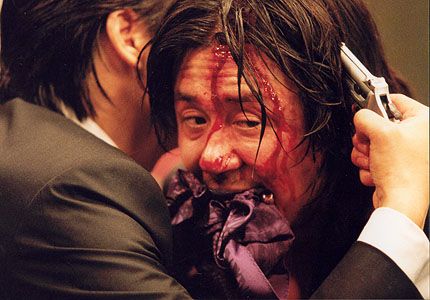
You Can’t Teach an Oldboy New Tricks

Oldboy (2003) would be a whodunit, only the “who” is revealed before the film’s halfway point. So—it’s more of a whydunit, with a highly unsatisfying “why.” The story concerns a man who is mysteriously imprisoned for fifteen years, and then released. Hunting down his captor, the prisoner rediscovers the youthful guilt that so inspired his captor’s revenge, Neither party can live with the guilt; one commits suicide, and the other undergoes hypnosis. Vengeance is whine.